Charlie & Ike: From Capitol Hill to St. Joseph’s College

Former President Dwight Eisenhower (left) joins Rep. Charles Halleck (center) to lay the cornerstone brick for the Halleck Student Center at St. Joseph’s College on September 13, 1962, courtesy of St. Joseph’s College, accessed Rensselaer Republican.

On a muggy September afternoon, gregarious Congressman Charles A. Halleck, flanked by wife Blanche and former President Dwight D. Eisenhower, blinked back tears. Known for his oratorical prowess, Representative Halleck stood speechless before a large crowd in his hometown of Rensselaer, Indiana. From the lawn of St. Joseph’s College, Hoosiers keenly observed the political titans—both clad in collegiate cap and gown—at a dedication ceremony for the Halleck Student Center.[1] Laying of the cornerstone was just the tip of the “Charlie Halleck Day” iceberg. Accounts of the 1962 festivities provide a window into the friendship of Charlie and Ike and help humanize the nation’s leaders.

Although Halleck proudly donated to St. Joseph’s and served as a lay trustee for the college, he was actually an Indiana University alum. Born in DeMotte in 1900, the Halleck family moved to Rensselaer when Charles was just two years old. In 1922, he earned his A.B. from IU and his LL.B. in 1924, successfully campaigning for Jasper-Newton County Prosecutor in his last year of law school.[2] His seemingly limitless energy on the campaign trail and artful speeches helped secure his election. The young attorney served in this role from 1924 to 1926 and 1928 to 1934.[3] But he had bigger ambitions.

Indianapolis News, January 30, 1935, 13, accessed Newspapers.com.

After the sudden death of U.S. Rep. Frederick Landis in 1934, the Second District held a special election. Halleck’s ability to mobilize once again got him into office and, at 35, he became one of twelve Hoosier representatives in Congress. He was the only Republican in this cohort, which, according to the Indianapolis News, reflected his district’s disdain for the New Deal.[4] At a public celebration in Rensselaer a few days later, Halleck introduced his mother to the crowd, telling them she deserved most of the credit for the victory, having “‘given him the spirit and inspiration to go through the successful campaign.'”[5]

Congressman Halleck’s adroit political maneuvering and ability to whip up votes kept him in office until 1969, and earned him appointments as Majority Leader (1947-1949, 1953-1955) and Minority Leader (1959-1965).[6] From the Great Depression to the Vietnam War, his tenure spanned some of the most significant events and legislation in American history. After World War II, Rep. Halleck joined a contingent of lawmakers who focused on identifying and ousting Communists in America. As Majority Leader, he shepherded passage of the 1947 Taft-Hartley Act, which limited the power of labor unions, whose members many conflated with Communists. Halleck ascribed to this belief, but also supported the bill because labor strikes had paralyzed parts of the country, as reflected in a letter from a constituent who wrote “Those labor troubles, strikes and slow-downs, deprived farmers of much needed machinery and supplies.”[7] Halleck’s deft politicking was evident after he whipped up enough votes to override President Harry S. Truman’s veto of the bill.

Halleck and Truman unified over the Economic Recovery Plan, better known as the 1948 Marshall Plan. Foreign Affairs Specialist Curt Tarnoff described the legislation in his 2018 “The Marshall Plan: Design, Accomplishments, and Significance” as:

An effort to prevent the economic deterioration of postwar Europe, expansion of communism, and stagnation of world trade, the Plan sought to stimulate European production, promote adoption of policies leading to stable economies, and take measures to increase trade among European countries and between Europe and the rest of the world.[8]

Truman solicited a massive aid package, hoping to help alleviate the suffering of those in war-ravaged countries and to make them less vulnerable to Communist forces. Halleck used his influence as Majority Leader to convince his congressional colleagues to support the program, which Tarnoff noted was “considered by many to have been the most effective ever of U.S. foreign aid programs.”[9]

While Halleck publicly scrutinized Truman, accusing him of aligning with “radicals and Communists” with his labor bill veto, he later told an interviewer “I enjoyed working with him. He’s undoubtedly got a place in history.”[10] But Eisenhower? Halleck stated:

my association with President Eisenhower was one of the happiest, greatest experiences of my life. And understand I had served thirty-four years, had been majority leader twice, minority leader three times, I’ve been through wars, depressions, and whole ball of wax and I know them all.[11]

Halleck (L) with Eisenhower (R) after a lunch meeting at the Brown Palace Hotel in Denver, October 3, 1954. accessed Getty Images.

The feeling was seemingly mutual. When Eisenhower first entered the Oval Office as President in January 1953, he had never been elected to public office and had virtually no legislative experience. Someone like Congressman Halleck, who spent decades in Capitol Hill and knew its inner-workings intimately, proved invaluable to the 34th President. Halleck biographer Henry Scheele wrote that Halleck “emerged as the president’s chief legislative lieutenant on Capitol Hill.” This was, in large part, because he was an “expert on the subtleties of parliamentary procedure.”[12] A 1959 TIME article detailed why Halleck was such an asset to the Eisenhower administration, noting that Halleck:

goes into great and colloquial detail to explain what decisions were made—and why. The minutes of Policy Committee meetings are mimeographed and placed on each Republican’s desk. Not in many a long year have the Republican members of the House been so fully informed about the party line and positions, and the results can be found in their cohesiveness on vote after vote this year.[13]

Halleck would prove one of Eisenhower’s staunchest advocates, bullish in his pursuit of advancing the President’s initiatives, browbeating lawmakers, if necessary. Through his tenacity, he helped Eisenhower extend reciprocal trade agreements, pass the Civil Rights Act of 1957, and kill a “heavy protectionist tariff proposal.”[14] Scheele noted that before submitting a bill to the House, Eisenhower always sought out Halleck’s input. In his 1963 Mandate for Change, Eisenhower wrote that Halleck was a “fighting leader and was valuable to me.” Therefore, when Democrats swept the 1954 elections and ousted Halleck as Majority Leader, Eisenhower wrote “I personally insisted that Halleck still attend the Legislative-leaders meetings at the White House.”[15]

Image courtesy of Time.com.

The two worked even more closely when Halleck was appointed Minority Leader in 1959. TIME profiled Halleck’s new role, highlighting the fact that he:

helped bring White House and congressional Republicans closer together than at any other time during the Eisenhower Administration. As never before, Congressmen are informed about Administration aims, and the President gets an accurate and detailed picture of congressional sentiment.[16]

Although he could be pugnacious, Halleck understood the value of comradery and often invited his Republican colleagues to “get together for political shoptalk” over drinks. To further boost morale, he routinely furnished the Commander in Chief with the names of Congressmen worthy of a letter of appreciation.

TIME reported that because of Halleck’s influence, Republican lawmakers worked much more cohesively and their weekly legislative conferences had “passed from pain to pleasure.” Eisenhower agreed, stating “‘These sessions are getting to be so much fun . . . that they’re running overtime.'” He attributed this to Halleck , writing “‘You are a political genius.'”[17]


Eisenhower (L) and Halleck (R) at the dedication of the Halleck Student Center at St. Joseph’s, courtesy Vidette-Messenger of Porter County, September 14, 1962, 1, accessed Newspapers.com.

After Eisenhower left office in January 1961, the two stayed in touch. On occasion, Halleck and colleagues like Everett Dirksen went up to Gettysburg to visit with Eisenhower and ask for his advice.[18] Charlie and Ike reunited publicly in Indiana on September 13, 1962, their mutual admiration evident. Despite the oppressive heat, about 20,000 Hoosiers greeted Ike at the Purdue University Airport.[19] Robert Kriebel remembered “A stairway parted from the front of the plane and suddenly there he was—good old Ike—grinning and doffing a gray a gray homburg.” It was evident that many missed his presence in the Oval Office. Charlie recalled there was “Just a sea of people. Just terrific. He was President; he was General; he was everything. And the people just idolized him. They realized, even the wild-eyed right wingers, that he’d been a [sic] terrific.”[20]

After landing in West Lafayette, Charlie and Ike traveled to Rensselaer to attend the dedication ceremony for St. Joseph’s College Halleck Student Center. The Vidette-Messenger of Porter County reported on the event, noting that “A picnic atmosphere prevailed . . . There was some live music, and lots of big circus tents were strung on the campus.”[21] Politicians, students, and dozens of members of the press milled about while local law enforcement directed heavy traffic from the air.[22] A farm truck parked nearby bearing a sign that read “‘Charlie and Ike. No Dove Hunting Please,'” a call-back to Halleck’s arrest a week earlier in North Carolina for shooting doves over a baited field.[23]

Journal and Courier, September 14, 1962, 1, accessed Newspapers.com.

Guests from twelve counties sat on tent-covered hay bales and ate barbequed chicken. Halleck recalled “Every chicken and broiler producer in Indiana was here,” serving twelve double-lines of people.[24] Charlie tried to curtail the dreaded, universal experience of being watched while eating finger food. Ike was in the mood for some chicken, but didn’t “‘want any of that barbeque stuff on it.'” Charlie noted “So we get out and get up where he could sit down, and I was a little disturbed by some of my people. Hell, they just get, look right over his shoulder, you know, when you’re eating a piece of chicken.”[25]

When the ceremony began, Ike and Charlie joined college president the Very Rev. Raphael Gross on stage. Ike had recently remarked in Europe that he would enjoy being a president of a small college. Very Rev. Gross quipped that the college “‘is all yours,'” eliciting Ike’s signature grin.[26] Ike delighted the crowd when he eschewed protocol and insisted that Charlie join him in cementing the building’s new cornerstone. At the dais, Charlie told the crowd “‘This is a unique honor; it’s significance leaves me without words to adequately  express my appreciation.'” He commented on the importance of higher education to both “the individual and to the nation.”[27] Ike added that the federal government “‘has a right and duty’ to provide aid for education.”[28]

Eisenhower listening to elementary school singers at the Jasper County Courthouse, photo by Dick Vellinger, Journal and Courier, September 14, 1962, 1, accessed Newspapers.com.

Charlie Halleck Day continued into the evening at the local courthouse, where Ike opened his campaign tour for Republican congressional candidates.[29] The Vidette-Messenger described Ike as “looking fit and erect despite his 71 years.” He was delighted by performances by the Purdue University Glee Club and grade schoolers, dubbed the “Wee Singers.”[30] Halleck recalled that Ike watched the “cute little devils . . . and he just beamed. He just loved that.”[31] In his speech, Ike said the crowd probably wondered why Republicans weren’t “‘in overwhelming control of the Congress.'”[32] He mused “‘As long as we have Charlie Halleck and Everett Dirksen as leaders we don’t need overwhelming numbers.'” After all, he considered Charlie “‘a loyal, fighting, and deeply patriotic legislative leader . . . my warm friend; a staunch supporter and a champion of Republican principles and programs.'”[33]

In addition to lauding Charlie, Ike addressed broader issues regarding American government, troubled by the:

constant seeking for more governmental power over all our economic life. . . This is one of the most disturbing trends of our day—the apparent thirst for more and more power centered in the federal government, particularly the executive branch.'”[34]

Halleck mss., 1900-1968, Lilly Library, Indiana University, Bloomington, Indiana.

He assured the crowd “‘as long as human honesty and integrity endure our great country will lead civilization to its proper destiny'”[35]

Exhausted from a demanding day, Ike stayed the night on St. Joseph’s campus. The next morning, he traveled to Kankakee, Illinois for a GOP breakfast, leaving Hoosiers electrified in his wake.[36]


After serving seventeen terms in Congress, Halleck announced he would be retiring and bid farewell to Capitol Hill on January 3, 1969.[37]  No easy decision, he stated “‘the House has been my life.'”[38] This monumental life change was punctuated by news that his good friend, Ike, had passed away just two months later. In a news piece about Eisenhower’s death, Halleck declared he was “‘one of the greatest friends of my life, one to whom I was completely devoted.'”[39] While in D.C. for his funeral, Indiana papers announced Halleck’s next chapter, which included practicing law with former Governor Roger D. Branigin.[40]

Surely, nothing would be as fulfilling as the leadership sessions between Eisenhower and Halleck. The two men had shouldered the unique responsibility of navigating the country through the early Atomic Era. They worked amidst the ever-looming threat of global instability and seismic shifts in American identity. For a shared moment, however, they got to experience the small joys of civic life in Rensselaer, Indiana.

* The Indiana Historical Bureau will be installing a historical marker for Halleck in 2025. Stay tuned for details!

Notes

* All newspaper articles accessed via Newspapers.com.

[1] Rollie Bernhart, “Halleck’s Name on New Building,” Vidette-Messenger of Porter County, September 14, 1962, 1, 6.

[2] “New Candidate Phi Beta Kappa at University,” Lafayette Journal and Courier, December 12, 1934, 1.

[3] William White, “Charles Halleck, County Prosecutor in the Shadows of the Depression,” Indiana Magazine of History 114 (December 2018), accessed scholarworks.iu.edu.

[4] “Wins Election,” Indianapolis News, January 30, 1935, 13.

[5] Henry Z. Scheele, Charlie Halleck: A Political Biography (New York: Exposition Press, 1966), p. 57.

[6] Biographical Directory of the American Congress, 1774-1971 (United States: Government Printing Office, 1971), accessed HathiTrust.

[7] “GOP Leaders Score Action by President,” Chronicle Tribune (Marion, IN), June 20, 1947; “Marshall Plan Most Important,” Camden News (Arkansas), June 20, 1947, 1-2; “Indiana’s Solons Vote Unanimously to Override Veto,” Princeton Daily Clarion, June 20, 1947, 1; “GOP Leaders Blast Veto; Halleck Spearheads Attack,” Indianapolis Star, June 21, 1947, 2; “Halleck Enumerates Pledges Kept by G.O.P. Congress,” Buffalo News, August 12, 1947, 13; Quotation from Letter, Fred H. Foster to Hon. Charles A. Halleck, April 2, 1948, Box 16, Folder “1948, Apr. 1-10. Halleck mss. Correspondence,” Halleck mss., 1900-1968, Lilly Library, Indiana University, Bloomington, Indiana.

[8] Curt Tarnoff, Specialist in Foreign Affairs, “The Marshall Plan: Design, Accomplishments, and Significance,” Congressional Research Service, (January 18, 2018), accessed marshallfoundation.org.

[9] “Action on Measure Expected to Be Completed by Nightfall: Time and Amount Are Final Issues,” Central New Jersey Home News, March 31, 1948, 1; Press Conference, Republican National Committee, Joint Senate-House Leadership, Senator Dirksen-Representative Halleck, July 10, 1962, Box 96, Halleck mss., 1900-1968, Lilly Library, Indiana University, Bloomington, Indiana; Oral history interview with Charles A. Halleck, by Stephen Hess, March 22, 1965, John F. Kennedy Presidential Library and Museum, accessed jfklibrary.org; Curt Tarnoff, “The Marshall Plan,” summary page.

[10] “GOP Leaders Score Action by President,” Chronicle Tribune (Marion, IN), June 20, 1947, 1; Oral history interview with Charles Halleck, by Thomas Soapes, April 26, 1977 for Dwight D. Eisenhower Library, p. 12, accessed eisenhowerlibrary.gov.

[11] Soapes, p. 12.

[12] Henry Z. Scheele, “President Dwight D. Eisenhower and U.S. House Leader Charles A. Halleck: An Examination of an Executive-Legislative Relationship,” Presidential Studies Quarterly 23, no. 2 (Spring 1993): 292, 298, accessed JSTOR.org.

[13] “The Congress: The Gut Fighter,” TIME 73, no. 23, June 8, 1959.

[14] Oral history interview with Charles A. Halleck, by Stephen Hess, March 22, 1965, p. 9-10, John F. Kennedy Presidential Library and Museum, accessed jfklibrary.org; Scheele, “President Dwight D. Eisenhower and U.S. House Leader Charles A. Halleck,” 291-294.

[15] Dwight D. Eisenhower, The White House Years: Mandate for Change, 1953-1956 (Garden City, NY: DoubleDay & Company, Inc., 1963), p. 442.

[16] “The Congress: The Gut Fighter,” TIME.

[17] Ibid.

[18] Soapes interview, p. 36.

[19] Robert Kriebel, “Remember When Ike Was Here in ’62? It Was a Thrilling Day for Thousands,” Journal and Courier (Lafayette, IN), March 29, 1969, 4.

[20] Soapes interview, p. 38.

[21] Herb Steinbach, “Charlie Is All Smiles on Big Day,” Vidette-Messenger of Porter County, September 14, 1962, 1.

[22] “Thousands Attend Halleck Day Fete,” Rensselaer Republican, September 14, 1962, 1, submitted by marker applicant.

[23] Ibid.

[24] Soapes, p. 37.

[25] Ibid., p. 37-38.

[26] “St. Joseph’s Names Ike ‘Impromptu President,'” Journal and Courier (Lafayette, IN), September 14, 1962, 8; “‘President’ Ike Again,” Journal and Courier (Lafayette, IN), September 14, 1962, 8.

[27] Rollie Bernhart, “Halleck’s Name on New Building,” Vidette-Messenger of Porter County, September 14, 1962, 1.

[28] “Thousands Attend Halleck Day Fete,” Rensselaer Republican, September 14, 1962, 1, submitted by marker applicant.

[29] Irwin J. Miller, “Spending by Government Hit by Ike,” Vidette-Messenger of Porter County, September 14, 1962, 1.

[30] Ibid.; Soapes interview, p. 37.

[31] Soapes interview, p. 37.

[32] “Praises Halleck in Rensselaer Talk,” Journal and Courier (Lafayette, IN), September 14, 1962, 1, 8.

[33] Ibid.

[34] Irwin J. Miller, “Spending by Government Hit by Ike,” Vidette-Messenger of Porter County, September 14, 1962, 1.

[35] “Thousands Attend Halleck Day Fete,” Rensselaer Republican, September 14, 1962, 1, submitted by marker applicant.

[36] Irwin J. Miller, “Spending by Government Hit by Ike,” Vidette-Messenger of Porter County, September 14, 1962, 6.

[37] United Press International, “Charlie Halleck Dies; Longtime Congressman,” Logansport Pharos-Tribune, March 3, 1986, 1.

[38] Bart Barnes, “House Majority Leader Charles Halleck Dies at 85,” New York Times, March 3, 1986.

[39] Terre Haute Tribune, March 29, 1969, 2.

[40] “Halleck Joins Branigin Firm,” South Bend Tribune, April 1, 1969, 5.

Lincoln School: “Laying Before the Body Our Grievance”

Dr. Robert L. Anthony teaching Lincoln students, accessed https://lsfcccrawfordsvilleindiana.com/.

In addition to the struggles of daily life, Black Americans had to wage an often losing battle to secure suitable education for their children. They had historically been deprived of that which affords an understanding of one’s rights and enables one to secure a livelihood. Crawfordsville’s Lincoln School embodied this decades-long fight. However, like other segregated schools, students went on to achieve success and make a name for themselves, despite inequities.

After the Civil War, education for Black pupils was conducted in piecemeal fashion. In an article for the Indiana Magazine of History, Professor Abraham C. Shortridge noted that around 1862 the Indiana State Teachers’ Association began to lobby for “colored schools,” but lawmakers failed to take action. Shortridge lamented that it looked as if in the ensuing years:

the black children were doomed to run the streets for another term of two years while their fathers and mothers continued to pay their taxes, by the aid of which the children of the more favored race were kept in school ten months of the year.

However, in 1869, after much deliberation at a special session called by Governor Conrad Baker, the Indiana General Assembly approved an act that admitted Black children to public schools.

The new law stated that township trustees “shall organize the colored children into separate schools, having all the rights and privileges of other schools of the township.” Should there not be a large enough population to warrant a separate school, the law stated that “Trustees shall prove such other means of education.” According to historian David P. Sye, “other means” often included sending children to “private school or in some cases giving them books, giving money back to the parents, or just nothing. The courts did not help in this situation.” This was the case in Crawfordsville, as Black children were educated privately, at institutions like Bethel AME for years after the act was ratified.

The Crawfordsville Weekly Journal reported in the 1870s that Black children studied under Harmon Hiatt in the church’s basement. Little is known about what pupils studied, but it is clear that school conditions were poor, as the Weekly Journal reported in 1873 “complaints are made that the old church in which the school is held is not properly heated during the cold weather.” The school board trustees did nothing to remedy this. In fact, eight years later, 126 students attended the house, which was designed to accommodate only 48.

Lincoln School, no date, courtesy Crawfordsville District Public Library.

In the summer of 1881, the city council voted to build a school for Black children at Spring and Walnut Streets. Students attended first through seventh grade (although at times eighth grade was offered) at Lincoln School before attending integrated Crawfordsville High School. Lincoln pupils studied traditional grade school subjects like arithmetic, reading, and writing. However, much like at the AME church, school conditions were poor and the teacher-to-student ratio abysmal.

Black residents refused to accept this institutionalized inequality. According to the Crawfordsville Review, in April 1892 parents submitted a complaint to the school board, stating that they would withdraw their children should there be no remedy to Lincoln’s “proximity to two or three houses of ill fame in the neighborhood, and the inmates of which have no regard for the ordinary decencies of life and set dangerous examples for children.” Trustees responded that they could secure “no better” accommodations.

The following year, the Crawfordsville Daily Journal reported that conditions had not improved, alleging that the principal was abusive and that it was difficult to find qualified teachers, resulting in many students being unable or unwilling to come to school. The paper noted that, “in view of the fact that all the neighboring cities have race co-education,” the school board was considering transferring Black children to the white elementary schools. Just weeks later, the Journal reported the board decided to maintain segregation and remedy the issue by appointing a “brawny white teacher.”

The Black community challenged this “solution” in 1894, gathering at Second Baptist to discuss Lincoln School, which was “quite inferior in many respects to the other schools of the city,” according to the Crawfordsville Daily Journal. They felt that it was a “farce” to tax the community, only to provide such abysmal education. Meeting attendees formed a committee to “to wait on the Board of Trustees, laying before the body our grievance.”

The trustees remained unmoved by their formal petition, spurring another strategizing meeting. Attendees advocated for either appointing Black educators and administrators—as had been the case in previous years—or sending children to white schools. Neighboring towns, like Lebanon, Greencastle, and Frankfort, had successfully integrated schools. However, meeting attendees preferred the appointment of Black teachers, stating:

It needs no argument to prove that for colored children, colored teachers are manifestly superior to white teachers since the latter have no sympathy in common with colored children, do not associate at home, at church or on the street with colored patrons and are diametrically opposed in conduct and natural feeling. (Crawfordsville Weekly Journal)

They won a small victory when the board appointed Black educator Mr. Teister to “take charge” of Lincoln.

Despite parents’ persistence, the school experienced a shortage of teachers and its facilities remained inadequate until its closure. In oral histories with students who attended in the 1930s and 1940s, many recalled there was only one educator to teach seven grades. Not only were there not enough teachers, but far from enough space. Madonna Robinson recalled:

It was cramped up, because they would have like two rows of maybe the third and fourth grade here, and then in the other room was the fifth and sixth grade, you know, there were two classes in one room, very cramped, no windows in the front, just had windows in the back of the school, no windows in the front. It wasn’t much fun to me.

Some students felt unprepared for high school due to the disparities at Lincoln, and struggled to catch up to other students.

Portrait of Wilbur De Paris and Sidney De Paris, Onyx, New York, N.Y., ca. July 1947, courtesy of Library of Congress.

Alumnus Elsie Bard told interviewer Eugene Anderson “The teachers had quite a few children to really be teaching, and couldn’t devote their full time to them right, but that’s what they had to work with, so they did the best they could.” The lack of supervision meant that children often played the piano, rehearsed plays, and acted. Madonna Robinson recalled “It just wasn’t school to me. . . . It just seemed like a place to go practice plays.” Similarly, Leona Mitchell remembered that teachers liked to have “little plays and dramas and things and we learned to sing,” adding “we were always doing oh some kind of little skit.” Perhaps this creative, formative environment helped foster the musical prowess of jazz greats Bill Coleman and Wilbur de Paris, who achieved national success and performed with legendary recording artists.

De Paris learned to play trombone as a child and performed in the Crawfordsville High School band. He later relocated to New York City. According to the Syncopated Times, by the 1930s de Paris recorded with jazz greats Benny Carter and Louis Armstrong. In the 1950s, his New New Orleans Jazz Band had become “one of the most exciting groups of the era.” His brother, Sidney—likely also a Lincoln School alum—played in his band and was a successful musician in his own right, recording with artists like Jelly Roll Morton. Arguably, Wilbur achieved greater success than his brother and a 1958 Indianapolis Star article described him as “possibly the world’s greatest jazz trombonist,” having “performed with almost every legendary jazz figure of the century, and played in almost every spot in America where jazz was allowed to seep in or burst out.”

Bill Coleman at Cafe Society, mid-1940s, William P. Gottlieb Collection, Library of Congress, accessed Wikipedia.

Bill Coleman also achieved acclaim as a jazz trumpeter. He and the de Paris brothers met as students at Lincoln. Coleman gained success playing in Europe and, according to his Washington Post obituary, spent most of his life in France as “’one of the numerous black musicians here as refugees from segregation.’” He played with famous performers like Fats Waller and Billie Holiday.

Alum Blanche Patterson achieved local success in music and was an officer of the Indiana State Association of Negro Musicians. Her obituary stated she “developed a state-wide reputation as a musician” and “organized a program which brought numerous Negro instrumental and vocal music groups to Crawfordsville.” Patterson was likely better known for her business prowess, owning and operating the Petite Beauty Shop in Crawfordsville’s Ben-Hur building, described by the Indianapolis Recorder as “one of the finest beauty parlors in the State.” Additionally, she was a member of the National Beauty Culture League of Indiana and later became a chiropodist.

In addition to the arts, Lincoln students excelled at athletics under the guidance of principal George W. Thompson, a former Indiana University athlete. According to the Indianapolis Recorder, in 1913 the school’s baseball team won all of its games and its track team earned the highest number of points among all Crawfordsville grade schools. The paper reported that white schools had “refused to meet them on the field, but patience and diplomacy by Prof. Thompson won over prejudice and when our boys won in the recent meet . . . Wilson school boys (white) placed a card in the local papers praising them for their fairness and superiority.”

Tuttle vs. Lincoln soccer game, 1907, accessed https://lsfcccrawfordsvilleindiana.com/.

According to local historian Charles L. Arvin, Black residents began moving to the eastern part of Crawfordsville. In 1922, Lincoln School relocated to South Pine and East Wabash Avenue to accommodate them. Alumnus Patty Field stated that many moved to that side of town for job opportunities at factories.

The school closed in 1947 and the building was later converted into a recreation center for the Black community, and it served as a meeting space for the Baptist Church and Mason’s Lodge. By the 1970s, Parks and Recreation Department monthly reports showed that nearly 1,000 people used the center’s playground in just one month, and that thousands attended its summer program. In addition to two basketball courts and workout equipment, the center had pool tables, swings, slides, and a softball diamond. Field recalled “even when we got older and had kids, Lincoln [recreation center] was our safe place.” However, the Parks Department decided to close it down in 1981. Lincoln alum Madonna Robinson described the decision’s impact on the Black community, saying “it was really a sad thing that they took it away from them, because they don’t have any where to go now.”

However, Lincoln’s legacy as a site of refuge, community, and self-advocacy will not be forgotten. In 2025, with the help of local partners like Shannon Hudson, IHB will install a state historical marker commemorating the school. Check back for dedication details.

For sources used for this post, see our historical marker notes.

Learn more and see photos of Lincoln School via “Memories of Crawfordsville’s Lincoln School for Colored Children,” a collaboration between the Carnegie Museum of Montgomery County and the Robert T. Ramsay, Jr. Archival Center at Wabash College.

How South Bend Attorneys Elizabeth and J. Chester Allen Lifted the “Heel of Oppression”

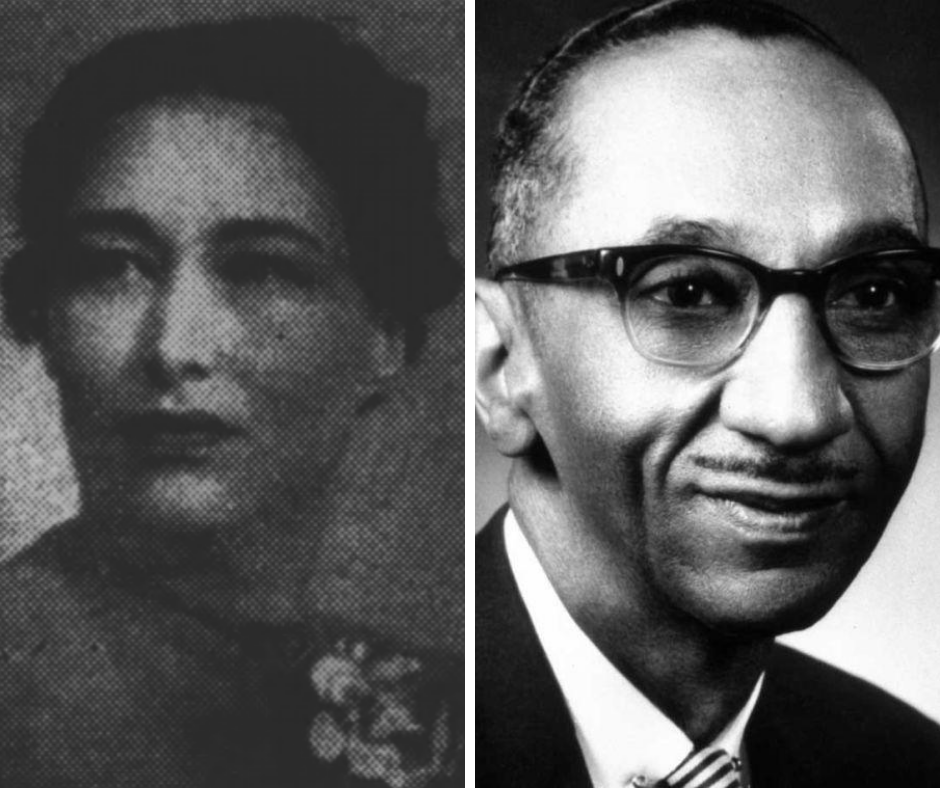
Elizabeth and J. Chester Allen, courtesy of Indianapolis Recorder, July 25, 1942, accessed Hoosier State Chronicles and South Bend Tribune, February 10, 2014, accessed SouthBendTribune.com.

*This is Part One in a series about the Allens.

Marriage is complicated enough. Add in opposing political views, routinely confronting systemic racism and sexism, and coping with the hardships of the Great Depression and World War II, and it’s even more challenging. African American attorneys Elizabeth and J. Chester Allen experienced these struggles and, while theirs was not a perfect marriage, through compromise, mutual respect, shared obstacles and goals, and love, they enjoyed 55 years together as man and wife. The South Bend couple dedicated themselves to each other and to uplifting the Black community by crafting legislation, organizing social programs, creating jobs, and demanding educational equality. The opportunities the Allens created for marginalized Hoosiers long outlived them.

On his way to Indianapolis in the late 1920s, J. Chester’s car broke down in South Bend and, after staying with a family on Linden Street, liked the city so much he decided to make it his home. Or so the story goes. Elizabeth Fletcher Allen, whom he met at Boston University and married in 1928, was likely working towards her law degree back in Massachusetts when J. Chester made that fateful trip. She would eventually join her husband in Indiana, but in the meantime J. Chester quickly got to work serving South Bend’s Black community. In 1930, J. Chester was admitted to the bar and the following year was appointed County Poor Attorney for St. Joseph County.

His arrival was perhaps serendipitous, as the Great Depression had begun rendering African Americans, who were already disenfranchised, destitute. J. Chester served as management committee chairman of the Hering House, which he described as “‘the clearing house of most of the social activities of the colored people as well as the point of contact between the white and colored groups of South Bend. . . . Its activities in the three fields of spiritual, mental and physical training make it indeed a character building institution.'” Through the organization, J. Chester helped provide 4,678 meals to unemployed African Americans, along with clothes, lodging, and medical aid to others in the Black community in 1931.

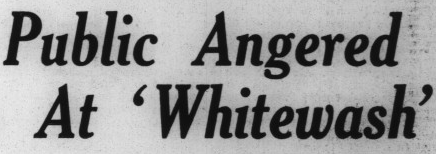
In addition to providing basic necessities during those lean years, J. Chester took on various anti-discrimination lawsuits in South Bend. In 1935, he helped prosecute a case against a white restaurant owner, who refused to serve Charles H. Wills, Justice of the Peace, in a section designated only for white patrons. That same year, J. Chester served as attorney for the Citizens Committee, formed in protest to the “unwarranted shooting” of Arthur Owens, a Black 18 year-old man, by white police officer Fred Miller. The Indianapolis Recorder, an African American newspaper, noted that eleven eyewitnesses recounted that “the youth was shot by Officer Miller as he stepped from a car with hands raised, after having been commanded by the officer and his companion, Samuel Koco Zrowski, to halt.” The officers had been pursuing the car with the belief it had been stolen.

“Public Angered at Whitewash,’” Indianapolis Recorder, June 1, 1935, 1, accessed Hoosier State Chronicles.

Elizabeth Allen-likely back in town temporarily-and other Black leaders organized a mass meeting to protest the “wanton, brutal and unwarranted” shooting. Despite boycotts, a benefit ball to raise prosecutorial funds, and protests by the Black community and white communists, a grand jury did not return an indictment against Officer Miller for voluntary and involuntary manslaughter. This, J. Chester said, was due to “blind prejudice on the part of the prosecutor.”

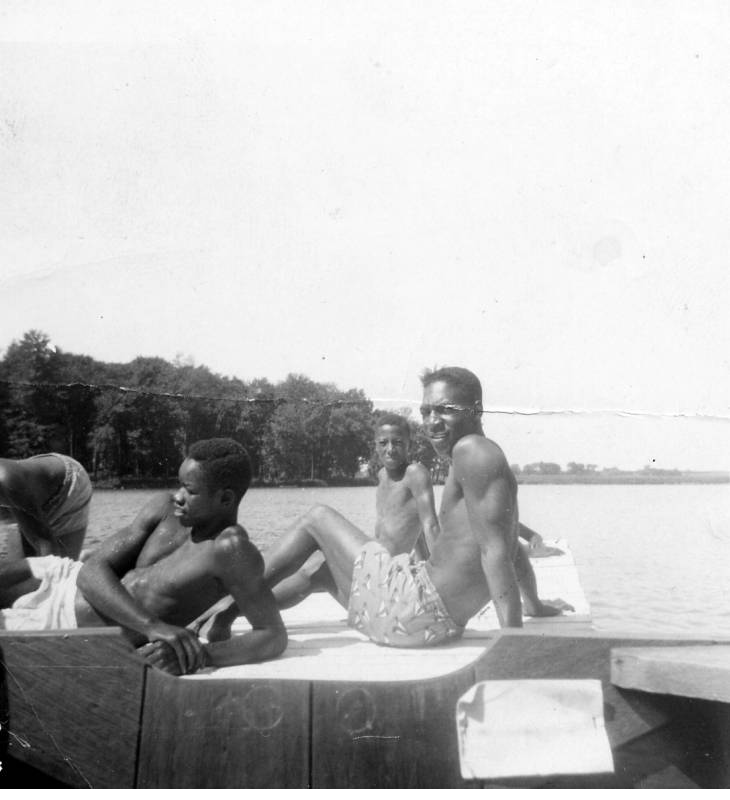
Despite a disheartening outcome, J. Chester continued to lend his legal expertise to combating local discrimination. The following year, he and a team of lawyers challenged Engman Public Natatorium’s ban on African Americans from using the facilities. The team presented a petition, likely prepared by Elizabeth, to the state board of tax commission demanding Engman remove all restrictions. Allen and other NAACP representatives had tried this in 1931, arguing that the natatorium was “supported in whole or in part by taxes paid by residents of the city,” including African Americans. Without access to the pool, they would be relegated to unsafe swimming holes, one of which led to the death of a Black youth the previous summer. While they had no luck in 1931, the 1936 appeal convinced commissioners to provide African American residents access to the pool, but only on the first Monday of every month and on a segregated basis. This was just one victory in the decades-long fight to fully desegregate the natatorium.

Image caption: Photograph of Leroy Cobb and two unidentified men sitting along Pinhook Park. In the era of segregation in South Bend, with city pools like the Engman Public Natatorium barring African Americans from entry, Pinhook Park became a popular location for public swimming, ca. 1947, St. Joseph County Public Library, accessed Michiana Memory Digital Collections.

While it appears that Elizabeth lent her aid to certain events in South Bend, like protesting the shooting of Owen, it is tough to discern Elizabeth’s activities at this time. This is perhaps due to scant documentation for African Americans, particularly women, during this period. Likely, she was working towards her law degree at Boston University, despite being told by an admissions officer “there was not need to come and advised she get married.” Proving the officer wrong, Elizabeth not only got married, but gave birth to two children while pursuing her law degree. She attributed this tenacity to the confidence her father instilled in her during childhood and later said “’To be a woman lawyer you have to have the hide of a rhinoceros.’”

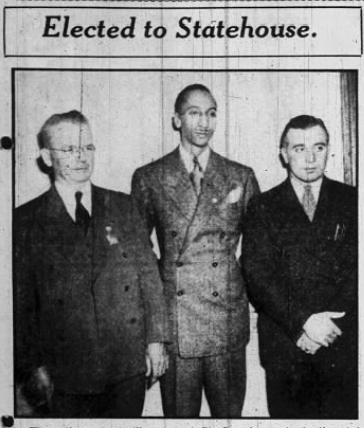
Her persistence paid off and after joining J. Chester in South Bend, she was admitted to the bar in 1938. Perhaps her presence inspired in him a sense of security and conviction, resulting in a run for the Indiana General Assembly. That year, voters elected J. Chester (D) the first African American to represent St. Joseph County. Rep. Allen introduced and supported bills that would eliminate racial discrimination in sports, the judicial system, and public spaces. The new lawmaker also endorsed bills that would require Indianapolis’s City Hospital to employ Black personnel and that would mandate appointing at least one African American to the State Board of Public Instruction, telling his colleagues “the legislature should see to it that these children had a spokesman of their own racial group to assure their obtaining a measure of equal accommodation and facilities in the segregated public school system” (Indianapolis Recorder, March 11, 1939). Writer L.J. Martin praised Allen’s unwavering commitment to serving Black Hoosiers while in public office, noting in the Indianapolis Recorder,

Hon. J. Chester Allen said he had stayed up late at night reading bills for such ‘racial traps.’ He found them, he eliminated them, one hotel sponsored bill in particular would have been a slap at the race. Mr. Allen astonishes me, in the forcible argument for racial progress.

J. Chester Allen (center), South Bend Tribune, November 6, 1940, 17, accessed Newspapers.com.

While J. Chester walked the halls of the statehouse, championing bills that furthered racial equality, Elizabeth was able to make a difference as a lawyer. The couple opened “Allen and Allen” in 1939—the same year she gave birth to their third child. One of the first Black female lawyers in the city, and likely state, Elizabeth quickly forged a reputation as an articulate and ambitious woman. She did not hesitate to express her convictions, not even to First Lady Eleanor Roosevelt. Elizabeth sent her a letter expressing the need to integrate housing and provide African Americans with the same government-funded housing white Americans received. Elizabeth’s son, Dr. Irving Allen, told an interviewer that Roosevelt’s response resulted in his mother’s “angry departure” from the Democratic Party. Allegedly, Roosevelt “sent back this long-winded pretentious letter rationalizing the situation . . . that the races couldn’t live together.” Both idealistic, Dr. Allen recalled that his parents’ political discourse over the dinner table “could blow up at any time.”

Elizabeth’s editorial for the South Bend Tribune, entitled “Negro and 1940,” also provides insight into her views. She lauded the “new Negro,” who:

is fearless and motivated by confidence in his belief that he owes to his race the duty of guiding those members whose minds have not been trained to clear thinking, his knowledge that the able members of his race have always from the beginning of this country contributed to the civic upbuilding and a conviction that it is up to him to keep the gains which have been made.

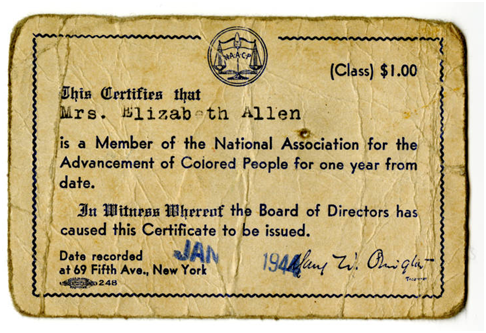
Membership Card, 1944, J. Chester and Elizabeth Fletcher Allen Collection of the Civil Rights Heritage Center, Indiana University South Bend Archives, accessed Michiana Memory Digital Collection.

By this definition, Elizabeth exemplified the “new Negro,” dedicating her life to uplifting South Bend’s Black community through her work with the NAACP’s Legal Redress Committee and by organizing drives to improve housing for minorities. According to her son, Dr. Irving Allen, Elizabeth embodied the Black empowerment she wrote about, challenging oppression and advocating for those “being cheated out of a decent life.” Dr. Allen suspected that his mother also wanted to effect change as a legislator, but sacrificed her political aspirations to support her husband’s career.

Elizabeth Allen, courtesy The History Museum Collection, accessed Roberta Heinman, “Suffragists and Activists are Among 10 Influential Women in Indiana,” South Bend Tribune, August 16, 2020.

Although Elizabeth felt she had to shelve her political aspirations, she complemented her husband’s legislative work, particularly regarding World War II defense employment. The outbreak of war in Europe in 1939 created an immediate need for the manufacture of ordnance. While U.S. government war contracts lifted many Americans out of the poverty wrought by the Depression, many manufacturers refused to hire African Americans. This further disenfranchised them as, according to W. Chester Hibbitt, Chairman of the Citizens’ Defense Council, an estimated 54% of African Americans living in Indiana were on relief by 1941.

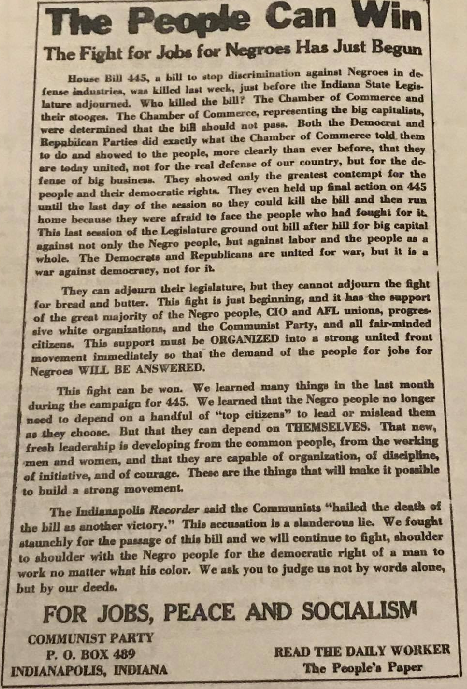
And while the federal government complained of a labor shortage, J. Chester contended that “Negro workers, skilled and semi-skilled, by the thousands are walking the streets or working on W. P. A. projects, because they happen to have been endowed with a dark skin by the Creator of all men'” (“The Story of House Bill No. 445, p.15). He argued that it was the responsibility of lawmakers to prohibit employment discrimination, not only to eliminate poverty, but to safeguard democracy. Echoing the Double V campaign, Rep. Allen stated that “our first line of defense should be the preservation of the belief in the hearts of all men, black and white alike, that Democracy exists for all of us; that we are all entitled to a home, a job and the expectancy of better things to come for our children.” The continued denial of American minorities’ rights undermined the fight for freedom abroad.

Elected to a second term in 1940, J. Chester led the call for anti-discrimination legislation. Months before President Roosevelt issued Executive Order 8802, Rep. Allen and Rep. Evans introduced House Bill No. 445. If enacted, it would make it illegal for Indiana companies benefiting from federal defense contracts “to discriminate against employing any person on account of race, color or creed.” So popular was the bill that after the Indiana Senate passed it, delegations of African Americans and their children filled statehouse corridors and galleries, carrying “placards advocating passage of the bill, describing the measure as the only thing necessary to provide Negroes with jobs” (“The Story of House Bill No. 445”, p.7).

The Indiana State Chamber of Commerce, “The Story of House Bill No. 445 . . . A Bill That Failed to Pass,” (Indianapolis, 1941?), Indiana State Library pamphlet.

Despite the bill’s promising fate, on the last day of session the House kicked it over to the Committee on Military Affairs, where it essentially died. In an article for the Indianapolis Recorder, J. Chester noted that although the bill was defeated,

such state-wide attention had been drawn to the sad economic plight of the Negro workers of Indiana and its attendant dangers that people of both races agreed that the alleviation of the Negro unemployment problem was the number one job of the preparations for war of Indiana and proceeded in for right home-rule manner to do something about it.

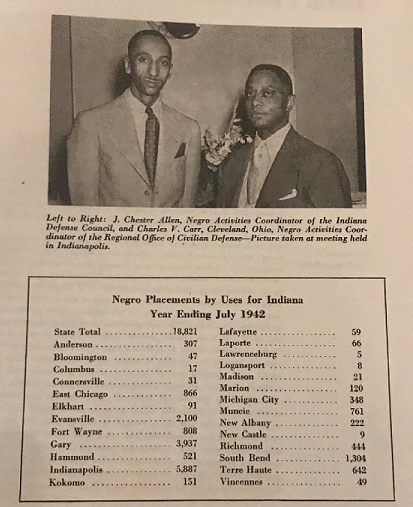
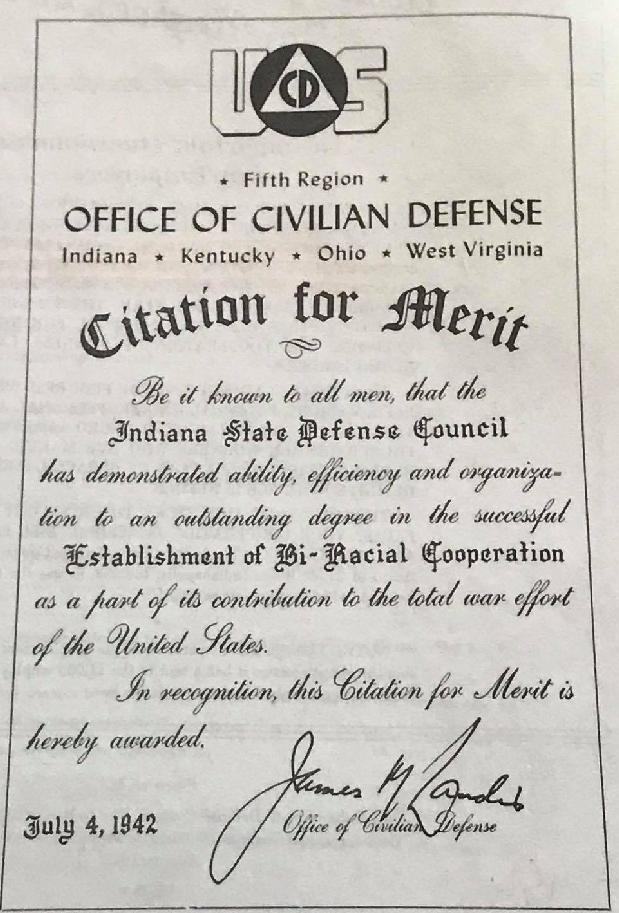
On June 1, 1941, Governor Schricker answered the call to “do something about it,” appointing J. Chester the Coordinator of Negro Affairs to the Indiana State Council of Defense. As part of the Indiana Plan of Bi-Racial Cooperation, Allen traveled throughout the state, appealing to groups like the A.F.L., C.I.O., and the Indiana State Medical, Dental and Pharmaceutical Association, which all formally pledged to employ African Americans. Through intensive groundwork, Allen established bi-racial committees in at least twenty Indiana cities.

Based on the “mutual cooperation between the employer, labor and the Negro,” the Recorder reported that these local committees would “go into action whenever and wherever Negro industrial employment presents a problem.” Although his persuasive skills often convinced employers to hire Black employees, historian Emma Lou Thornbrough noted that “Allen sometimes invoked Order 8802 and threats of federal investigation to persuade management to employ and upgrade black workers.”

The Indiana State Defense Council and The Indiana State Chamber of Commerce, “’Job Opportunities for Negroes:’ The Goal of Indiana’s Bi-Racial Cooperation Plan,” Pamphlet No. 4 (January 1943), accessed Hathitrust.

Allen and the bi-racial committees also served as a sort of “middlemen” for white employers who wanted to hire African Americans, but were unsure how to recruit those best-suited for the job. Allen and the committees distributed “mimieographed questionnaires,” which provided” more valuable information with respect to Negro labor supplies, skills, etc. This information was then used with great effect in the mobilization and cataloguing of types of dependable Negro workers for local defense industries.”

Under Allen’s leadership, the Indiana Plan proved incredibly successful, providing employment to those, in Allen’s words, “whose record of loyalty and services dates in an unbroken chain back to the year 1620” (“The Indiana Plan of Bi-Racial Cooperation,” p.5). According to the “Job Opportunities for Negroes” pamphlet, between July 1, 1941 and July 1, 1942, there “was a net increase of 82% Negro employment, most of which was in manufacturing. . . . working conditions also improved” (p.2). (It should be noted that employers continued to deny African Americans jobs in “skilled capacities.”) In fact, Indiana was awarded the “Citation of Merit” by the National Director of Civilian Defense for “outstanding work in the field of race relations.” So efficiently organized and implemented, other states used the plan as a model to bring African Americans into the workforce.

Indiana State Defense Council, The Indiana State Chamber of Commerce, and Governor Schricker’s Negro Employment Committee, “What is the Truth About Job Opportunities for Negroes in Indiana?,” (August 1942), Indiana State Library pamphlet.

The Bi-Racial Cooperation Plan’s significance endured long after World War II ended. White employers could no longer claim that Black Hoosiers lacked the skills or competence required of the workplace or that it was “unnatural” for white and Black employees to work alongside each other. Reflecting on the program, Allen wrote in 1945, “Time was when a Negro interested in securing better employment opportunities for his people could not even obtain an audience with those able to grant such favors.” But the Bi-Racial Cooperation plan “has accomplished more for the Negro’s permanent economic improvement than had been done in the preceding history of the state.”

While African Americans were often the first to be let go from defense jobs with the conclusion of war, Allen’s work permanently wedged the door open to employment for Black Hoosiers. Allen, perhaps at the encouragement of Elizabeth, emphasized the importance of creating job opportunities for Black women and in his 1945 article noted that thousands of female laborers “have been upgraded from traditional domestic jobs, to which all colored women had previously been assigned irrespective of training or ability, to defense plants as receptionists, power-sewing machine operators, line operators and other better paying positions where their training can be utilized.”

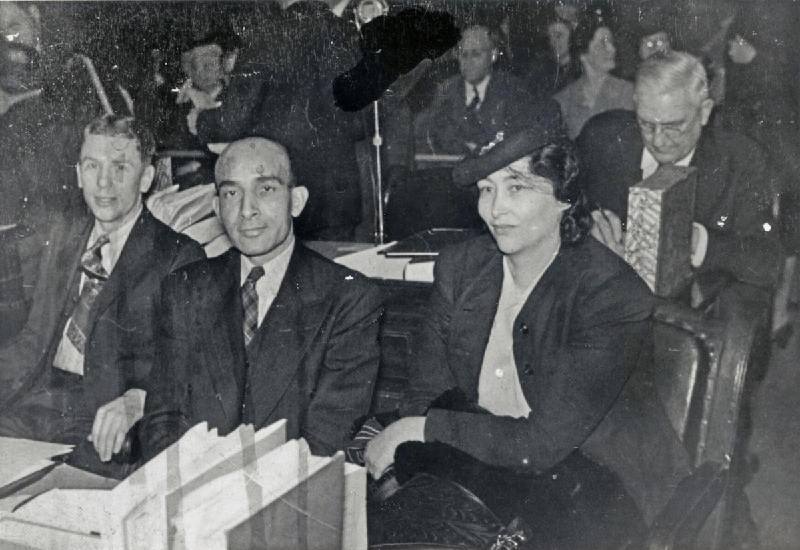
Elizabeth Allen front left, J. Chester Allen back of the table, Ca. 1944, J. Chester and Elizabeth Fletcher Allen Collection of the Civil Rights Heritage Center, Indiana University South Bend Archives, accessed Michiana Memory Digital Collection.

Like her husband, Elizabeth refused to accept that Black Hoosiers would be excluded from the economic boon created by defense jobs. In the early 1940s, she established a nurse’s aid training and placement program for Black women in St. Joseph County. Of her WWII work, Elizabeth’s son said that she opened professional doors for Black women and that she saw herself as helping people who were oppressed. Like J. Chester, Elizabeth helped select local men for placement in defense jobs and, according to an October 11, 1941 Indianapolis Recorder article

used the utmost care in selecting the men to go into the factory realizing that future opportunities were dependent upon the foundation which these pioneers laid both in building good will among the fellow employes, and proving to the management that colored are reliable, trustworthy, hard-working and capable of advancing.

While J. Chester traveled the state, Elizabeth tended to the needs of the local community, chairing a drive in 1942 at Hering House for “community betterment in housing[,] social and industrial fields.” In the 1940s, Elizabeth organized various meetings to improve local housing for the Black community, emphasizing the link between substandard residences and crime rates, delinquency, and health. Deeply committed to ensuring quality education for African American children, Elizabeth founded Educational Service, Inc. in 1943, which encouraged youth to pursue social and economic advancement, provided financial aid to “worthy” students, offered individual counseling, and fostered good citizens. All of this while caring for three young children and likely manning the couple’s law office, as J. Chester fulfilled his duties with the Indiana State Council of Defense. Fortunately, Elizabeth later told the South Bend Tribune, “I want to keep busy constantly. I have to be about something all the time.”

When the war clouds cleared, the Allens achieved many of their professional and philanthropic goals. But they also experienced immense personal loss that appeared to test their marriage. Their post-war journey is explored in Part II.


Sources:

The majority of this post is based on state historical marker notes, in addition to the following:

“11,605 Helped by Hering House,” South Bend Tribune, April 22, 1931, 5, accessed Newspapers.com.

“11 Witnesses Charge Police Shot too Soon,” South Bend Tribune, April 10, 1935, 1, accessed Newspapers.com.

“Seek to Avenge Youth’s Death,” Indianapolis Recorder, May 25, 1935, 1, 2, accessed Hoosier State Chronicles.

“Public Angered at Whitewash,’” Indianapolis Recorder, June 1, 1935, 1, accessed Hoosier State Chronicles.

Elizabeth F. Allen, “Negro and 1940,” South Bend Tribune, October 1, 1939, 5, accessed Newspapers.com.

The Indiana State Chamber of Commerce, “The Story of House Bill No. 445 . . . A Bill That Failed to Pass,” (Indianapolis, 1941?), Indiana State Library pamphlet.

The Indiana State Defense Council and The Indiana State Chamber of Commerce, “The Indiana Plan of Bi-Racial Cooperation,” Pamphlet No. 3, (April 1942), Indiana State Library pamphlet.

Mary Butler, “Mrs. Elizabeth Allen Lays Down Law to Family,” South Bend Tribune, July 30, 1950, 39, accessed Newspapers.com.

“Adult Award Winner,” South Bend Urban League and Hering House, Annual Report, 1960, p. 5, accessed Michiana Memory.

“Area Women Lawyers Tell It ‘Like It Is,’” South Bend Tribune, March 9, 1975, 69, accessed Newspapers.com.

Marilyn Klimek, “Couple Led in Area Racial Integration,” South Bend Tribune, November 30, 1997, 15, accessed Newspapers.com.

Emma Lou Thornbrough, Indiana Blacks in the Twentieth Century (Bloomington: Indiana University Press, 2000), p. 207.

Oral History Interview with Dr. Irving Allen, conducted by Dr. Les Lamon, IU South Bend Professor Emeritus, David Healey, and John Charles Bryant, Part 1 and Part 2, August 11, 2004, Civil Rights Heritage Center, courtesy of St. Joseph County Public Library, accessed Michiana Memory Digital Collection.