Fort Wayne’s Charles Allen: Theatrical Ingenue & “Unsung Gay Hero”

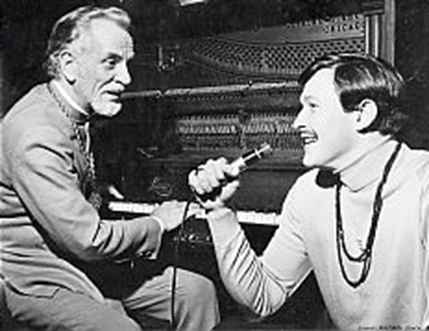
Courtesy of the Fort Wayne News-Sentinel, caption: Pianist Charles Allen, left, and singer Steve Black were part of the entertainment scene in the late ’60s, when bars replaced coffeehouses as the centers of musical activity.

Legendary choreographer and “unsung gay hero” Charles Allen sat with a tape recorder in his Fort Wayne house, a veritable art museum awaiting curation. Sipping gin and orange juice from an empty peanut butter jar, he began to document his life. Notorious for self-mythologizing—once claiming to have killed a man using “voodoo and black magic”—some of the anecdotes he fed the tape no doubt were embellished.[1] These would prove unnecessary, however, as his legacy speaks for itself. Not only did Allen give “birth to generations of dancers and . . . change the way people looked at the world around him,” but he inspired and empowered LGBTQ+ Hoosiers, perhaps unintentionally. Upon Allen’s 1980 death, Jerry Jokay wrote in TROIS, Fort Wayne’s gay newsletter, that “Although he probably wouldn’t have seen it this way, one of his greatest contributions was that he was a gay hero. And he is a gay hero simply because his gayness was a trivial issue in his life even in spite of the oppression it caused him.”[2] Allen, on the other hand, would probably consider his greatest contributions to be advancing performing arts and instilling a love of storytelling and self-expression in Hoosiers.
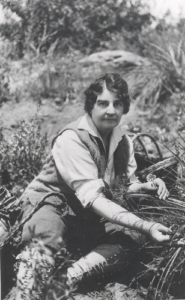
Gene Stratton Porter, courtesy of the Indiana State Museum, courtesy of KPC News.

Born in 1912, Allen was likely raised by his aunt and uncle in Mongo, Indiana. Depictions of Allen’s childhood are characteristically colorful and include a traipse through Tamarack Swamp with famed author and naturalist Gene Stratton Porter in search of insects and plant specimens.[3] Allen “recalled dyeing his hair pinkish-brown as a child, catching blue racer snakes, putting them around his neck, and startling passersby on highway 20 near his home. A barefoot, innocent, wild-haired child of the swamp.”[4]  The spirited child attended school in Kendallville and spent free time in LaGrange, where he learned to play piano at Wigdon Theater. Fully enamored with artistic expression, he devoured performances delivered by a travelling company. The News-Sentinel reported “there was a troupe of four or five men, who did a two-reel silent movie, and set up an impromptu stage with an indian scene. There was singing, and two of the men did female impersonations. When he left the show, his life had changed. . . . He’d fallen in love.”

The production continued to call to him, long after the caravans departed. He left school, took a train to northern Michigan, where the travelling company had migrated, and became its new pianist. As despair deepened during the Great Depression, the public increasingly took solace in travelling shows. These provided Allen with opportunities to try his theatrical hand and hone his skills as a performer. The News-Sentinel noted, “People were doing almost anything for money. He fell in with a freak show,” dubbed the Palace of Wonders, for which he mesmerized crowds as the Human Pin Cushion. During this period, Allen learned how to perform the “half-man, half-woman” act, styling his feminine half after screen siren Marlene Dietrich. When he returned to Fort Wayne, he would perform this routine at local tavern, Henry’s, and played piano at bars like This Old House, Trolly Bar, and the Caboose.[5] Allen insisted that friends stay at his house once the bars closed down for the night, hating solitude.[6]

The eclectic career he had forged for himself was abruptly derailed by the conformist ethos of the 1940s. At a time of global upheaval, Americans held evermore sacrosanct heteronormativity. The News-Sentinel reported that during this “less enlightened age,” a judge sentenced Allen to six years in a Michigan City Prison after “an affair with a soldier led to a charge of sodomy.”[7] Allen recalled in the Fort Wayne Free Press that the judge declared ironically “we’re going to send you where you’ll be happy; locked up with a lot of men!”[8] This prediction proved correct, as he spent time with paramours in a makeshift room fashioned out of old pianos and curtains. On weekends, he played piano for the men waiting in line to watch a movie. While it played, a band mate would take his place at the piano, so that he could go hold hands with his companion. During his few years in prison, Allen made friends, assembled a band—for which he played the sousaphone—and learned how to dance.[9]
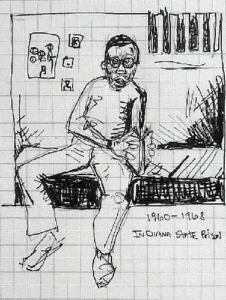
A sketch of Etheridge Knight in prison by Terrance Hayes, accessed theparisreview.org.

The News-Sentinel noted that in prison Allen “kept following his insatible [sic] desire to learn. Where he could find no one else to teach him, he taught himself. The creativity could never let him rest. It would be that way to the end of his life.”[10] This cultivation of self-expression paralleled the journey of African American poet, Etheridge Knight. While serving eight years at the Indiana State Prison in the 1960s, he discovered the restorative power of writing, culminating in his revolutionary Poems from Prison. Knight later stated that “Poetry and a few people in there trying to stay human saved me . . . I knew that I couldn’t just deaden all my feeling the way some people did.”[11]

So, too, did music and dance sustain Allen during his incarceration. Upon release, he returned to Fort Wayne, opening the Charles Allen Dance Studio.[12] According to the Journal-Gazette, he was the city’s only choreographer and, through his trips to New York and Chicago, “single-handedly” invigorated the city’s theater scene. Something of a cultural conduit, Allen traveled to Vera Cruz, Mexico to research indigenous dances. He studied dance at the University of Guatemala and the Palace of Fine Arts in Mexico, imbuing midwestern students with unique material and perspectives.[13]

In life and work, Allen gravitated towards those on the fringes, perhaps identifying with their struggles or the stigmatization they endured. He reportedly taught exotic dancers how to improve their performances and played piano at “houses of ill repute.”[14]  In his TROIS article, Springer wrote that Allen played piano and felt a “kinship” with Black Americans because “like him, they were among the outsiders of society.”[15] Though he was exacting and sometimes cruel, the News Sentinel reported that “he would work with beginners no one else had time for, work tirelessly because he felt a love of what he was doing.”[16] Janice Dyson recalled this experience, after her mom “scrimped grocery money to help pay” for lessons for her and her sister, Bernice. She recalled that Allen “was a real taskmaster. . . . Bernice was intimidated by him and quit after about a year. I wasn’t afraid of him, but I learned pretty quickly that when he said practice or else, he meant it.”[17] Perhaps he hoped to provoke the same grit he’d developed through surmounting the many hardships imposed by society.

While he worked with Fort Wayne performers, Allen reportedly knew the jazz greats, like Billie Holiday and Louis Armstrong, and one friend noted that “a lot of famous people used to come here and have him fix their acts. Polish the acts. Reblock them or rechoreograph them.'”[18] Legend has it that one winter Allen sold his horse to pay the train fare to see Holiday perform in New York City. Due to a snow storm, he was the only person to show up at the theater. The usher relayed his presence to Holiday, who performed only for him, after which they went out for a drink. She reportedly drove him to the train station and ran alongside the cars, waving as the train departed. Allen was so moved by the experience that he wept while watching the train station scene in “The Lady Sings the Blues.”[19]
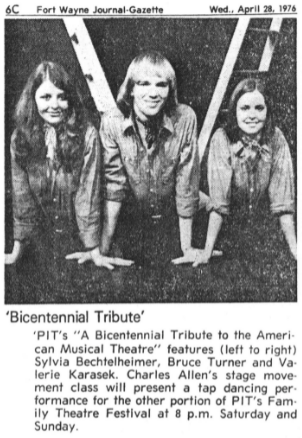
Family Theatre Festival (1975-1976), OnStage On Campus Collection, mDON: mastodon Digital Object Network, Helmke Library, Purdue University Fort Wayne.

Purdue University Fort Wayne (PUFW) recognized the ingenue’s talent, hiring Allen to teach courses like Stage Movement.[20] He felt immense pride about being self-taught. A man who embodied resistance towards oppression and convention, his influence intersected fortuitously with the cultural revolution of the late 1960s and 1970s. Friends and colleagues seem to agree that he was not an activist in the traditional sense, but he always answered when called to provide insight about homosexuality or the burgeoning “homophile” movement. He recognized that, as one of few men in the area living openly, if he did not engage in public discourse that no one one would. When asked by WANE-TV to serve as one of five panelists about homosexuality Allen agreed, saying “‘I’m all right here, I don’t have any problems because I’m not scared. But a lot of people are scared; they’re scared they’ll get arrested.”[21] He appealed to dozens of people to serve as panelists, but only two agreed. Those who declined feared that their parents would disown them or that they would lose their job, as had one of Allen’s friends who served in World War II. Others claimed the panel was unnecessary or worried that it would upset the “status quo,” which had provided a modicum of safety. To this reasoning, Allen said, “‘I thought if everything is so fine, why can’t they get on the air and say it’s fine. It’s because it isn’t fine.”[22]

Allen spoke about homosexuality at PUFW campus teach-ins and college classes, and wrote editorials for the student paper, The Fort Wayne Free Press, under the pseudonym “Claude Hawk.”[23] He wanted audiences to understand that sexuality was not a choice, noting that “My own doctor tells me that one gene or chromosome determines sexual preference—not butchness, effeminancy, athleticism, not militancy, but whom you want to go to bed with.”[24] He added that this knowledge, while “comforting,” doesn’t help if you get fired or the “bartender breaks your glass after each drink, etc., etc.” His efforts shifted the perspectives of students like Linda Lamirand and Katharine Stout, who attended a teach-in with the “brave man” who “sat up there and told it like it is.”[25] The authors were enlightened by Allen’s revelations that he knew he was gay at the age of four and that scientific studies suggested that biology dictated sexual preference.
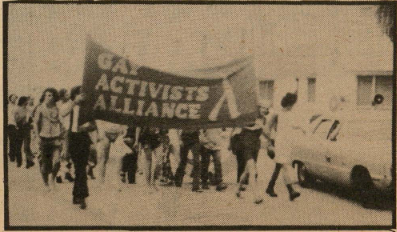
Courtesy of The Fort Wayne Free Press, 3, iss. 16 (July 27, 1972): 9, accessed mDON: mastadon Digital Object Network, Helmke Library, Purdue University Fort Wayne.

In one Free Press editorial, Allen addressed those who had come to terms with their sexuality, but faced the question “where do you go?” to meet someone. Of the dilemma, he wrote:

You can’t find someone at an office party or at a neighborhood bar because someone would ‘find out’. So you experiment. You drink too much or get so horny that, without experience, you get your teeth bashed in saying something dumb to to the wrong person; or the right-wrong person who relieves you of your watch, wallet, and rings. Or sometimes you are picked up by a nicelooking, intelligent, young man with long hair and bare feet, who turns out to be fuzz and you are entrapped, fined, and-or jailed.[26]

He advised readers to find a “gentle, gay” friend, who can help navigate the covert social world, or a relatively tolerant restaurant or bar. A “third salvation,” Allen noted, was to “know an art or theater crowd who don’t give a damn. Not about you, but about it.” The theater provided a world in which he did not have to explain himself or act as a local spokesperson for homosexuality. He wrote that the “freedom, acceptance, and love” afforded by the theater community created “a place to breathe in this pollution of brotherhood. Since one doesn’t have to hide, or lose his job in these fields, these are the more obvious” ones in which to work.[27] In fact, Allen noted that living as a gay man paralleled life in the performing arts, writing:

“You are forced to think and live like a male and play the game so well that you are never uncovered. And this becomes an art, gives you a facility for understanding objectively what’s going on. It’s like a play, and while others are doing it naturally you’re listening for clues, and if well rehearsed, arrive at a happy ending.”[28] 
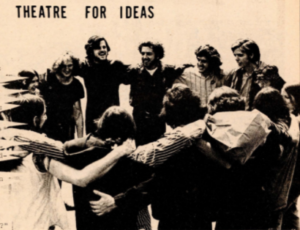
The Fort Wayne Free Press 4, iss. 3 (January 25, 1973): 6, accessed mDON: mastadon Digital Object Network, Helmke Library, Purdue University Fort Wayne.

While TROIS writer Jerry Jokay considered Allen “Fort Wayne’s unsung gay hero,” he noted that “his fortitude laid in the fact that he didn’t dwell upon his difference . . . Allen was preoccupied with being so much more, as his best friends attest.”[29] Preoccupied, he was. Allen informed Free Press readers about his life, writing in 1971 that “I ran my own school, taught at Purdue, played piano in bars, was connected with Ft. Wayne Civic Theater, Kenosha Little Theater, Theater Alanta, had choreographed a Broadway show, was a Japanese paper folder, an Arabian knot tier.”[30] He had traveled the globe in search of inspiration and imbued new generations of performers with it. The News-Sentinel wrote that “he became unique, in a world of his own creation. His art became his life, his life his art.”[31]

His life, his art. Perhaps it was his cancer diagnosis that inspired him to detail them on tape, stories that writer Dan Luzadder suggested “may have been plucked from the intensity of his nether world.”[32] We don’t know what stories he told, as he ran out of time to complete the recordings,* but perhaps he described the demands of caring for his pet python or recited original sonnets, haikus, and Limericks, “both clean and questionable.”[33] We can be certain that his life and art profoundly influenced those around him. This is evidenced by the obituaries written upon his death in 1980 at the age of 68. Luzadder wrote in the Fort Wayne News-Sentinel:

There was loneliness and insecurity. There were things that drove him. And there was tremendous courage to live through the times of his life, to aspire to art, to survive with nothing more than intelligence and faith in himself, to go hungry, to be alone, to see the world in its intolerance and still love it.[34]
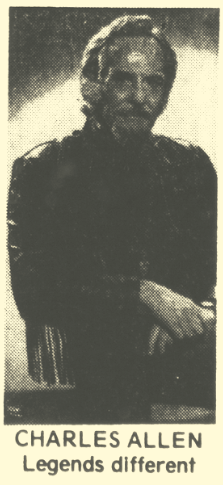
Dell Ford, “Artists’ Artist Charles Allen Dies,” Fort Wayne Journal-Gazette, March 20, 1980, 1C, 2C, ISL microfilm.

On March 21, hundreds of people from all walks of life—including actors, dancers, bartenders, city officials, and editors—stood shoulder-to-shoulder at the Performing Arts Center to pay their respects to the man “whose life had taught them the meaning of art.”[35] His memorial served as a final standing ovation, with Civic Director Richard Casey reading from “Hamlet,” poets performing spoken word, and dancers delivering a finale performance of “Mr. Bojangles.”[36]

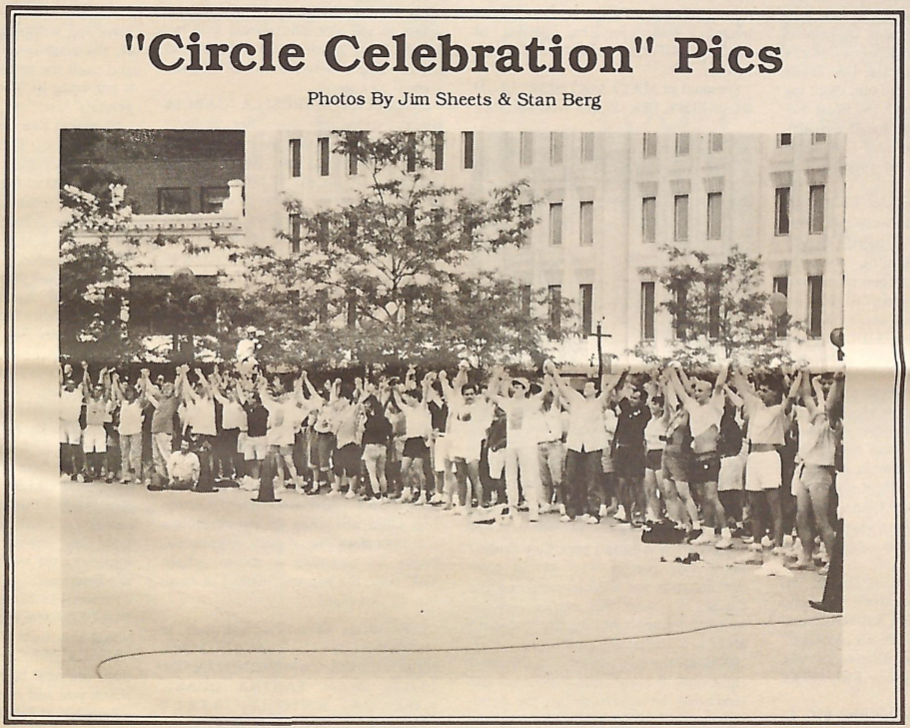
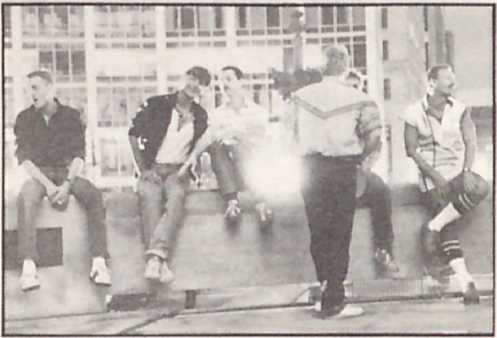
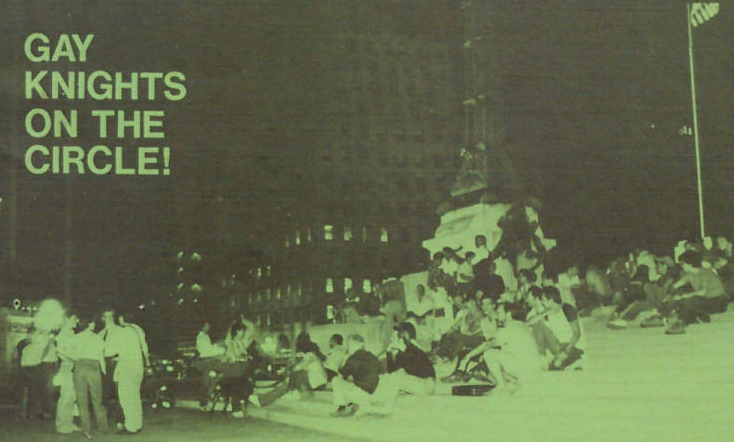
Allen provides us with a window into the experiences of those who lived openly in Indiana prior to the liberating events of the 1980s and 1990s. Before a sense of community was fostered by the formation of groups like Fort Wayne Gay and Lesbian Organization (GLO), Pride Week celebrations, and the publication of gay newsletters, Allen drew upon a deep reservoir of self-assurance and creative impulse to fashion a fulfilling life.[37] In his 1980 tribute, Steve Springer described Allen as “an individualist. Society had its standards of behavior and Allen had his own.” And although he had suffered because of these standards, Springer insisted that “Long after Anita Bryant and her hordes of intolerants are forgotten, the legend of Charles Allen will live on.”[38]

* The author has been unable to locate these recordings. If you know of their location please contact npoletika @library.in.gov.

Sources:

All issues of The Fort Wayne Free Press were accessed via mDON Mastodon Digital Object Network, Helmke Library, Purdue University Fort Wayne.

[1] Dan Luzadder, “Charles Allen: His Life and His Art Were his Epitaph,” (Fort Wayne) News-Sentinel, March 21, 1980, 7A, Indiana State Library (ISL) microfilm.

[2] Jerry Jokay, “Who Was Charles Allen?,” TROIS (Three Rivers’ One in Six) (March 1983), Northeast Indiana Diversity Library Collection, accessed Indiana Memory.

[3] “Arts Center Site for Allen Service,” (Fort Wayne) News-Sentinel, March 20, 1980, ISL microfilm.

[4] Dan Luzadder, “Charles Allen: His Life and His Art Were his Epitaph,” (Fort Wayne) News-Sentinel, March 21, 1980, 7A, ISL microfilm.

[5] Dell Ford, “Artists’ Artist Charles Allen Dies,” Fort Wayne Journal-Gazette, March 20, 1980, 1C, 2C, ISL microfilm.

[6] Dan Luzadder, “Charles Allen: His Life and His Art Were his Epitaph,” (Fort Wayne) News-Sentinel, March 21, 1980, 7A, ISL microfilm.

[7] Ibid.

[8] Claude Hawk, “Boys Will Be Girls!,” The Fort Wayne Free Press 2, iss. 1 (January 1, 1971): 3.

[9] Ibid.

[10] Dan Luzadder, “Charles Allen: His Life and His Art Were his Epitaph,” (Fort Wayne) News-Sentinel, March 21, 1980, 7A, ISL microfilm.

[11] Nicole Poletika, “Etheridge Knight: ‘can there anything good come out of prison,'” May 3, 2017, accessed Untold Indiana.

[12] Steve Springer, “Chas. Allen,” The Communicator, March 27, 1980, reprinted in TROIS (Three Rivers’ One in Six) (May 1980): 5, 7, Northeast Indiana Diversity Library Collection, accessed Indiana Memory.
[13] Dell Ford, “Artists’ Artist Charles Allen Dies,” Fort Wayne Journal-Gazette, March 20, 1980, 1C, 2C, ISL microfilm.

[14] Ibid.; Dan Luzadder, “Charles Allen: His Life and His Art Were his Epitaph,” (Fort Wayne) News-Sentinel, March 21, 1980, 7A, ISL microfilm.

[15] Steve Springer, “Chas. Allen,” The Communicator, March 27, 1980, reprinted in TROIS (Three Rivers’ One in Six) (May 1980): 5, 7, Northeast Indiana Diversity Library Collection, accessed Indiana Memory.
[16] Dan Luzadder, “Charles Allen: His Life and His Art Were his Epitaph,” (Fort Wayne) News-Sentinel, March 21, 1980, 7A, ISL microfilm.

[17] Janice Dyson, “Studio Marks 65 Years of Dancing,” KPC News, December 28, 2017, accessed kpcnews.com.

[18] Dell Ford, “Artists’ Artist Charles Allen Dies,” Fort Wayne Journal-Gazette, March 20, 1980, 1C, 2C, ISL microfilm.

[19] Steve Springer, “Chas. Allen,” The Communicator, March 27, 1980, reprinted in TROIS (Three Rivers’ One in Six) (May 1980): 5, 7, Northeast Indiana Diversity Library Collection, accessed Indiana Memory.
[20] “Family Festival Slated,” Fort Wayne Journal-Gazette, April 28, 1976, 6C.

[21] “It Isn’t Fine,” The Fort Wayne Free Press 2, no. 17 (September 9-23, 1971).

[22] Ibid.

[23] Claude Hawk, “Wherever You Are!,” The Fort Wayne Free Press 1, iss. 10 (October 7-21, 1970): 4.; Claude Hawk, “Out of the Closet,” The Fort Wayne Free Press 1, iss. 11 (November 2-18, 1970): 3, 6.; “It Isn’t Fine,” The Fort Wayne Free Press 2, no. 17 (September 9-23, 1971).

[24] Claude Hawk, “Wherever You Are!,” The Fort Wayne Free Press 1, iss. 10 (October 7-21, 1970): 4.

[25] Linda Lamirand and Katharine Stout, “Dear Freep,” The Fort Wayne Free Press 2, iss. 7 (April 22-May 6, 1971): 10.

[26] Claude Hawk, “Wherever You Are!,” The Fort Wayne Free Press 1, iss. 10 (October 7-21, 1970): 4.

[27] Ibid.

[28] Claude Hawk, “God Love Us All,” The Fort Wayne Free Press 2, iss. 8 (May 6, 1971): 9.

[29] Jerry Jokay, “Who Was Charles Allen?,” TROIS (Three Rivers’ One in Six) (March 1983), Northeast Indiana Diversity Library Collection, accessed Indiana Memory.

[30] Bob Ihrie and Charles Allen, “Holiday on Ice,” The Fort Wayne Free Press 2, iss. 2 (January 18-February 2, 1971): 3.

[31] Dan Luzadder, “Charles Allen: His Life and His Art Were his Epitaph,” (Fort Wayne) News-Sentinel, March 21, 1980, 7A, ISL microfilm.

[32] Ibid.

[33] Dell Ford, “Artists’ Artist Charles Allen Dies,” Fort Wayne Journal-Gazette, March 20, 1980, 1C, 2C, ISL microfilm.

[34] Dan Luzadder, “Charles Allen: His Life and His Art Were his Epitaph,” (Fort Wayne) News-Sentinel, March 21, 1980, 7A, ISL microfilm.

[35] Dell Ford, “Funeral Celebrates Dance, Poetry, Drama, Music,” Fort Wayne Journal Gazette, March 22, 1980, C1, ISL microfilm.; Steve Springer, “Chas. Allen,” The Communicator, March 27, 1980, reprinted in TROIS (Three Rivers’ One in Six) (May 1980): 5, 7, Northeast Indiana Diversity Library Collection, accessed Indiana Memory.

[36] Dell Ford, “Funeral Celebrates Dance, Poetry, Drama, Music,” Fort Wayne Journal Gazette, March 22, 1980, C1, ISL microfilm.

[37] Nicole Poletika, “From ‘Gay Knights’ to Celebration on the Circle: A History of Pride in Indianapolis,” October 5, 2021, accessed Untold Indiana.

[38] Steve Springer, “Chas. Allen,” The Communicator, March 27, 1980, reprinted in TROIS (Three Rivers’ One in Six) (May 1980): 5, 7, Northeast Indiana Diversity Library Collection, accessed Indiana Memory.

What Pearl Bassett’s Memory Reveals About Discrimination in Marion

Image of Pearl Bassett courtesy of WRTV

*This post was written by IUPUI Public History graduate student Molly Hollcraft. 

Often, stories and memories play an important part in understanding history. They offer a human element that helps connect people to one another. W. Todd Groce wrote in an article for History News that “Memory is deeply emotional,” and when people remember something they do so because they have a connection to it. According to historian David Thelen, memory “can illuminate how individuals, ethnic groups, political parties, and cultures shape and reshape their identities.” In 2009, at the age of 98, Black activist Pearl Cannon Bassett gave an interview to a student at the University of Southern Indiana. In the interview, she recounted events related to civil rights and desegregation that she witnessed while living in Marion, Indiana. Bassett’s memories of the discrimination and Civil Rights Movement in Grant County illuminate how Black citizens in Marion shaped their identity.

Pearl Bassett and Civil Rights

Pearl Elizabeth Cannon Bassett was born April 28, 1911, in Marion, Indiana. Aside from the years she spent in Dayton and Cincinnati, Ohio and Chicago, Illinois, Pearl Bassett, also known to many as “Ms. Pearl,” spent her life in Marion. In her oral history interview, Bassett briefly talked about her early education and her family. She recalled how her teacher lowered her grade because it was “too high.” While she was not living in Marion at the time, she recalled the impact the 1930 Marion lynching had on the local Black community. As a 19-year-old, she would have been about the same age as victims Tom Shipp and Abe Smith. In August, the young men had been jailed for the murder of Claude Deeter and rape of Mary Ball. A white mob ripped Shipp and Smith from their cells, brutally beat them, and lynched them near the Marion courthouse. Fearing for her safety, Bassett’s family told her that she should not return home yet. When the National Guard was called into action in Marion not long after the lynching, some of the soldiers were standing in her family’s yard. In remembering the lynching, she said “that was terrible because we had a lot of discrimination.” Shortly after the tragedy, she became a member of the National Association for the Advancement of Colored People (NAACP).

Through organizations like the NAACP, Bassett became an active member in the Marion community and helped fight discrimination and segregation. Her name appeared frequently in the African American newspaper The Indianapolis Recorder for these efforts. Her work included how helping the Red Cross reach its quota for war relief, serving as chairman for the war service commission, and serving as a board member for the Carver Community Center. In her interview, Bassett talked about how she helped organize the NAACP Auxiliary, Women in NAACP, and the Urban Gild, all of which would play a role in desegregation efforts throughout the city.

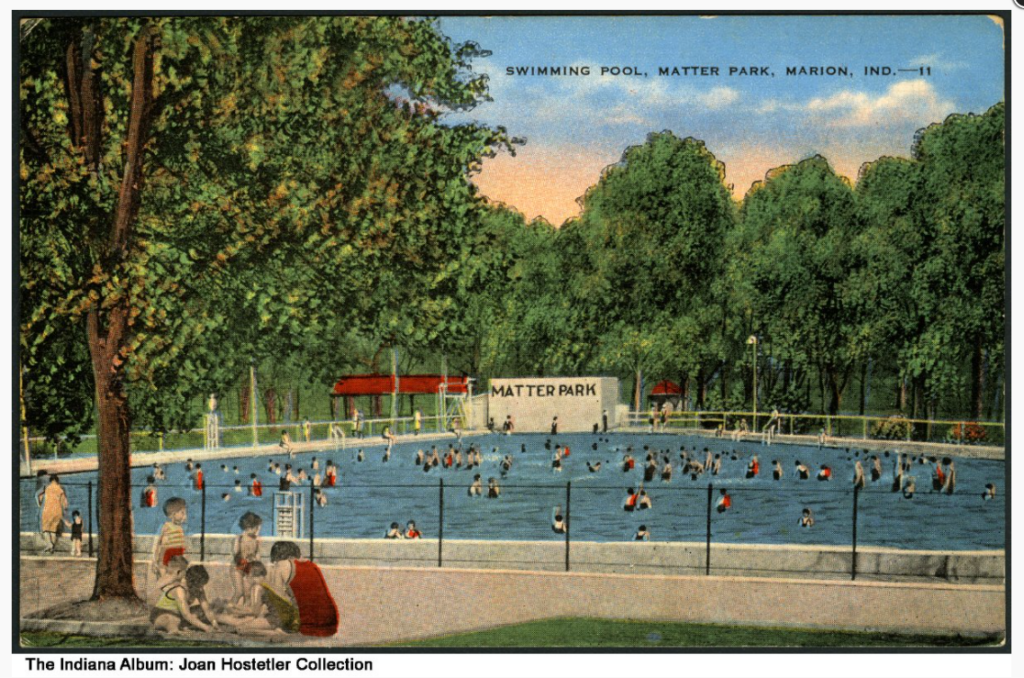
Matter Park, ca. 1925, courtesy of Indiana Album.

She also described the discrimination that Black citizens in Marion faced because of segregated of swimming pools, such as Matter Park. Before its 1954 integration, African Americans had to travel to Anderson to swim. When they did get to swim in the Marion pools they would be drained and refilled afterwards. While it is unclear how directly Bassett was involved in these efforts, it is certainly possible as she was a member of the Marion Urban League, one of the two civil rights organizations that worked to desegregate the swimming pool.

We do know that she participated in anti-discrimination efforts through civil disobedience, as she stated: “When we could not go into the restaurant and eat. . . we formed a committee, and we just read the civil rights law, which has always been right. . . . And if they didn’t open up the place, when they were charged $100 a person in their restaurant. So they opened it up the day we walked in there.”

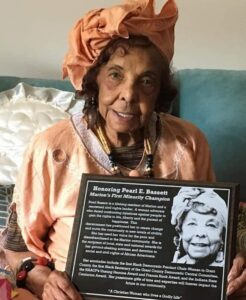
Photo of Pearl Bassett with a plaque that says “Marion’s First Minority Champion.” Photo courtesy of Rawls Mortuary

She also joined an NAACP march in 1969, recalling “We first had the walk from 26th Street to the courthouse for discrimination and equal opportunities for people and jobs. And it was a wonderful thing.” The Ku Klux Klan tried unsuccessfully to confront them at the courthouse, but were told by the city that “they would need a permit and that they [the KKK] would have to take their hoods off.” This was not the only experience that Pearl Bassett had with the Klan. While president of one of the many organizations she was involved in, she received a call from the Klan members. She said, “Many a time they told me they were coming out and burn up my house.”

While in the NAACP, The Indianapolis Recorder reported in the 1960s that Bassett was elected secretary and chaplain for the Marion branch. Bassett was also the President of Women and “wore her tiara as the state queen of the NAACP” during a visit to Kokomo in 1982. She was also the first Black secretary of the Democratic Committee in Grant County. Pearl Bassett also received numerous awards from the NAACP and The Fort Wayne Frost Illustrated reported in 2004 that she received the Region Three Rosa Parks Women of the Year award for her work in civil rights. The Mayor of Marion made a Proclamation for Pearl Bassett Day and gave her a key to the city. In June 2021, Pearl Bassett passed away at the age of 110. Her first-hand accounts help humanize tragic events and shape the identity of Black citizens in Grant County. Her documented memories are invaluable because traditional media often mischaracterized or neglected to record minority history.

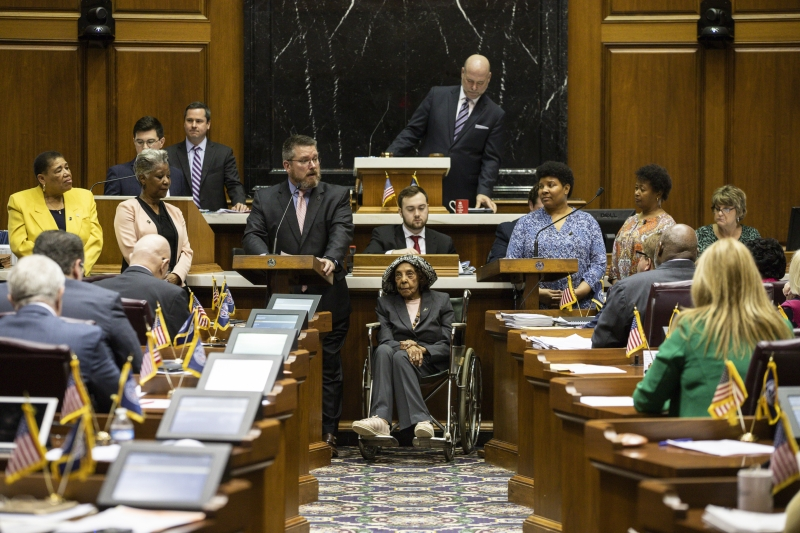
State Rep. Kevin Mahan (R-Hartford City) (left, podium) honoring Marion native Pearl Bassett (center), April 8, 2019, at the Indiana Statehouse, courtesy of the Indiana House of Representatives Republican Caucus.

Sources:

*Newspapers accessed through Hoosier State Chronicles and Newspapers.com.

W. Todd Groce, “The Value of History: When History and Memory Collide,” History News (2006): 5-6, accessed JSTOR.

David Thelen, “Memory and American History,” The Journal of American History (1989): 1117 1129, accessed JSTOR.

“Pearl Bassett,” Indiana Commission for Women: Writing her Story, 2019, accessed in.gov.

“Pearl Bassett Oral History Interview,” University of Southern Indiana, November 7, 2009, University Archives and Special Collections, David L. Rice Library, University of Southern Indiana.

Nicole Poletika, “Strange Fruit: The 1930 Marion Lynching and the Woman Who Tried to Prevent It,” Untold Indiana, May 15, 2018, accessed Untold Indiana.

A Hoosier Shackleton: Julius Frederick and the Greely Expedition

Julius R. Frederick, courtesy of NOAA.

During the late nineteenth and early twentieth centuries, expeditions from multiple nations took on one of the most dangerous, treacherous parts of the globe: the north and south poles. The most well-known example is Irish explorer Sir Ernest Shackleton. His expedition to Antarctica in 1915 became world-famous for his actions to save all 22 men of his crew from extreme cold for 105 days. Biographies of this journey became best-sellers, inspiring many on-screen adaptations, most notably 2002’s Shackleton, starring Kenneth Branagh. However, Shackleton wasn’t the only artic explorer to receive accolades for his endurance and bravery. Julius Frederick, Indiana resident and survivor of the Lady Franklin Bay expedition, also endured harsh temperatures, food shortages, and crew disruptions while stranded in the arctic.

The crew of the Lady Franklin Bay expedition. Frederick is fifth from the left in the back row. Courtesy of NARA/Glenn Stein.

According to the Indianapolis News, Frederick was born in Dayton, Ohio on July 21, 1852. He spent most of his early years in St. Mary’s, Ohio before his mother died when he was thirteen. Without much keeping him in Ohio, Frederick moved to Chicago, taking odd jobs as a messenger boy and railroad worker before he enlisted in the US army in 1876. For many years, Frederick was a soldier in military campaigns against Native Americans, fighting the Sioux and Nez Pierce. Specifically, he fought in the battle of Muddy Creek against the Sioux on May 7, 1877.

Adolphus Greely, leader of the Lady Franklin Bay Expedition. Courtesy of Google Books.

By 1879, Frederick was interested in a different course and signed up to join the Howgate expedition to the North Pole. However, the unstable condition of the ship stranded Frederick in Montana for another two years. Finally, in 1881, Frederick joined the Lady Franklin Bay expedition led by Adolphus Greely, a then-First Lieutenant of the Army’s 5th Cavalry Regiment. Lady Franklin Bay is by Ellesmere Island, Nanavut, Canada, making it one of the most northern spots on the globe to be explored. The expedition’s task, in Frederick’s words, was to “take scientific observations within the Arctic Circle.” This came in the form of weather recording devices and other techniques used to understand the intense climate of the arctic region. In August of 1881, the 21 person crew set course on the ship Proteus, a “steam whaler” that carried them from St. John’s, Newfoundland to Lady Franklin Bay. As historian Glenn Stein noted, Frederick’s “nick­name among his Arctic comrades was “Shorty” because of his five-foot, two-inch stature” and he “did little hunt­ing during the LFBE, but performed the various duties of a cook, steam-launch engineer, and shoemaker.”

Map of Fort Conger and Lady Franklin Bay. Courtesy of Wikipedia Commons.

Once they arrived at Lady Franklin Bay, Greely and his team began their months-long investigation of the region, complete with recordings of the climate and natives. This was all in accordance with a multinational project called the International Polar Year that, according to historian C. J. Taylor, sought to establish “14 research stations” to “study the geophysics and geodesy of the polar region.” Among these stations, they resided at Fort Conger, an outpost a few miles inland from the bay. During these investigations, Sergeants David Brainard and James Lockwood confirmed the “farthest north” record up to that time. Things were going well until the supply ship Neptune failed to reach Lady Franklin Bay and returned to the United States. With its failure went the expedition’s resupply of food and other necessities. Subsequently, the expedition went from a mission of knowledge to one of survival.

Fort Conger, the headquarters of the Greely Expedition. Courtesy of Wikipedia.
Another image of their headquarters, Indianapolis Journal, January 7, 1904, Hoosier State Chronicles.

Greely and his men began to face intense supply shortages which ravaged the crew, leading many to die from the lack of food and the harsh temperatures. A first rescue attempt in 1883 had failed, when the ship Proteus had been sunk by ice collisions, permanently shifting the crew southward from Fort Conger. It was in this dire situation that Julius Frederick endured his most painful experience of the expedition. In April of 1884, only a few months before the party was rescued, Frederick and Sergeant George W. Rice trekked to Cape Isabella, Baird Inlet, “to attempt the recovery of the hundred pounds of English beef which had been abandoned in November, 1883.” As a profile in Scribner’s magazine wrote, Frederick and Rice risked “their lives at almost every step of the way . . . only to find, after hours of searching among the floes, that their triumph was a barren one. . . .” The meat “had drifted from the shore” and was not salvageable. Rice’s condition worsened dramatically and he asked Frederick to leave him to die. Frederick refused and stayed with Rice until the very end, wrapping Rice’s “frozen feet with the temiak, or fur-lined jacket taken from his [Frederick’s] own back for this purpose, and then sat and held his unfortunate comrade till the latter’s pain was relieved by death.” Frederick initially yearned to die but, dedicated to his mission, saved Rice’s food ration, laid Rice’s body to rest, gathered up their supplies, and returned to camp so his colleagues wouldn’t suffer during a search attempt. As Scribner’s wrote, “He would use what was his own, but would not rob the living or the dead.”

Sergeant George W. Rice. Frederick comforted him during his final minutes while there were on a supply run. Courtesy of Internet Archive.
Julius Frederick (right) helping comrade George Rice (left) stay comfortable before he died in April, 1884. Courtesy of Internet Archive.

While many died from malnutrition, immense cold, and sheer exhaustion during the Greely expedition, only one was executed for insubordination. Private Charles B. Henry was caught stealing food in excess of his ration and summarily punished for his crimes. As the Fort Wayne Sunday Gazette noted, Frederick recalled that Private Henry was shot in the back with “two balls taking effect and producing instant death.” The Gazette shared more details from Frederick about the grisly conditions:

He said further there may have been cannibalism, but of this he has no personal knowledge. Henry had been warned several times about stealing food, but he repeated the offense and finally Greely issued the order for his execution.

Private Charles B. Henry. He was executed for stealing food and supplies. Courtesy of NARA/Daily Mail.

Frederick’s account was also published in the New York Times. However, the Indianapolis News reported that survivor Maurice Connell claimed Henry had been falsely accused and that Greely had actually stolen food. “To these charges,” the News wrote, “Sergeant Frederichs [sic], of this city, gives an emphatic denial, claiming that he himself saw Henry commit the theft. . . .” Greely also defended his decision to the New York Times, exclaiming that “it was discovered that, with other articles [food], Henry had stolen and secreted the sealskin boots of the hunter of the expedition.” The execution of Private Henry was one of the more inhumane moments of the Greely expedition, an acknowledgement of the harsh environment encompassing the men.

The six survivors of the LFB expedition. Frederick is the first on the left, back row. Courtesy of Corbis/Getty Images.

On June 23, 1884, after three long and suffering years, the survivors of the Greely expedition were rescued by a slew of ships led by Commander Winfield Schley. When all was said and done, there were only six survivors: Frederick, Brainard, Biederbick, Connell, Long, and Greely himself. Frederick was promoted to Second Lieutenant for his service during the expedition. The rest had perished during the years-long process to resupply and then rescue the expedition party. Greely, as quoted in the Indianapolis Journal, lamented that “six out of twenty-five were brought home. Nineteen brave men remain in that land of desolation.” When the crew docked at Portsmouth, New Hampshire on August 4, 1884, the New York Times wrote:

Never before in the history of Portsmouth has there been so grand and imposing an event as the celebration of the return of Lieut. Greely and the survivors of the expedition. . . . They were enthusiastically greeted as they landed, and the crowd pressed forward to shake their hands.

New York Times, August 5, 1884, Historic New York Times.

The hero’s welcome they received from their fellow citizens underscored the almost unthinkable hardships these men faced while in the arctic.

After a few other postings, Frederick moved to Indianapolis in February 1885, on assignment for the federal Signal and Weather Bureau Services. His move back to the US required some adjustment, especially in regards to the climate. “Sergeant Frederick[s],” the Indianapolis Journal wrote on January 13, 1887, “was about, yesterday, in his shirtsleeves complaining that the weather was much too warm.” The article further quoted him:

“I suppose an Esquimau [sic],” said the Sergeant, “couldn’t be made to understand that heat, no matter how strong it might be, could under any circumstances, occasion suffering. A hereafter of unquenchable fire would have no terrors for him, and when missionaries are sent to the ever-frozen north, they will have to preach a future for the wicked of even more intense cold.”

Indianapolis Journal, January 13, 1887, Hoosier State Chronicles.

Despite his acclimation to the cold, Frederick never fully recovered from his expedition. In an interview with the Indianapolis News, when asked of why he chose to live more inland in Indiana, he cited “rheumatism” as a motivator.

Indianapolis News, June 10, 1902, Hoosier State Chronicles.

In 1902, after many years of lobbying by the state legislature, Julius Frederick received a final promotion, first-class Sergeant of the signal corps of the army, as well as a retirement with pension. Biederbick, Long, and Connell also received the same commendation. The measure was passed by the Congress and signed by President Theodore Roosevelt on June 12, 1902. This final tribute, explained by Indiana Congressman Jesse W. Overstreet in an article in the Indianapolis News, was to “give to these men the only recognition which it remains for a grateful nation to bestow upon those who have imperiled their lives in war or in pursuit of science. This expedition carried the American flag to the northernmost point it has ever been planted by any scientific expedition.” Frederick’s contributions to exploration were finally recognized by the United States and he could finally retire to focus on his health.

Unfortunately, by the fall of 1903, Frederick’s health steadily declined. As the Indianapolis Journal reported, Frederick was “lying in a critical condition at his home on Center Drive, Woodruff place. Acute gastritis, brought on by exposure while with the General A. W. Greely expedition to the North Pole nineteen years ago, is the cause of Sergeant Frederick’s illness.” Frederick died on January 6, 1904 from complications from stomach cancer. He was only 51 years old. Upon his death, the Monthly Weather Review applauded his work in meteorology and noted that he died “enjoying the respect and esteem of all who knew him.” His friend and fellow Greely expedition survivor, Henry Biederbick, traveled all the way from New Jersey to attend his funeral. Frederick was buried in Crown Hill Cemetery in Indianapolis.

Indianapolis Journal, January 7, 1904, Hoosier State Chronicles.

Reflecting on the expedition, Frederick said to the Indianapolis News that:

The Greely expedition was most unfortunate. I am not going to criticise [sic]. It was a horrible experience. I think, however that the success of polar expeditions is largely a question of equipping well. My expedition for the most part had only the rigors of the climate to contend against.

Frederick’s humility and perseverance, in the face of unparalleled challenges, speaks to the importance of exploration. As astronomer Carl Sagan once wrote, “We have always been explorers. It is part of our nature. Since we first evolved a million years or so ago in Africa, we have wandered and explored our way across the planet.” Frederick was one of those explorers, a brave soul who dared to face the elements and survived. In his success the world grew more connected, more understood. Upon Frederick’s death, a friend recalled a motto that he had “made a precept throughout his life: ‘Nothing is impossible to him that does.” If that is the case, then Frederick thoroughly achieved the impossible.

LFB expedition memorial plaque, Pim Island, 2005. Courtesy of Wikipedia.

The Crusader: J. Frank Hanly and the Election of 1916

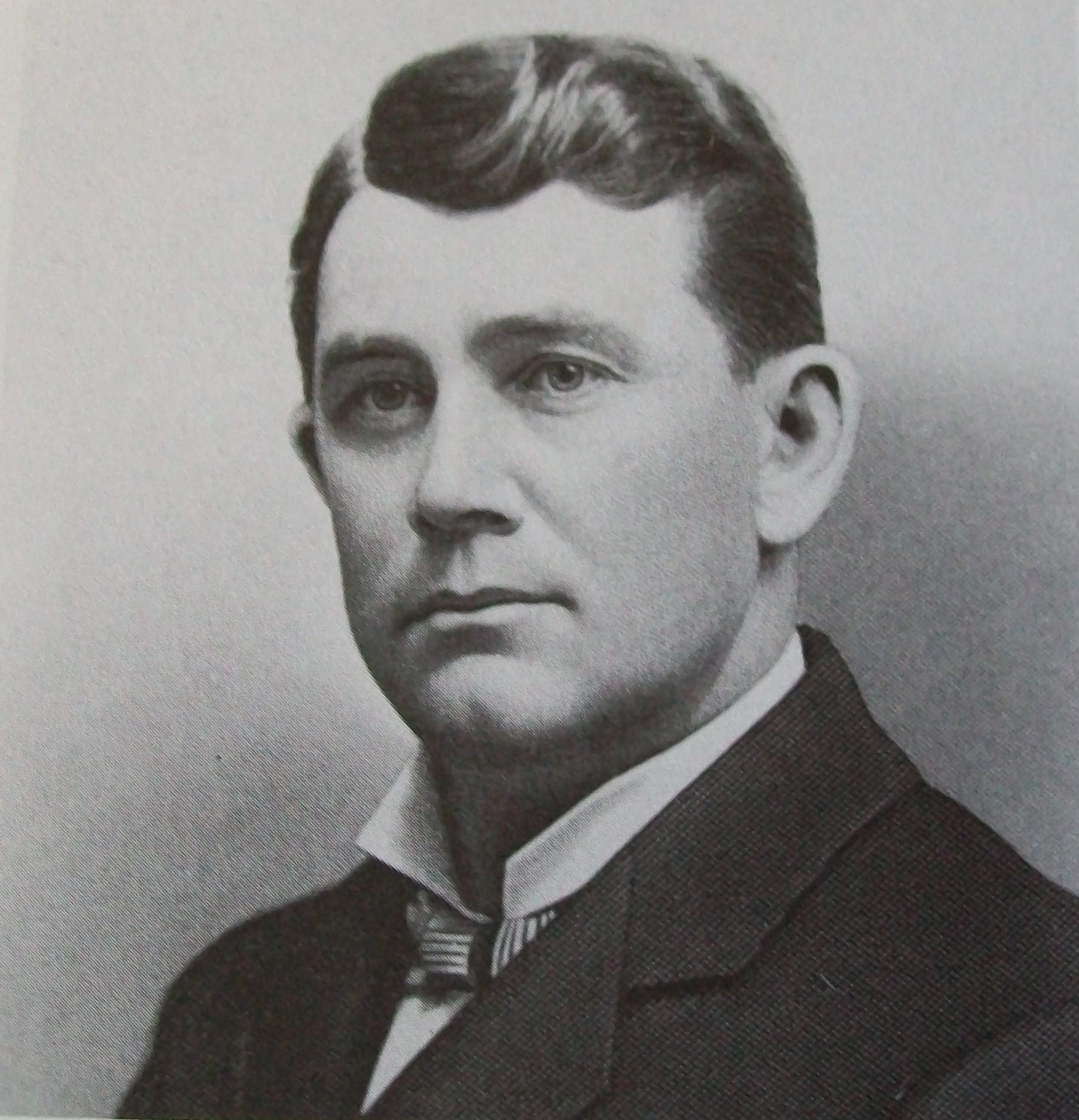
Indiana Governor J. Frank Hanly. Courtesy of WikiCommons.

Did you know that three Hoosiers appeared on national tickets for president or vice president in 1916?  The Democrats ran Thomas R. Marshall of Columbia City for re-election in 1916 alongside President Woodrow Wilson.  The Republican Party tabbed President Theodore Roosevelt‘s former vice president Charles W. Fairbanks of Indianapolis as the running mate of GOP presidential nominee Charles Evans Hughes.  You may ask, who was the third Hoosier running for president or vice president in 1916?  If you guessed Terre Haute-native Eugene V. Debs, you would be wrong.  After being the  Socialist Party presidential nominee four times from 1900-1912, Debs sat out the 1916 campaign before running again (from prison) in 1920.

The third Hoosier and national party candidate in 1916 was a man who is not well-known today, but was a former governor of Indiana, and an influential leader in the prohibition movement.  As a third-party challenger, J. Frank Hanly ran as the Prohibition Party presidential nominee during the 1916 election. Founded in 1869, the Prohibition Party campaigned for laws to limit or ban the sale and manufacture of intoxicating liquors.  The party nominated candidates for office, but only found real success with local elections.  For Hanly, his candidacy in 1916 served as the culmination of decades of advocacy for making Indiana, and the nation, dry as a desert.

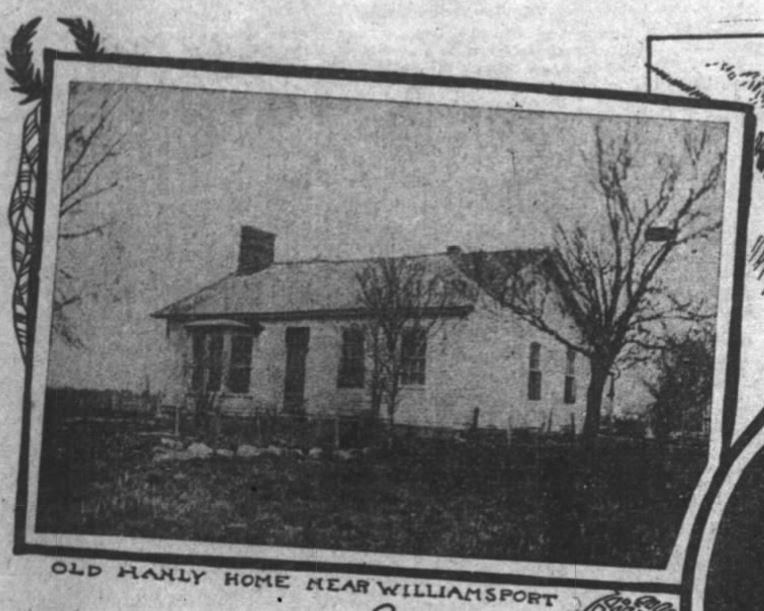
The Hanly Family Home in Williamsport, Indiana. Courtesy of Newspapers.com.
The Hanly Family Home in Williamsport, Indiana. Source: Indianapolis Star, May 7, 1904.

According to a 1904 profile in the Indianapolis News, James Frank Hanly was born on April 4, 1863 in Champaign County, Illinois. His early life exemplified the rough-hewn stereotype that politicians of the era both yearned to have and exploit when useful. As the News wrote, “The world had nothing to offer the cabin boy but poverty. His parents lived on a rented place and sometimes the Hanly’s wondered where the sustenance of coming days was to come from.” Hanly, described as a bookish child, reveled in debate during his schoolhouse days and had “victory perched on his banner very often.” With his mother blinded early in his life and the family thrown into even more intense poverty, Hanly was sent to live with friends of the family in Williamsport, Warren County, Indiana.

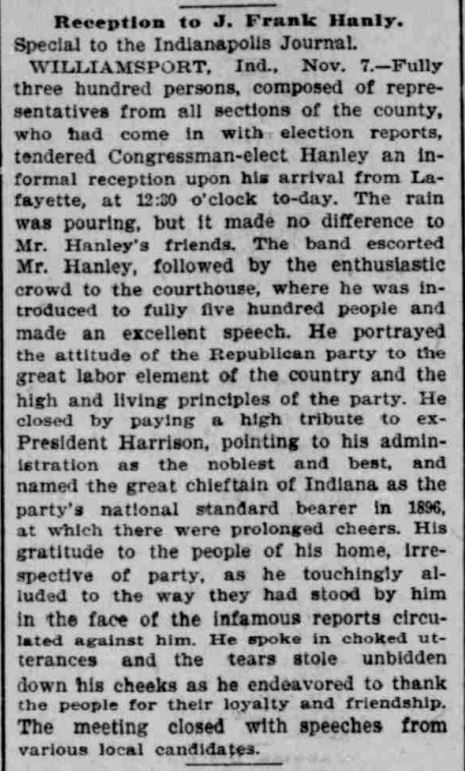
He held odd-jobs throughout his early years in Indiana, most notably ditch digging and teaching, before gaining an opportunity from a local judge named Joseph Rabb. Rabb provided Hanly with the tools to take the bar exam. After passing the exam, Hanly began work at Rabb’s office. Nearly two years later in 1890, he founded a law office with partner Ele Stansbury. Equipped with skills of law and oratory, Hanly was a natural fit for the role of public service. He was elected to the U.S. House of Representatives in 1894 and served one term; his reelection was dashed due to redistricting. After some considerations for a seat in the U.S. Senate, Hanly decided to run for governor of Indiana in 1904 and won, defeating Democrat John W. Kern by 84,000 votes, according to the Plymouth Tribune.

Indianapolis Journal, November 8, 1894. Courtesy of Hoosier State Chronicles.
Indianapolis Journal, November 8, 1894, from Hoosier State Chronicles.
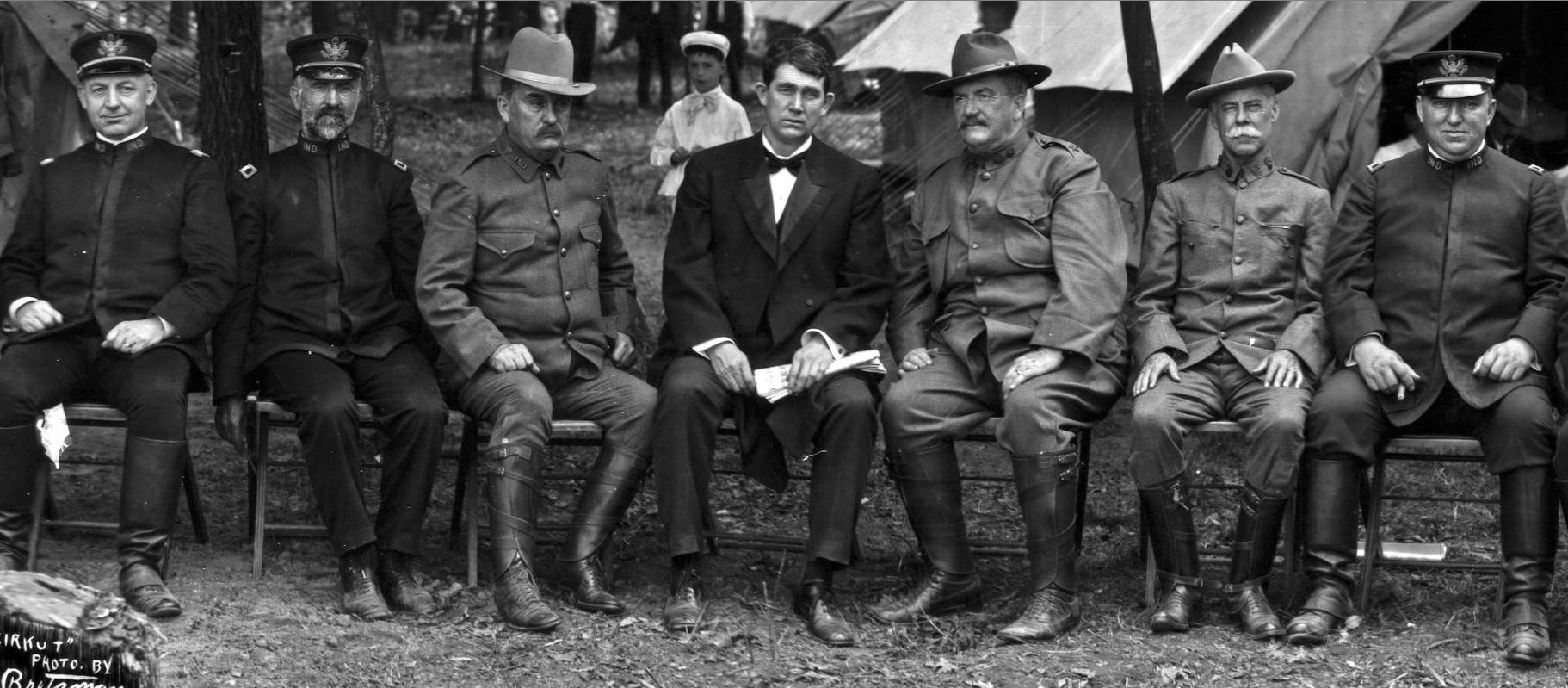
Governor J. Frank Hanly and military officers at Fort Benjamin Harrison Camp of Instruction, 1906. Courtesy of Indiana Memory.
Governor J. Frank Hanly (Center) and military officers at Fort Benjamin Harrison Camp of Instruction, 1906. Courtesy of Indiana Memory.
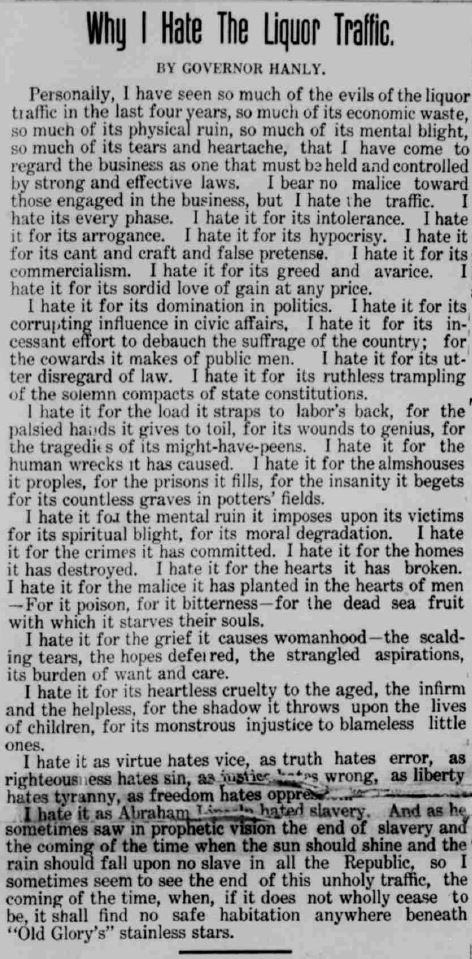
Hanly served as Indiana’s Governor from 1905-1909 and his tenure was marked by a controversial fight over Hanly’s central political issue: the sale of alcohol. He committed his tenure to enacting a stronger form of public policy in regards to the liquor traffic. In an op-ed for the Jasper Weekly Courier, Hanly wrote:

Personally, I have seen so much of the evils of the liquor traffic in the last four years, so much of its economic waste, so much of the physical ruin, so much of its mental blight, so much of its tears and heartache, that I have come to regard the business as one that must be held and controlled by strong and effective laws.

Jasper Weekly Courier, April 10, 1908, from Hoosier State Chronicles.

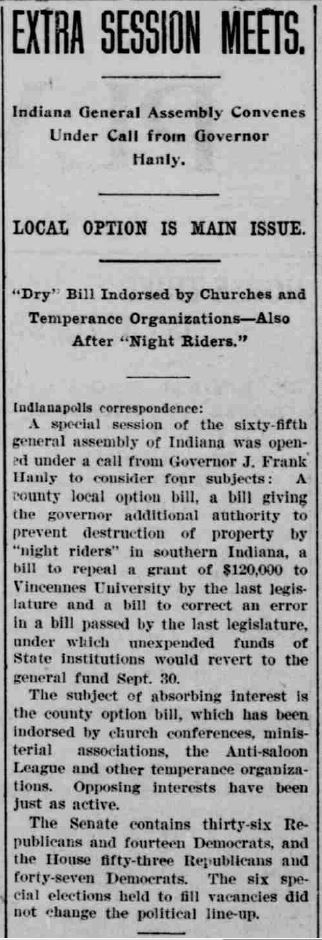
The type of “strong and effective laws” that Hanly wanted came in the form of a “county local option bill,” which Hanly foisted upon the Indiana General Assembly via a special session. This law strengthened the intent of the Nicholson Law, which required extended waiting periods for liquor licenses. Hanly saw this as the first step towards state-wide prohibition, but his opposition saw it as an opportunity. Due to his heavy-handed use of executive power during 1908, the Republican gubernatorial candidate James E. Watson was easily defeated by the Democratic challenger, Thomas Marshall.

Plymouth Tribune, September 24, 1908. Courtesy of Hoosier State Chronicles.
Plymouth Tribune, September 24, 1908, from Hoosier State Chronicles.

Hanly was undeterred. He reaffirmed his position against alcohol in a rousing speech at the 1908 Republican National Convention reprinted in the Indianapolis News. Concerning the liquor traffic, Hanly declared:

I hate it as Abraham Lincoln hated slavery. And as he sometimes saw in prophetic vision the end of slavery and the coming of the time when the sun should shine and the rain should fall upon no slave in all the republic, so I sometimes seem to see the end of this unholy traffic; the coming of the time when, if it does not wholly cease to be, it shall find no safe habitation anywhere beneath Old Glory’s stainless stars.

To Hanly, the sale of alcohol equaled slavery in its immorality, and akin to his political hero, viewed his indictment of alcohol as righteous as Lincoln’s position on slavery (at least on the surface).

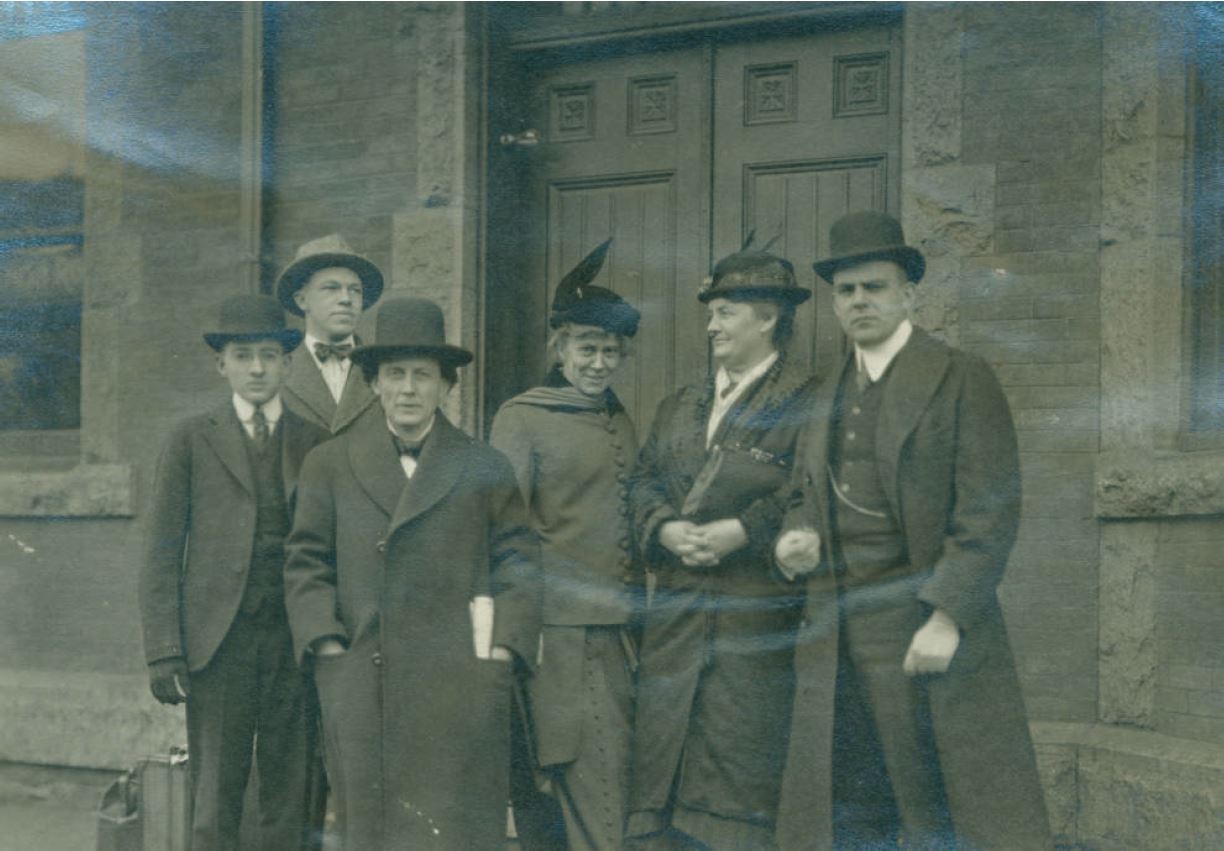
Over the next eight years, Hanly dedicated himself to his cause with a near-religious fervor. He wrote and published pamphlets calling for stricter laws for state liquor trafficking and for nation-wide prohibition. He also formed an organization called the Flying Squadron Foundation that routinely gave speeches throughout the country in defense of outlawing alcohol.  He also founded a prohibitionist newspaper, the National Enquirer (not to be confused with the supermarket tabloid).

Lecturers of the Flying Squadron, a prohibitionist organization founded by J. Frank Hanly, 1917. Courtesy of Indiana Memory.
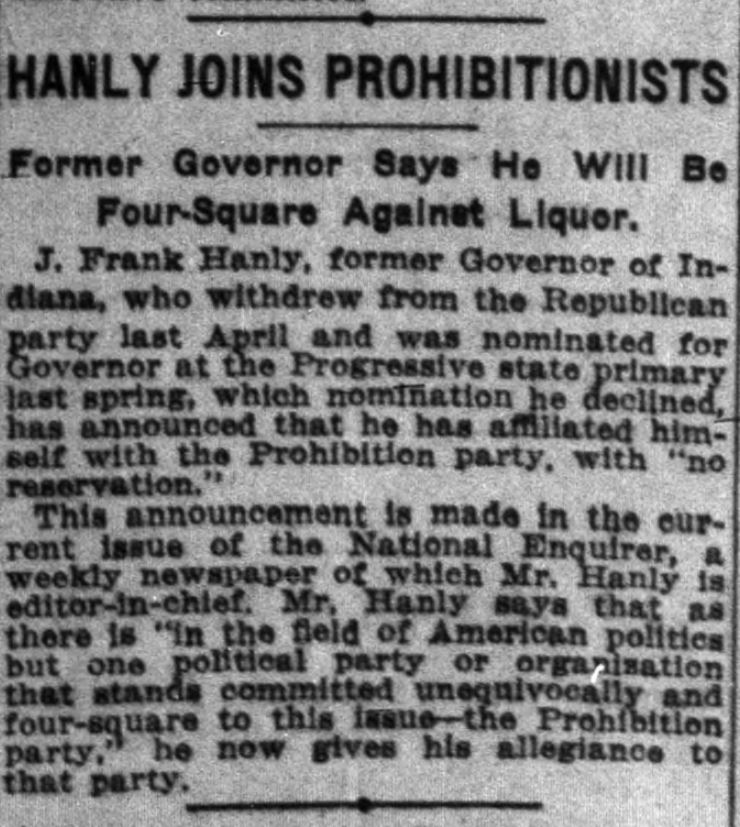
All of his activism proved valuable by the election of 1916. Originally, Hanly received the Progressive Party’s nomination for governor, after he ran unopposed in the March primary. Despite support from the party and the voters, Hanly felt ambivalent about his nomination. As the Indianapolis News reported, Hanly “spent nothing and made no promises when a candidate before the primary for the Progressive nomination as Governor.” The Progressive Party, in some respects, was a poor fit. Even though Hanly alienated himself from mainstream Republican politics due to his strict prohibitionist views, his dedication to fiscal conservatism and limited government did not align with the Progressives. While Hanly internally debated accepting the Progressives’ gubernatorial nomination, another political party began recruiting him for an even higher office.

Indianapolis News, June 15, 1916. Courtesy of Hoosier State Chronicles.
Indianapolis News, June 15, 1916, from Hoosier State Chronicles.

In June 1916, Hanly abandoned the Progressive Party, and declined the nomination for governor. Later that summer, he received the Prohibition Party nomination for President of the United States. The Indianapolis News and the Indianapolis Star reported that Hanly would gladly accept this charge only after the party decided to abandon a plank in their party platform supporting “initiative, referendum, and recall” elections, which Hanly saw as anathema to his limited government views. The party acquiesced to Hanly’s demands, which later drew criticism from an editorial in the Indianapolis Star and later reprinted in the Jasper Weekly Courier.  On the day of his nomination, Hanly reiterated his resolve to the cause of Prohibition and argued that “legislative enactments, administrative action, judicial decision and constitutional amendment—all shall be used for its [alcohol’s] dethronement.” In eight short years, Hanly went from Republican, to reluctant Progressive, to ardent Prohibitionist.

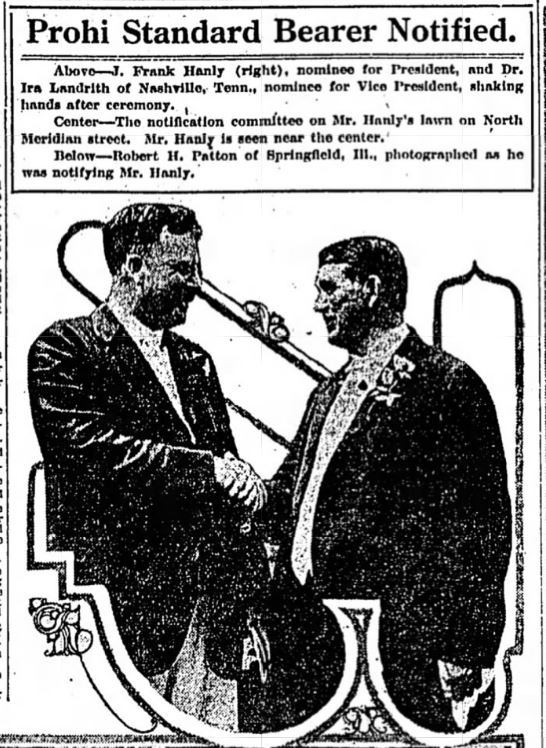
Dr. Ira Landrith (Left) and J. Frank Hanly (Right) shaking hands at their nomination ceremony for the Vice-Presidential and Presidential nominations for the Prohibition Party, respectively. Source: Indianapolis Star, August 9, 1916.

His disassociation with the Republican Party led to a fairly embarrassing episode reported in the August 15 issue of the Indianapolis News. The paper wrote that, “state officials are wondering how a picture of J. Frank Hanly got on the wall in [Ed] Donnell’s office [at the state printing board’s office]. Mr. Hanly, former Governor of Indiana, is now the nominee for President on the Prohibition national ticket.” A little over a week later, on August 28, the portrait disappeared. When asked how it left, Donnell “referred questioners to [J. Roy] Strickland, who disclaimed all knowledge of any theft, other than to declare that he understood the picture had been confiscated by the Democratic state committee.” The installation and later removal of the painting remains a mystery, but this story exemplified one conclusion that many political observers were making about the Prohibition Party candidate: the major parties were done with him too.

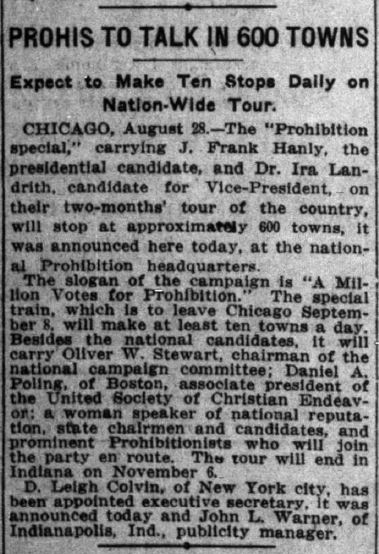
Indianapolis News, August 28, 1916. Courtesy of Hoosier State Chronicles.
Indianapolis News, August 28, 1916, from Hoosier State Chronicles.

Hanly’s presidential campaign began later that August with an announcement from Hanly and his Vice-Presidential running mate, Dr. Ira Landrith, that they would conduct a “two-months’ tour of the country, will stop at approximately 600 towns.” The slogan for their campaign was “A Million Votes for Prohibition.” As part of the Prohibition Party’s push for a million votes, Hanly heavily criticized the major party candidates, Republican Charles Evans Hughes and incumbent Democratic President Woodrow Wilson. On the issue of prohibition, Hanly said that “President Wilson has not changed his mind on the liquor question, not in the last six years, at least, but we know that during these six years he has changed his mind on every other question which has come before him.” Of Hughes, Hanly remarked that the Republican nominee “stands for nothing.” By supposed contrast, Hanly and Landrith stood for women’s suffrage, an eight-hour work day, environmental protections, and military preparedness in line with the Monroe Doctrine alongside its desire to end the liquor trade.

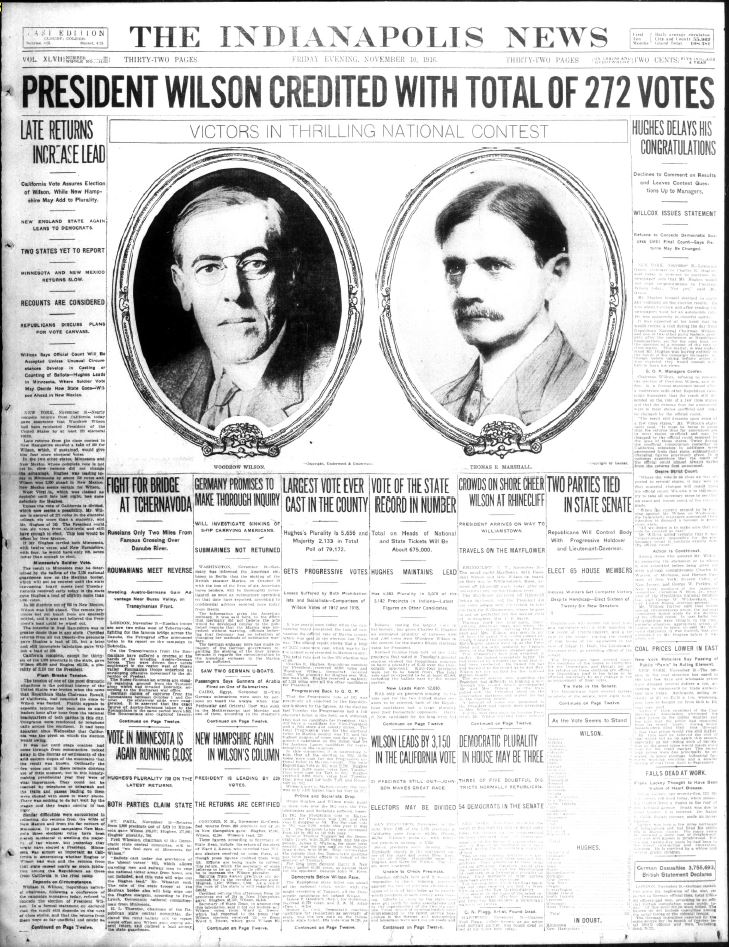
Indianapolis News, November 10, 1916, Courtesy of Hoosier State Chronicles.
Indianapolis News, November 10, 1916, from Hoosier State Chronicles.

By November 1916, the Prohibition Party appeared confident in their chances for some electoral success. The Indianapolis News covered their claims of success at a rally in Auburn, Indiana. “Ira Landrith, the vice-presidential candidate,” the News reported, “declared there now are 167 electoral votes in “dry” states; that next year there will be 200, and in 1930 there will be 300.” Their optimism was misplaced, for the election returns told a different story. Hanly and Landrith only captured 221,302 votes, or only 1.19 percent of the popular vote. They neither secured the one million votes they campaigned on, nor picked up a single electoral vote. Wilson won the election with 277 electoral votes and 49.25 percent of the popular vote. The Indianapolis News highlighted that the level of the vote for the Prohibition Party had dropped in Marion County alone by nearly 500 votes, from 1241 to 744, and throughout the State of Indiana, Hanly only garnered 16,680.

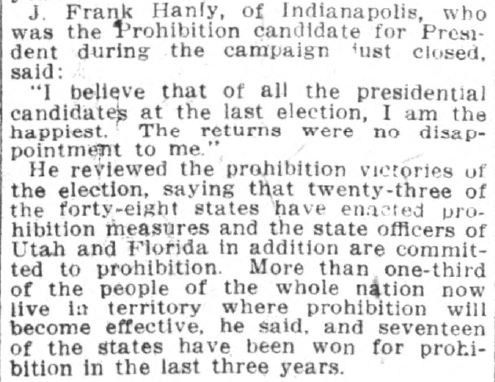
Indianapolis News, November 20, 1916. Courtesy of Hoosier State Chronicles.
Indianapolis News, November 20, 1916, from Hoosier State Chronicles.

Of the returns, Hanly was delighted despite his small showing at the polls.  He stated, “I believe that of all the presidential candidates at the last election, I am the happiest. The returns were no disappointment to me.” Despite the Prohibition Party’s electoral loss, the prohibition movement made great strides after the election. The News wrote“More than one-third of the people of the whole nation now live in territory where prohibition will be effective.” After the election Hanly remained an active prohibition proponent.  He played a key role in lobbying for the state-wide prohibition of alcohol by 1918, two years before the 18th Amendment to the U.S. Constitution mandated prohibition across the United States. Hanly celebrated its implementation by introducing National Dry Federation President William Jennings Bryan at a meeting in Indianapolis.

Indianapolis News, August 2, 1920. Courtesy of Hoosier State Chronicles.
Indianapolis News, August 2, 1920, from Hoosier State Chronicles.

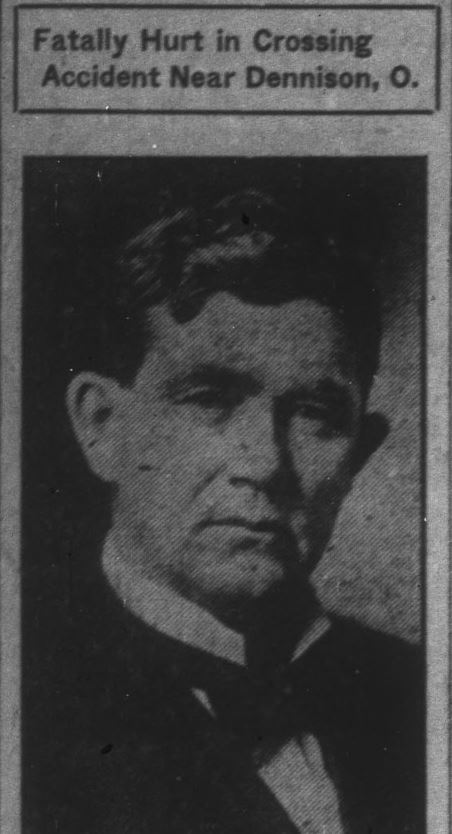
Hanly’s lifelong efforts advocating for prohibition came to an end with his untimely death on August 1, 1920, at the age of 57. He had been “fatally injured in an automobile accident near Dennison [Ohio],” reported the Indianapolis News. His funeral was held at Meridian Street Methodist Episcopal Church and he was buried in Williamsport, Indiana. In a eulogy by Indianapolis Phalanx publisher Edward Clark, Hanly was hailed as a “a national leader in the greatest moral and political reform of the century.” Clark concluded, “[Hanly] has ended life’s combat and laid down the weapons he wielded so heroically and so valiantly.”

Historian Jan Shipps argued that the choices Hanly made during his political career may have been pure opportunism, the mark of a true believer, or somewhere in the middle. The last argument seems to be the most accurate, because Hanly appeared to be a bit of both, at least in the press. He was an astute, masterful politician who used the workings of power to achieve his own prerogatives. At the same time, he was a deeply religious man whose moral judgement animated him to act as a crusader against alcohol. As Edward Clark’s eulogy intimated, Hanly knew that “to announce himself as a party prohibitionist meant unpopularity, scorn, ridicule, abuse, and political oblivion—but he hesitated not.” While he never saw the effects of Prohibition, both good and bad, in his state or in the country, Hanly’s contributions to the movement should not be neglected in our understanding of the era.

Death Through the (P)ages: Funeral Homes in Indiana

Muncie Funeral Parlor, 1910s. Indiana Memory.
During the month of Halloween, it seemed fitting to do a blog about the history of funeral parlors and funeral homes in Indiana. The funeral parlor, or funeral home, became a mainstay of American life in the late nineteenth century and into the early twentieth century. Before that, most American families held a wake (now called a “viewing”) in their home, in a room often named the parlor. Then, they were either buried on the family homestead or in the cemetery by their church. The Civil War changed that; massive numbers of dead soldiers from across the country prompted new funerary practices, such as embalming and preserving for long trips. After the war, industrialization, urbanization, and the rise of the middle class facilitated further modernization of funerals. It was here that the funeral parlor, or funeral home, became the norm. In this blog, we will share with you how the funeral homes of Indiana’s past often advertised themselves in newspapers and how they developed into the modern, standardized industry that they are today.

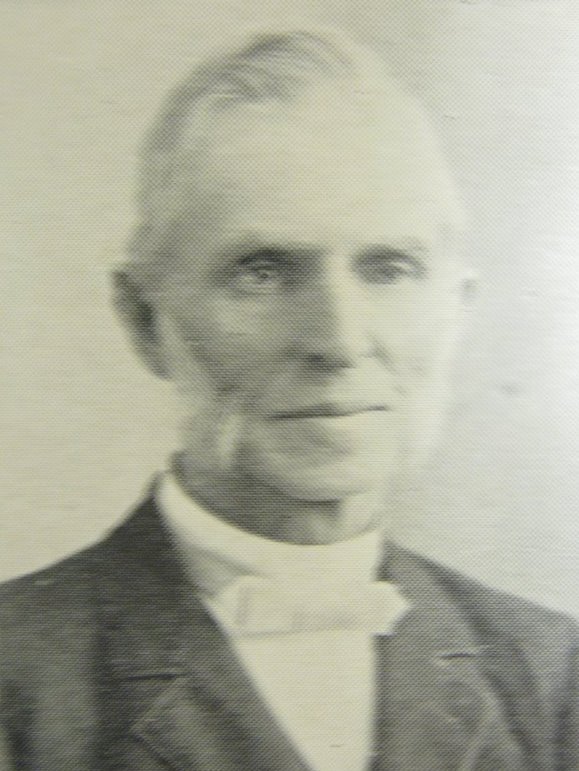
Isaac Ball, the co-founder and first president of the Indiana Funeral Directors Association. Find a Grave.
Terre Haute Saturday Evening Mail, May 21, 1881. Hoosier State Chronicles.

The modern Indiana funeral industry began in the 1880s, with the establishment of the Indiana Funeral Directors Association (IFDA). It was founded in 1880-81 by a group of undertakers led by funeral pioneer Isaac Ball. Ball and company wanted to modernize and standardize their practices, making it less macabre and more inviting to the public. One of the first steps that they took was a name change. No longer would leaders within the industry refer to themselves as “undertakers;” the preferred term under the IFDA was “funeral director,” hence the organization’s name. In fact, the Bloomington Progress even published as much in their June 1, 1881 issue: “An undertaker will hereafter be known as a ‘funeral director,’ at least that is the name the State organization has assumed.” Ball served as the IFDA’s first president at their first annual convention in Indianapolis. The Terre Haute Saturday Evening Mail published a short mention of the conference in their May 21 1881 issue, ironically noting that “It was an odd coincidence that the State Medical Association was in session at the capital at the same time.”

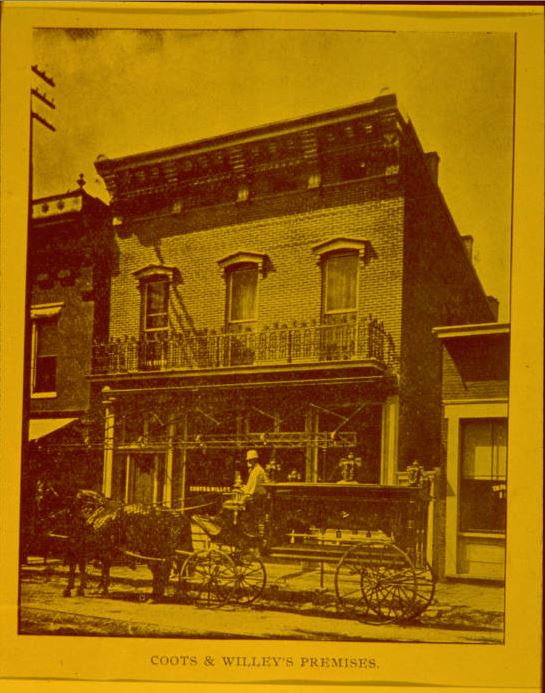
Coots and Willey’s Funeral Parlor, Jeffersonville, Indiana, 1897. Indiana Memory.
While “funeral director” became the accepted industry term, it took a few years for funeral homes around the state to use the term. Some of the earliest uses of “funeral director” found in Hoosier State Chronicles are in the Indianapolis News. Its April 21, 1899 issue printed a funeral director section on its classified page; similar funeral director sections from the classified pages can be found in 1916 and 1918, respectively. Individual funeral directors, such as Indianapolis’s Frank W. Flanner & Charles J. Buchanan, adopted the term as early as 1888.

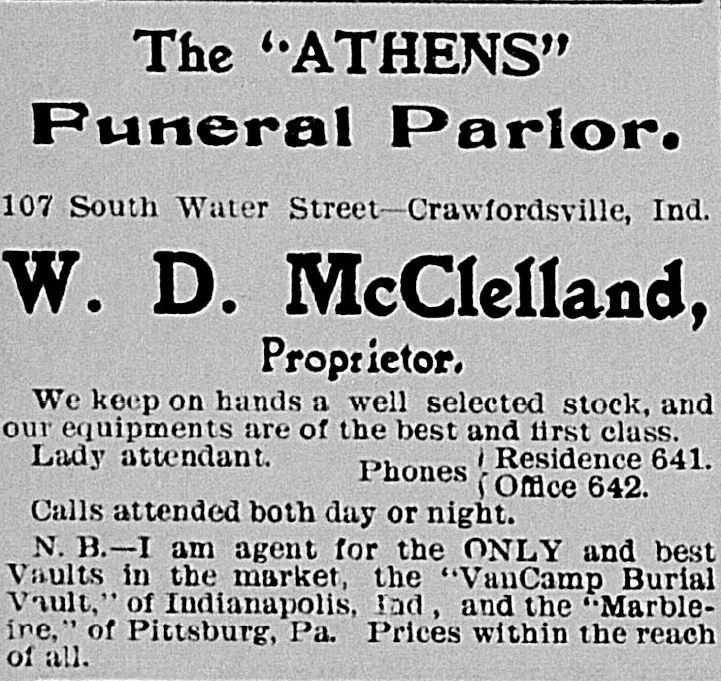
Crawfordsville Weekly Journal , June 14 1901. Hoosier State Chronicles.

These examples are the general listings for funeral homes and funeral directors; there are also many newspaper advertisements that document the change in funeral homes over time. One of the earliest paid ads found in Hoosier State Chronicles was for the Athens Funeral Parlor, run by William D. McClelland in Crawfordsville, Indiana, in 1901. McClelland fully purchased the business in June of 1901 and published a formal announcement in the June 7 issue of the Crawfordsville Journal:

Having purchased the Interest of my partner, W. W. McCann, in the undertaking business, situated on south Water street, (Thomas block) I submit my services to the public of this city and county, competent in the business and profession which each and every family have to support sooner or later. My equipments [sic] are of the best, and stock first class, and at reasonable prices, and each one will be treated with only kindness and respect. Death comes to all and the great responsibility of the care is taken from the family in this sad and distressful hour. Hoping that you may feel when you place your confidence in me that it will be for carried out to the letter,

I Remain Your Friend

W. D. MCCLELLAND.

Crawfordsville Weekly Journal, May 2, 1902. Hoosier State Chronicles.

Another ad ran in a 1902 issue of the Crawfordsville Journal. The later ad provided more details on the staff of the funeral parlor. Alongside McClelland’s title as “proprietor” and “licensed embalmer.” He also employed a “lady assistant” (to prepare the bodies of deceased women and girls) and a business assistant named James H. Robbins.

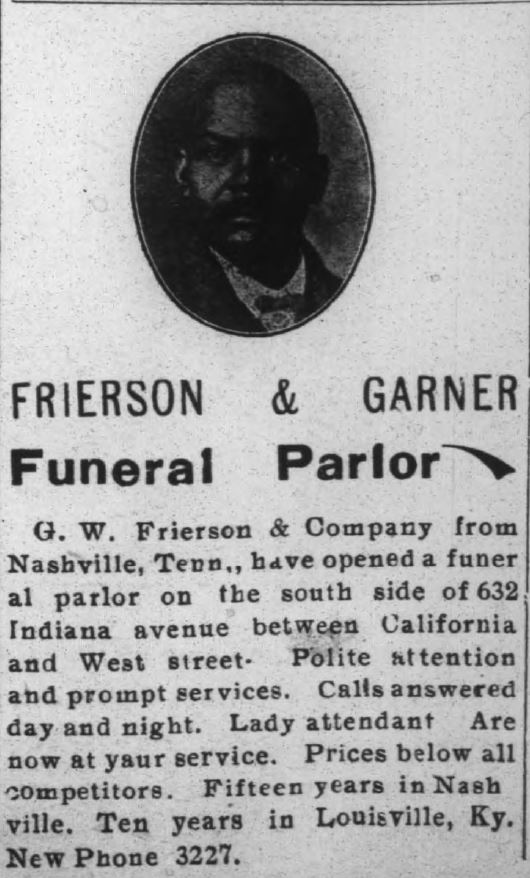
Indianapolis Recorder, January 12, 1907. Hoosier State Chronicles.
Indianapolis Recorder, February 9, 1907. Hoosier State Chronicles.
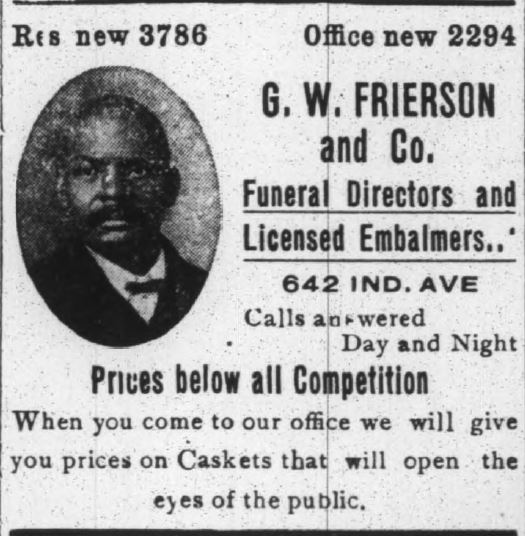
Indianapolis Recorder, July 11, 1914. Hoosier State Chronicles.

One demographic well documented in Hoosier State Chronicles, in regards to funeral homes and directors, is the African American community. George W. Frierson, originally from Nashville, Tennessee and then Louisville, Kentucky, established a funeral parlor at 632 Indiana Avenue (near the Walker Theatre) in 1907. The first published ad for Frierson’s funeral parlor ran in the January 12, 1907 issue of the Indianapolis Recorder. About a month later, a new ad ran in the Recorder confirming that Frierson partnered with James B. Garner, an embalmer. Frierson served as the “proprietor” and Garner as the “manager.” Like McClelland back in Crawfordsville, they also had a “lady attendant.” Frierson maintained his funeral parlor until at least 1914, at which point it was located at 642 Indiana Avenue.

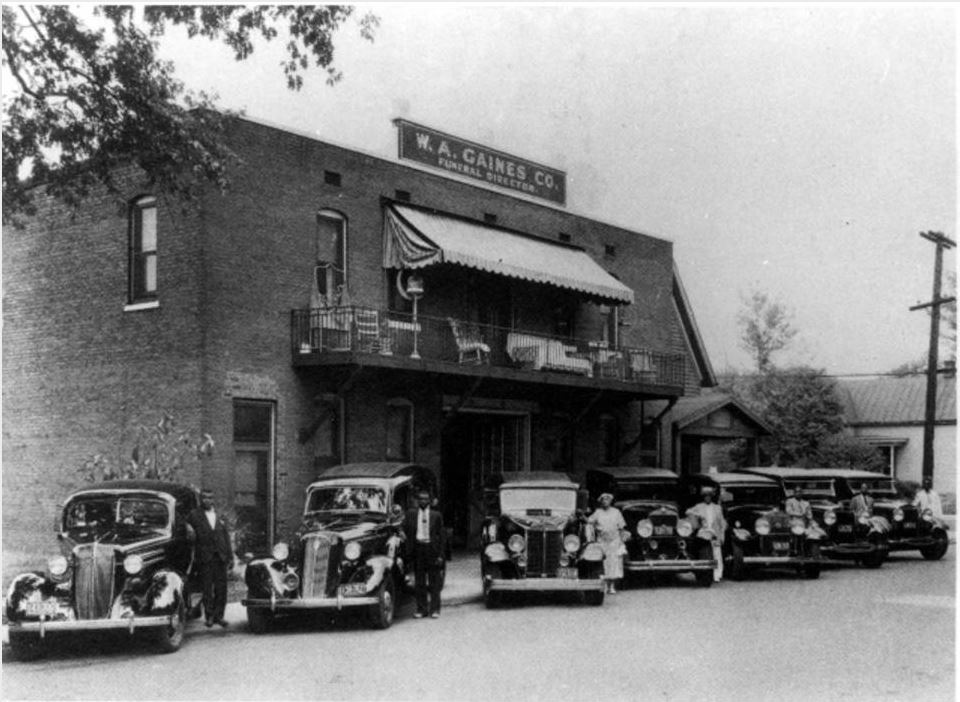
W. A. Gaines Funeral Home, Evansville, Indiana, 1920. Indiana Memory.
Portrait of W. A. Gaines, 1920. Indiana Memory.
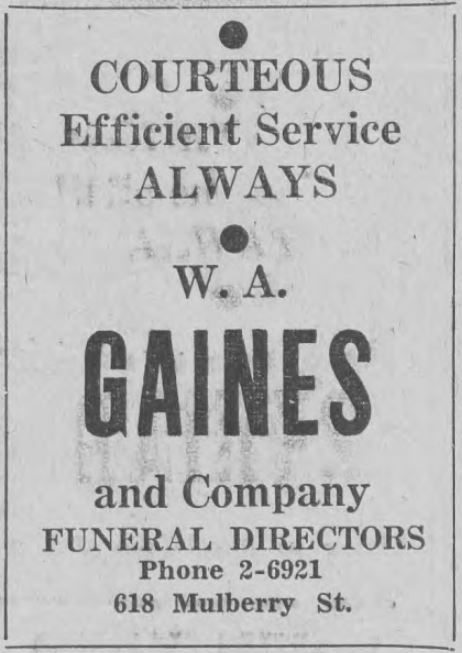
Evansville Argus, September 26, 1942. Hoosier State Chronicles.

Another key African American funeral parlor owner was Wallace A. Gaines of Evansville. Gaines founded the W. A. Gaines Company in 1918 with wife Tillie Y. Gaines and Rudolph D. O’Hara and $5,000 in initial capital, according to the Indianapolis News. It ran ads in Evansville newspapers for decades, with the particular ad in the September 10, 1938 issue of the Argus being an example. Gaines died in 1940, but his funeral home operated until at least 1989, when the last mention of its operation was made in the Indianapolis Recorder. It was then run by Michael J. Bluitt, who owned the funeral home and served as one of IFDA’s presidents.

Richmond Palladium, October 26, 1914. Hoosier State Chronicles.

While funeral parlor ads generally represented newspaper coverage, pithy anecdotes also made the cut. An interesting story out of Chicago and published in the Richmond Palladium noted that “Eighty women, playing cards for a prize, adjourned their game to an undertaking room and continued playing . . . with several coffins . . . .” The ladies moved to the funeral parlor “after the police had broken up their game at the home of Mrs. Clara Dermot.” It is unclear whether or not the coffins were occupied.

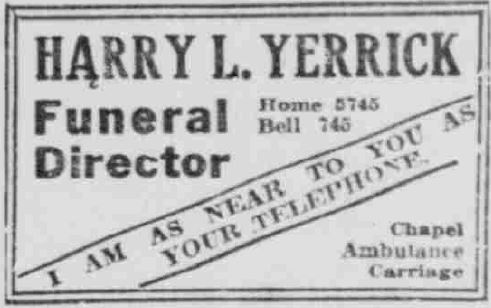
South Bend News-Times, January 26, 1915. Hoosier State Chronicles.

Up in the north, the city of South Bend maintained a few funeral parlors in the early 20th century. Harry L. Yerrick ran a funeral business in the 1910s in South Bend, as sort of a jack-of-all-trades with funerals. In a 1915 ad in the South Bend News-Times, Yerrick declared that “I am as near to you as your telephone” and cited multiple services, including a chapel, an ambulance, and a carriage. Yerrick died in 1920 and Clem C. Whiteman and Forest G. Hay took over the business. Whiteman owned a wholesale grocery company and Hay was the partner given “active charge of the business for the present.” In September of 1920, James H. McGann joined the business as their “licensed embalmer”, holding “one of the highest grades in the state” for his profession. Over the decades, McGann eventually created his own funeral home business while Hay’s also flourished. In 2005, after multiple generations of their respective businesses, they merged to form the McGann-Hay Company. The funeral home is now based in Granger, Indiana. What started as one guy’s profession became a decades-long, family-run business that still operates today.

Casket With the Body of a Young Woman named Clara, Spiceland, Indiana, 1900s. Indiana Memory.
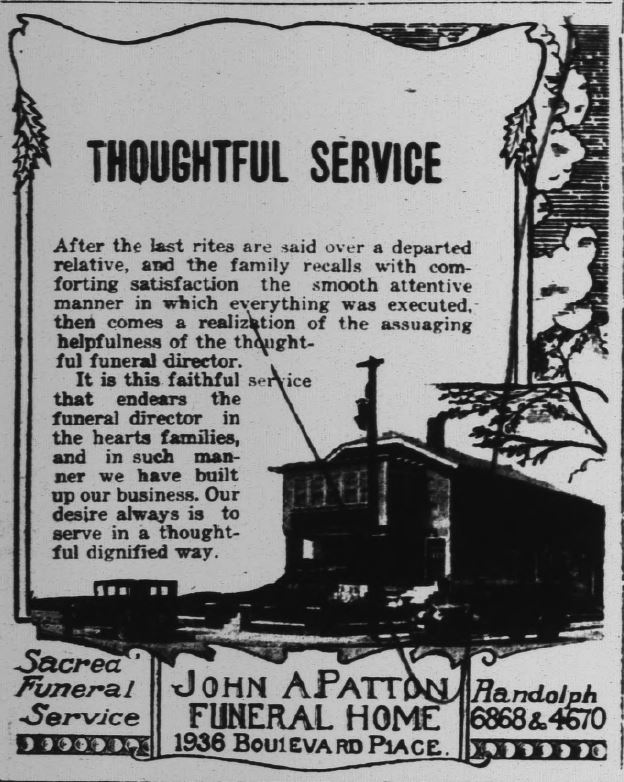
By the late 1920s, newspapers published more elaborate, detailed funeral home ads to share the services they offered. John A. Patton’s Funeral Home on Boulevard Place ran an ad describing its “thoughtful service” in the February 12, 1927 issue of the Indianapolis Recorder. The ad declared:

After the last rites are said over a departed relative, and the family recalls with comforting satisfaction the smooth attentive manner in which everything was executed, then comes a realization of the assuaging helpfulness of the thoughtful funeral director.

It is this faithful service that endears the funeral director in the hearts [of] families and in such manner we have built up our business. Our desire always is to serve in a thoughtful dignified way.

Indianapolis Recorder, February 12, 1927. Hoosier State Chronicles.

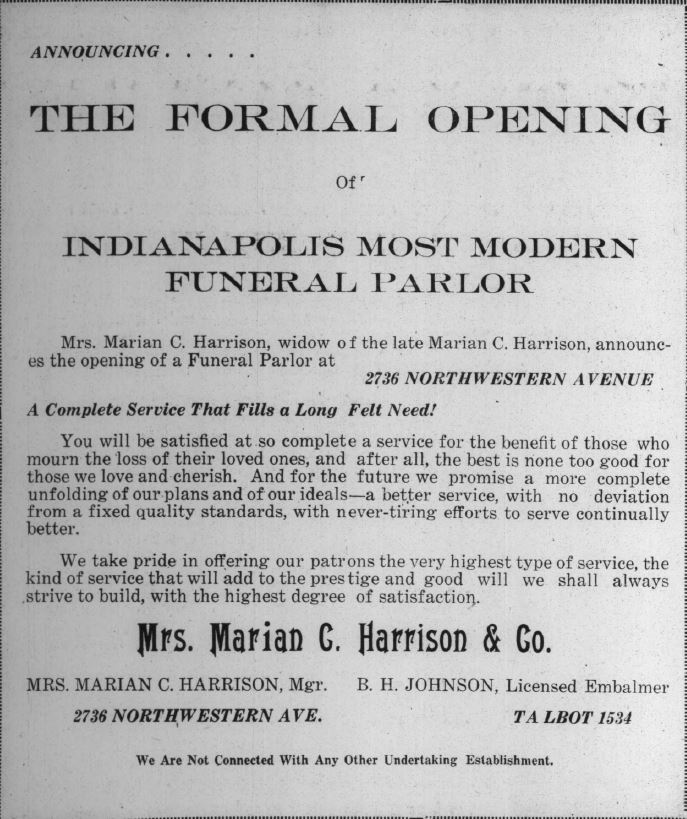
The texts reads like a service itself, with keen attention paid to the grieving families and an emphasis on dignity and thoughtfulness. This wasn’t the only ad from the period like this. When Nannie Harrison reopened her late husband’s funeral parlor in 1929, she published a nearly half-page ad in the Recorder. Pitching it as the “most modern funeral parlor,” Harrison’s ad proclaimed that families “will be satisfied at so complete a service for the benefit of those who mourn the loss of their loved ones . . . .”

Knightstown Buggy Company Catalog, 1920s. Indiana Memory.
Indianapolis Recorder, January 19, 1929. Hoosier State Chronicles.

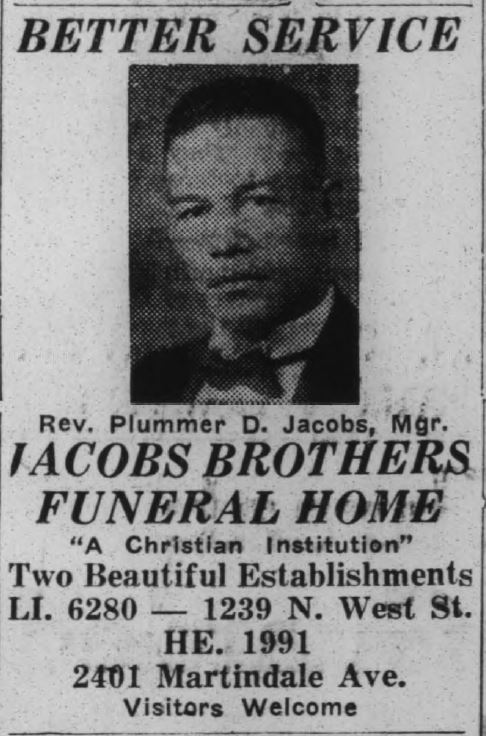
This trend continued into the 1930s. The Willis Mortuary in Indianapolis published an ad in a 1936 issue of the Recorder that called it their “honor to serve you in your hour of bereavement” and “endeavor[ed] to live up to your greatest expectations.” Nearly a decade after the illustrious grand reopening of the Harrison funeral parlor, brothers Plummer and Carey Jacobs opened up their Indianapolis Funeral Home on October 30, 1938. Two days before, they took out a whole-page ad in the Recorder to inform the public of their formal opening, including a full program of events and photographs of their new facilities. A few days later, the Recorder ran an unsolicited article about the Jacobs Brothers Funeral Home grand opening. “Marking another milestone in the increasingly brilliant parade of business activities among colored persons,” the Recorder reported, “thousands of persons swarms the new eastside funeral home of Jacobs Brothers in an unbroken stream Sunday.” They further added that the “general comment is that this is finest funeral home in the city for our people.” The Jacobs brothers had joined a long, historic line of groundbreaking, African-American funeral directors in Indianapolis.

Indianapolis Recorder, October 29, 1938. Hoosier State Chronicles.
Indianapolis Recorder, November 5, 1938. Hoosier State Chronicles.

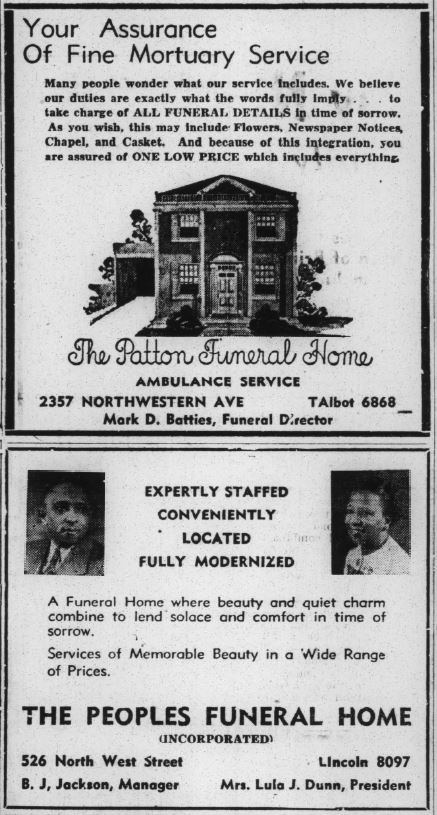
As the 1940s went along, not only did funeral home ads get more detailed, but the funeral home section did as well. A 1949 issue in the Indianapolis Recorder dedicated an entire newspaper column to fully detailed and illustrated funeral home ads, for such businesses as the Willis Mortuary, King & King Funeral Home, and the aforementioned Jacobs brothers. However, some papers, like the Sullivan Daily Times, stuck to a more simple approach to funeral homes, with one, non-detailed ad for the McHugh funeral home and a smaller ad for M. J. Aikin & Son.

Indianapolis Recorder, November 26, 1949. Hoosier State Chronicles.

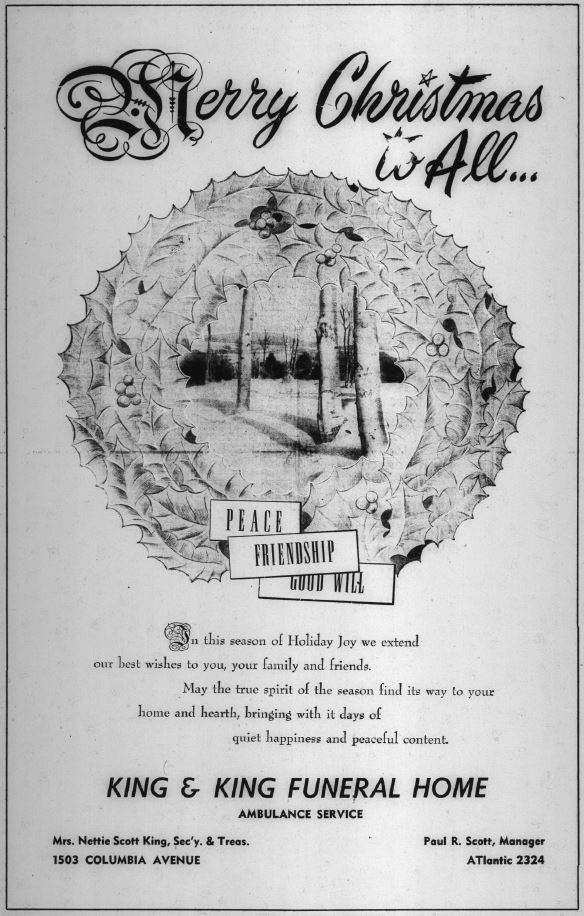
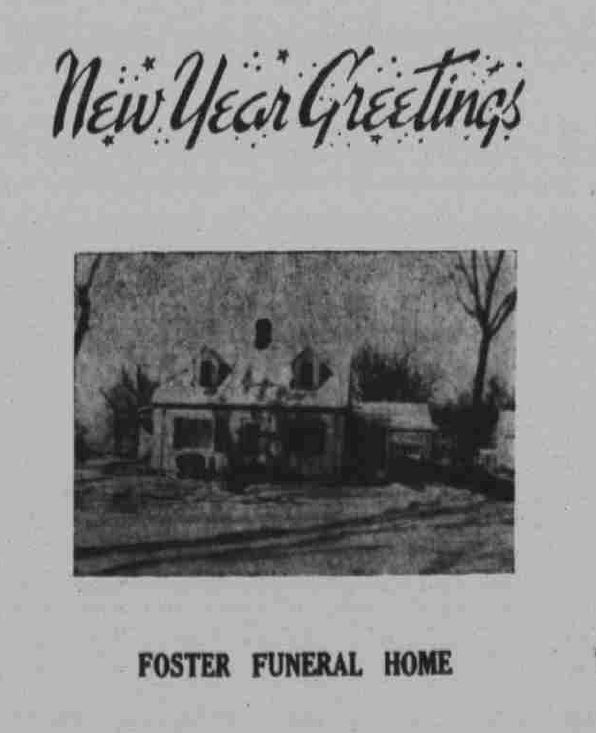
Speaking of the King & King funeral home, one of their more unique ads ran in the winter of 1951. King & King released a full-page ad on December 22 wishing the community a Merry Christmas. It came with a holiday message, much akin to a greeting card, and advertised the funeral home at the bottom, emphasizing their “Ambulance Service.” Now, if this strikes the reader as odd, other funeral homes engaged in this practice. As an example, a December 1963 ad in the Wolcott Beacon from the Foster Funeral Home wished readers a happy new year. They didn’t, however, advertise their ambulance service.

Indianapolis Recorder, December 22, 1951. Hoosier State Chronicles.
Wolcott Beacon, December 26, 1963. Hoosier State Chronicles.

The 1960s brought further experimentation to funeral home ads in newspapers. A rather clever ad in the Greencastle Daily Banner displayed the Whitaker Funeral home, who used their ad space to share with readers a short fable. “Experience is a bad teacher,” the story declared in its final line, “she gives the test first; the lesson afterwards.” Using ad space to share an amusing homily while advertising a funeral business appears inappropriate, but it actually elicits from readers a humble, personal connection that personifies the best in advertising.

Greencastle Daily Banner. February 19, 1968. Hoosier State Chronicles.
J. A. DeMoney & Son Funeral Parlor, Columbia City, Indiana, circa 1960. Indiana Memory.
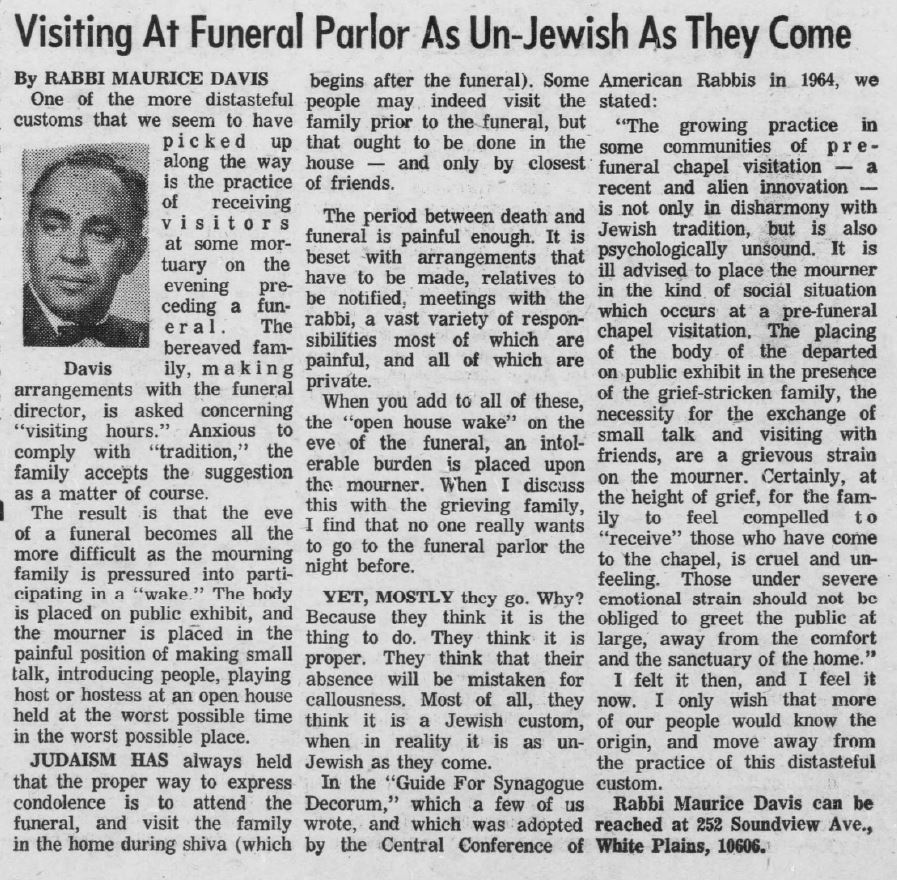
Ads and business articles about funeral homes comprise the majority of coverage in newspapers, but occasional editorials surfaced as well. In the April 21, 1972 issue of the Jewish Post, Rabbi Maurice Davis wrote a heavily critical editorial concerning a funeral practice, not of the directors, but of the visitors. Entitled, “Visiting at Funeral Parlor as Un-Jewish as They Come,” Rabbi Davis lambasted the practice of a “wake” the night before a funeral, arguing that the “pre-funeral chapel visitation” goes against Jewish traditions of shiva (meeting with the family at their home after the funeral) and violates the mourners’ rights to privacy. “I only wish,” Rabbi Davis wrote, “that more of our people would know the origin, and move away from the practice of this distasteful custom.” The wake has continued to be a common practice at funerals since Davis’s time, but his editorial educates readers on traditional Jewish funeral practices.

Jewish Post, April 21, 1972. Hoosier State Chronicles.

Circling back to advertising, funeral homes often used their newspaper space to celebrate their anniversary as a business. The Hopkins Funeral Home put out an ad in the Greencastle Banner Graphic in 1973 celebrating their 20th anniversary. “We are proud of the reputation for dependability that we have in servicing Putnam County for 20 years. Feel confident in turning to us in your hour of need,” the full-page ad lauded.

Greencastle Banner Graphic, December 13, 1973. Hoosier State Chronicles.

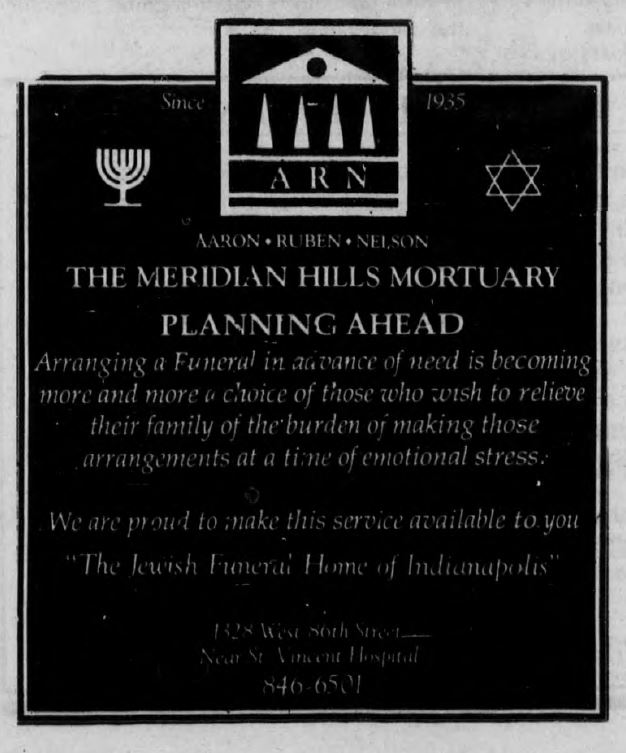
Ads from the 1980s and 90s highlighted the benefits of pre-arranging funerals, an expanding practice during the last 30 years. Summers Funeral Chapels published an ad in the Indianapolis Recorder in 1989 selling the benefits of pre-arranged funerals, noting that “making arrangements ahead of time has become the smart thing to do.” The Meridian Hills Mortuary sent out an ad in a 1994 issue of the Jewish Post that also advocated for pre-arranged funerals. “Arranging a Funeral in advance of need is becoming more and more a choice of those who wish to relieve their family of the burden of making those arrangements at a time of emotional stress,” the ad stressed. This trend continued into the 2000s as well, with the Stuart Mortuary and the Washington Park North Cemetery and Funeral Center urging patrons to consider a pre-arranged funeral plan.

Indianapolis Recorder, January 14, 1989. Hoosier State Chronicles.
Jewish Post, February 9, 1994. Hoosier State Chronicles.

For over 120 years, funeral homes and funeral directors have gone from a small, burgeoning family enterprise to big business. Nevertheless, the focus on dignity, customer service, and the importance of family continued in the pages of newspaper ads. Whether it was Isaac Ball and the IFDA re-configuring an industry or modern funeral homes pitching pre-arranged funeral plans, the emphasis on being a caretaker for the bereaved has never wavered. Death is a sore topic of discussion; people fear it and often ignore it altogether. Yet, it’s as much as a part of life as a birth, a graduation, or a wedding. It also helps us understand how we live, as a culture. Funerals changed as America, and Indiana, changed; they evolved from mostly rural and familial affairs into urban and professionalized practices. In sharing this history, as it unfolds in the pages of newspapers, we understand a crucial part of Hoosier life over the last century.

Wheels of Corruption: Bicycles, Billy Blodgett, and the Allen Manufacturing Company

An "outing bicycle." Indiana Historical Society.
Hay & Willit’s Outing Bicycle, 1896, Indiana Historical Society.

During his long and storied career, Indianapolis-based investigative journalist William H. “Billy” Blodgett exhibited a penchant for exposing local corruption and unlawful business practices. One not entirely aboveboard business in particular caught his attention in the 1890s.

"Bicycling Etiquette," Indianapolis News, August 18, 1894, Hoosier State Chronicles.
“Bicycling Etiquette,” Indianapolis News, August 18, 1894, Hoosier State Chronicles.

During the Gilded Age, bicycles became a national phenomenon. With ever-changing designs and the lowering of costs, bicycles spurred social clubs, faced religious blow back, and even influenced clothing trends. As such, the need for bicycles exploded, with hundreds of different companies competing for their share of the marketplace. There were dozens of companies in Indiana alone.

Of these companies, the Allen Manufacturing Company garnered moderate success but attracted controversy. Founded in 1894 and later incorporated in 1895 by David F. Allen, David A. Coulter, James Murdock, and William B. Hutchinson, Allen Manufacturing maintained a peculiar corporate structure and political affiliation with the Democratic party. In some respects, you could have called the company a “Government-Sponsored Enterprise,” wherein the products made were sold in the marketplace but the labor and capital costs were funneled through government institutions. This is especially true of its labor force, comprised exclusively of prisoners from the State prison north in Michigan City. As reported by the Indianapolis News, “the convicts who work in the factory are to be paid 42 cents a day. Mr. French [the prison’s warden] says that 150 men will be employed in the factory.”

James Murdock, one of the founders of the Allen Manufacturing Company. Biographical Record and Portrait Album of Tippecanoe County, Indiana, Google Books.

Before Blodgett’s investigative reporting on the company, the Indianapolis Journal published a pointed critique of Allen Manufacturing’s labor force. The piece referred to the venture as a “blow to honest labor” and argued that the lack of skilled bicycle makers will “glut the market with cheap wheels.” The article emphasized this point in a further passage:

At the price paid [for labor] the company will have a great advantage over the manufacturers of Indiana, and their employees will, of course, share in the loss by reason, if not through cheapened wages, then of less opportunity for work. The new venture is not likely to decrease their hostility to the prison labor system and the Democratic party of Indiana.

Indianapolis Journal, October 29, 1894, Hoosier State Chronicles.

Another piece in the Indianapolis News, possibly written by Blodgett, also criticized the company’s deep ties to political operatives, and in particular, founder David F. Allen. Allen was serving on the State Board of Tax Commissioners when the company was founded (but not incorporated), and if he didn’t leave the Board, he would be violating section 2,049 of the Indiana legal code. In other words, Allen and his business partners kept the public existence of the company private for nearly a year, incorporating on March 14, 1895, so as to avoid potential conflicts of interest.

Public record of Allen Manufacturing's labor agreement with Indiana prison north, Google Books.
Public record of Allen Manufacturing’s labor agreement with Indiana prison north, Google Books.

While Allen Manufacturing was still an unincorporated entity, it struck a deal with the Indiana prison north in October 1894 to employ 150 prisoners at forty cents a day (lower than forty-two cents, as mentioned in the papers) for the next five years. The agreement was then amended in 1896 to remove twenty-five workers from the contract for another project. Again, this is a private consortium of well-connected political operatives setting up a business to take advantage of the state’s prison labor system .

At least the prisoners made a quality product. While I couldn’t find photographs of the bicycles, they were apparently made well enough to appear in a state-wide bicycle exhibition on January 28, 1896 at the Indianapolis Y.M.C.A. According to the Indianapolis Journal, the Allen Manufacturing Company displayed its bicycles with 14 other firms and the show also displayed artwork by T.C. Steele, among others. Allen Manufacturing also acquired the Meteor Bicycle Company, a nationally recognized firm located in Grand Rapids, Michigan, and began manufacturing bikes under the name from 1896 to 1898. While the public face of their company seemed bright, its internal workings quickly began to unravel.

Indianapolis Journal, January 25, 1894, Hoosier State Chronicles.

By 1897, Allen Manufacturing’s financial problems began bubbling to the surface. After the release of twenty-five prisoners from their contract at Indiana state prison north, its labor force wasn’t big enough to keep up with an order for 2,000 bicycles wheels. From there, the company ran up debts that were nearly impossible to reverse, taking out a mortgage to offset their losses. As reported by the Indianapolis News:

Edward Hawkins, of this city [Indianapolis], who has been appointed trustee under the mortgage, returned to-day from a meeting of the officers and directors of the company at Michigan City. The company, he says, found itself unable to pay its paper due, and executed a mortgage on the plant for the benefit of the banks that hold the paper.

Even though it paid off $6,500 owed to the state in October of 1897, Allen’s troubles continued. Hawkins was removed as mortgage trustee, more and more creditors were filing claims, and two court-appointed receivers stepped in to try to clean up the mess.

Indianapolis News, October 9, 1897, Hoosier State Chronicles.

This is where Billy Blodgett’s articles began to shed light on the corruption. In January of 1898, Blodgett began a series of hard-hitting exposes in the Indianapolis News against Allen Manufacturing, writing of alleged abuses of state power, graft, and fraud. His first article, published on January 13, 1898, alleged that whole train-cars of bicycles were purchased by individual owners of the company, such as D. F. Allen and D. A. Coulter, and then shuffled around the assets for accounting purposes. Specifically, Allen purchased “$4,000 worth of bicycles,” transferred ownership to his son, and then “applied [the amount] on notes given to the Merchants’ National Bank of Lafayette.” The article also reaffirmed what many had suggested since the company’s founding. Namely, its public incorporation was made after key leaders removed themselves from conflicts of interest yet acted as an incorporated entity when it negotiated its labor contract with the prison.

The headline from Billy Blodgett's first major piece on the company in the Indianapolis News, January 13, 1898, Hoosier State Chronicles.
The headline from Billy Blodgett’s first major piece on the company in the Indianapolis News, January 13, 1898, Hoosier State Chronicles.

The next day, Blodgett published the next installment, writing of the company’s alleged fraud in connection to its stocks. The Chicago firm Morgan & Wright, who purchased the company’s manufacturing plant during its initial financial woes, alleged that Allen Manufacturing had used backdoor loans from the Merchant’s National Bank of Lafayette in order to inflate its asset value. “In other words,” Blodgett wrote, “Morgan & Wright will try to show [in court] that the total amount of money paid for the stock was $300,” rather than the $4,000 or $5,000 the company claimed.

Judge William Biddle, History of LaPorte County, Google Books.
Judge William Biddle, A Twentieth Century History and Biographical Record of LaPorte County, Indiana, Google Books.

Blodgett also reported another fascinating case of company misdirection. On October 15, 1897, LaPorte County Judge William B. Biddle ordered the company to stop selling any products and hand the reins over to receiver Alonzo Nichols. This order was ignored by Henry Schwager, another receiver appointed to the company in Michigan City. Biddle retaliated on November 23, issuing an order against the company at large and reaffirmed his previous decision. What came next is shocking:

. . . Sheriff McCormick went to Michigan City to take possession of the property. When he got there, he found the building of the Allen Manufacturing Company locked up, and he could not get in to make the levy, without using force. He was warned not to do this, so the sheriff and his deputies stood around on the outside of the prison, and as the carloads of property came out they seized them. He found the property at different points, and turned it all over to Nichols as receiver.

In other words, Sheriff N. D. McCormick and his deputies had to wait until the company didn’t think the authorities were looking before they could seize the goods. Even in the face of court orders, the Allen Manufacturing Company still tried to do things its own way, to disastrous results.

Headline for Blodgett's third and final major piece on Allen Manufacturing, January 15, 1898, Hoosier State Chronicles.
Headline for Blodgett’s third and final major piece on Allen Manufacturing, January 15, 1898, Hoosier State Chronicles.

Billy Blodgett’s final big piece on Allen Manufacturing appeared in the Indianapolis News on January 15, 1898. In it, Blodgett tries to track down and interview company big-wigs David Coulter and David Allen. Blodgett wrote of Coulter that, “He is pleasant and affable, courteous and polite, but I might as well have talked to the Sphynx in Egypt, so far as getting any information from him.” Over the course of a short, frosty conversation between Blodgett and Coulter, the businessman declined to speak about any of the charges leveled against him and maintained his innocence. When Blodgett pressed him on some of the specific charges of defrauding investors, his “demeanor demonstrated that the interview was at an end. . . .”

As for Allen, he was unable to interview the man directly but spoke to one of his colleagues. Blodgett chronicled the exchange:

A few weeks ago Mr. Allen met this friend and said to him:

“You remember the evening you asked me to dinner with you in Chicago?”

“Yes, I remember.it distinctly.”

“Well, that failure to take dinner with you has cost me $5,000, and may cost me more.”

The friend understood from this that if Allen had not gone to the meeting at which the company was formed he would have been money ahead. This friend gives it as his opinion that every member of the Allen Manufacturing Company lost from $3,000 to $5,000 each.

In one corner, you have Coulter trying to hold things together and denying changes against him and Allen in the other allegedly remarking on how he and many others lost money. This inconsistency in the press didn’t help to make the public or the company’s shareholders feel any better about the situation.

Indianapolis News, July 12, 1900, Hoosier State Chronicles.

By 1898, the company was defunct in all but name. Bicycles manufactured under the “Meteor” brand ceased and the company’s remains were being settled in numerous court cases. In 1900, a Louisville, Kentucky court ruled that Allen Manufacturing had in fact defrauded Morgan & Wright out of at least one payment for a shipment of product. Another lawsuit, clearing Sherriff Nathan McCormick of any wrongdoing against court-appointed receivers, was settled in 1901 in U.S. Court and upheld in the U.S. Seventh Circuit Court of Appeals in 1902.

Indianapolis News, September 14, 1901, Hoosier State Chronicles.

Blodgett did write a follow up article in 1901, noting that Indiana state prison north Warden Shideler resigned over allegations that he was a stockholder in the company at the time he was serving as Warden. It also indicated that labor contract developed by Allen, Coulter and others in 1894 was binding until 1904, with other companies stepping in to fill the void left by the demise of the Allen Manufacturing Company. Newspaper evidence suggests that Allen, Coulter, and many of the other big players never faced serious charges and that the company’s multiple lawsuits distracted from the other allegations leveled against them. Allen himself would eventually pursue other political offices, including Indiana Secretary of State, as well as serve in the Spanish-American War. He died in 1911, with the failure of his company firmly behind him.

Memorial plaque at David F. Allen's grave, Frankfort, Indiana, FindAGrave.com.
Memorial plaque at David F. Allen’s grave, Frankfort, Indiana, FindAGrave.com.

So what do we make of the Allen Manufacturing Company? In some ways, you can look at it as a quasi-private, quasi-public boondoggle, destined to fail. In other ways, you can look at it as a company created to enrich its leadership by taking advantage of sub-contracted labor. However, these may be the symptoms of a larger malady. The major take-away from this episode was that a rapidly changing industrial economy and a national fad in bicycles spurred a slapdash attempt to create a company that benefited from public connections. Furthermore, the episode highlights how determined and detailed journalism helps to keep the public and private sectors of society accountable, both to citizens and shareholders. While some of the key players never faced accountability, Blodgett’s success in investigating Allen Manufacturing’s corruption nevertheless exemplified how an individual citizen, and a free press, can check some of our more abject motivations.

From “Gay Knights” to Celebration on the Circle: A History of Pride in Indianapolis

The New Works (August 1990): 15, accessed Chris Gonzalez GLBT Archives.

* A note on terminology: We recognize that terminology referring to this marginalized community will continue to evolve. We have chosen to use “LGBTQ+” and “queer” after consulting with Indy Pride board members, historians specializing in the field, and new scholarship. We are cognizant that the community is not monolithic and that some individuals may not identify with these terms. It is also important to note that the mainstream civil rights movement excluded people of color, those living in poverty, and transgender individuals. 

The fabric of America has always been comprised of LGBTQ+ individuals, but due to social stigmas, legal discrimination, and the perpetuation of violence, many of these individuals lived quietly. While the 1969 Stonewall Uprising in New York City proved to be a watershed moment in the national fight for equality, those in the conservative state of Indiana continued to socialize privately, for the most part. In 1976, the first “Gay Pride Week” was held in Indianapolis, hosted by the Metropolitan Community Church (MCC) and the Gay Peoples Union. Rather than celebrate publicly, attendees were invited to attend a picnic at Sugar Creek Park, donate blood at MCC, participate in a “Youth Kamp Disco,” and attend workshops entitled “Do I Tell My Parents?,” “Christian and Gay,” “Lifestyles in the ‘70s,” and “Gays and Government.” MCC pastor Rev. James Hill said the purpose of the week was “to make society aware of our presence and as a self-affirming thing for gay people as well—affirming they have the right to be.’”

Program, 4th Annual Gay Pride Week Brunch, June 24, 1984, Jeffrey L. Huntington Collection, L198, accessed Indiana State Library Digital Collections.

According to an article The Works, when Pride plans failed to materialize in 1980, activists gathered at the Ramada Inn and formed a Pride Week Committee, which sponsored the 1981 Pride Week Brunch at Essex Hotel House. The Indianapolis Star noted in 1982 that celebrations continued in an insular manner, writing that individuals celebrated “Indiana style—without marches or noisy rallies.” Instead, they raised funds for various causes, donated food to the needy, and “tried quietly to let others know they are here.” Celebrants in 1984 continued the tradition of picnics, in addition to raising funds for AIDS research. The summer of that year, hundreds of LGBTQ+ Hoosiers met at Monument Circle to socialize, listen to local activists, learn about their rights, and register to vote.

The Works (September 1984): 6, accessed Chris Gonzalez GLBT Archives.

While organizers were careful to note that this was not a protest or demonstration, it was the first large public gathering of queer individuals in the state. Their goal was to increase visibility for the community, hoping the show of solidarity would lead to a decrease in police harassment and increased commitment to solving the murders of LGBTQ+ individuals. Mayor Bill Hudnut reluctantly issued a letter that was read at one of the gatherings, declaring a commitment to “an absence of anti-gay bias in all police matters.” According to a June 1985 The Works article, this marked “the first time any Mayor of Indianapolis has made any positive public pronouncement on gays in Indianapolis.” Although relations between police and elected officials and queer Hoosiers would remain relatively fraught, the Works considered the 1984 gatherings a success, writing that the events:

will go down in the gay history of Indiana as the first time gays in this state have exercised their Constitutional right to freedom of public assembly. Gays and lesbians exercised this Constitutional right in no less a place than the Monument Circle area of Indianapolis in full view of many Indianapolis citizens who came to see what gays had to say.

The Works (September 1984): 1, accessed Chris Gonzalez GLBT Archives.

After the 1984 gatherings, which some dubbed “Gay Knights on the Circle,” Pride Week celebrations remained relatively private until 1990. That year, the twentieth anniversary of NYC’s first Pride Week, Indiana activists felt ready to celebrate publicly. Organized primarily by Justice, Inc.’s Ruth Peters, the New Works News noted that the June event would “provide an opportunity for gays and lesbians to increase their political and community awareness and visibility. Having the event on the Circle will provide both an educational and enjoyable atmosphere for the Indianapolis community at large to enjoy the speakers and entertainers.”

Some Hoosiers, like Drew Carey, feared making themselves vulnerable by attending the state’s first large outdoor Pride event. Nevertheless, he felt his presence was important, writing in an editorial reprinted in the New Works June 1990 issue:

I can’t tell you how much this intimidates me. I have never made such an open stand. But I’m going to be there, stomach in knots and all, because there is nothing so vitally important. . . . If we make excuses for not going, we manifest the internalized homophobia that will continue to keep us on the fringe, where society need not even recognize that we exist. We say to ourselves, to friends, to family, and to society, ‘I’m ashamed; I’m embarrassed about what I am. Your stereotypes about gays and lesbians are right.’

Those who turned out for the unprecedented event enjoyed entertainment like drag shows, learned about gay rights legislation, listened to AIDS activists, and interacted with those manning booths for the Indiana Crossdresser Society (IXE), Indiana Youth Group, Damien Center, Act-Up Indy, Marion County Health Department Condom Contest, and Indiana Pro-Choice Action League.

“Circle Celebration Pics,” The New Works (August 1990): 15, accessed Chris Gonzalez GLBT Archives.

Despite the presence of protesters, the event empowered attendees, challenged social stigmas, and welcomed a range of sexual and gender expressions. The New Works News editor reflected in August, “As I looked around me . . .  I had but one thought: this is what a city is supposed to be like-alive, vibrant, filled with productive, enjoyable activity.” Carmen Kruer had a similar sentiment, writing in an editorial for the same issue that for the first time the community could:

socialize publicly with minimal fear of harassment and was also able to feel the strength that its numbers can provide. I was very proud to be a part of the lesbian and gay community as it drew together to support one goal – the attainment of a safe environment for all persons regardless of their sexual orientation, race, creed, or gender. I will always remember this day as I anticipate the next public celebration in Indiana.

“3000 Attend ‘Circle Celebration,'” The New Works, 1, accessed Chris Gonzalez GLBT Archives.

With the event’s success, organizations like Justice, Inc. pushed to keep the momentum going through donations and activism. One writer for the New Works News wrote in July that the “Celebration on the Circle” was only the beginning, contending that “The Gay Civil Rights movement is at a critical point in its development. Much has been accomplished, but there is still much of a negative nature which must be overcome both within ourselves and in the public in general. . . . It’s up to us.”

In the ensuing years, Justice, Inc. and Indy Pride helped grow the event and by 2012 an estimated 80,000 people and 300 vendor booths attended the celebration. According to Indy Pride, the Cadillac Barbie Pride Parade “featured a float, an antique truck, a few drag queens, some antique cars, and several walking groups,” becoming a cornerstone of celebrations. Of the annual event’s significance, Indy Pride noted “In the years since Pride first ‘came out of the closet,’ the exposure has created a massive change in the society of the city of Indianapolis and the state of Indiana. The battle is not won until everyone is equal but the Indy Pride Festival and the Indy Pride Parade are Indiana’s symbol of a growing acceptance in our cultures.”

Indy Pride celebrant, Mark A. Lee LGBT Photo Collection, accessed Indiana Historical Society.

As with most efforts to secure civil rights, progress for the queer community in the city known for its “Polite Protest” and “Hoosier Hospitality” occurred in fits and spurts. The 2014 legalization of gay marriage and the 2015 enactment of the Religious Freedom Restoration Act exemplifies this duality. As of 2021, organizations like the Indiana Youth Group and Indy Pride continue to provide resources and press for equal protection under the law.

* Sources used to write this post can be found here.

Learn about the following Indiana LGBTQ+ history topics:

“’Actually, Genuinely Welcomed:’ How North Meadow Circle of Friends Embraced and Wed LGBTQ Individuals”

“Gloria Frankel & The Seahorse: The South Bend LGBT Club’s Fight for Gay Rights”

“How Indy’s Queer Community Challenged Police Harassment in the 1980s”

“The Debate over ‘Decency:’ How Hoosiers Challenged Anita Bryant’s Anti-Gay Rights Crusade”

“’Walk a Mile in Their Pumps:’ Combating Discrimination within Indy’s Queer Community”

“’We Had Sung Them Off the Monument Steps:’ Pride, Protest, and Patriotism in Indianapolis”

Hoosier State Chronicles: The Series | A Communist in Terre Haute: Earl Browder and Free Speech

This video was originally published on the Hoosier State Chronicles blog.

Five men are sitting in a jail cell in Terre Haute, Indiana. The leader of the group—a middle-aged, mustached, and unassuming figure—had been arrested on charges of “vagrancy and ‘for investigation’,” according to the local police chief. But it wasn’t a drunk or an unlucky drifter sitting in the cell. It was the leader of an American political party and its nominee for President of the United States. He had tried to give a speech in Terre Haute when arrested by the local authorities. His case became a statewide and even national discussion on the importance and limits of free speech. Now, who could’ve caused all of this ruckus? It was Earl Browder, General Secretary of the Communist Party of the United States.

Learn more Indiana History from the IHB: http://www.in.gov/history/

Search historic newspaper pages at Hoosier State Chronicles: www.hoosierstatechronicles.org

Visit our Blog: https://blog.newspapers.library.in.gov/

Visit Chronicling America to read more first drafts of history: https://chroniclingamerica.loc.gov/

Learn more about the history relevance campaign at https://www.historyrelevance.com/.

Please comment, like, and subscribe!

Credits:

Written and produced by Justin Clark. 

Music: “And Then She Left” by Kinoton, “Echo Sclavi” by the Mini Vandals, “Namaste” by Audionautix, “Myositis” by the United States Marine Band, “Finding the Balance” by Kevin MacLeod, and “Dana” by Vibe Tracks

Continue reading “Hoosier State Chronicles: The Series | A Communist in Terre Haute: Earl Browder and Free Speech”

Dr. Scholl’s… or “Dr.” Scholl’s?: A Hoosier’s Empire Built on Advertising

50th Anniversary Advertisement, Life Magazine, June 14, 1954, 3, accessed Google Books.

This post was originally published on the Hoosier State Chronicles blog.

Many companies choose a face for their brand and then build a mythology around it. For example, the Converted Rice Company marketed their new parboiled, vacuum-dried rice as the homey-sounding “Uncle Ben’s Rice.”  The company used the racially charged nomenclature “uncle” and an image of a distinguished-looking African American man to imply that the product would be like a friendly servant for the housewife.  The company  has claimed at various times that “Uncle Ben” was a respected rice grower or a hotel maitre d’, but more likely he never existed — much like Mr. Clean, Sara Lee, or Mr. Goodwrench.

William M. Scholl, passport photo, 1921, accessed AncestryLibrary.

While there are plenty of questions surrounding his origin story, the man called “Dr. Scholl,” was not only the founder of one of the most famous companies in the world and the inventor of many of its products, but he was a master of the world of advertising — changing the business in innovative ways. Scholl may (or may not) have been a quack doctor, but he was a crackerjack businessman.

William Scholl, passport photograph, 1915, accessed AncestryLibrary
William M. Scholl, passport photograph, 1915, accessed AncestryLibrary.com

William Mathais Scholl was born on a farm in LaPorte, Indiana in 1882.* According to the 1900 census, William spent his youth working as a laborer on his parents’ farm, along with many other siblings.  Sometime around 1900, Scholl moved to Chicago and found a job as a salesman at the popular Ruppert’s Shoe Store on Madison Street. Here, he encountered a variety of foot problems faced by his customers and became interested in podiatry. That same year, secondary sources claim, he enrolled in medical school at Loyola University. This has been hotly debated.

Dr. William M. Scholl, The Human Foot: Anatomy, Deformities and Treatment (Chicago: Foot Specialist Publishing Co., 1915), accessed Google Books
Dr. William M. Scholl, The Human Foot: Anatomy, Deformities and Treatment (Chicago: Foot Specialist Publishing Co., 1915), accessed GoogleBooks

Despite investigations beginning in the 1920s and continuing today, it is still unclear if Scholl graduated with a medical degree around 1904 as he claimed. The Scholl College of Podiatric Medicine in Chicago supports the Scholl Museum which is dedicated to memorializing his achievements and authoritatively refers to him as “Dr. William Mathias Scholl.” However, the records of the American Medical Association tell a different story.  According to Robert McClory’s investigative piece for the Chicago Reader in 1994:

“Visit the recently opened Scholl Museum . . . and you’ll find the doctor and his achievements raised to almost mythic levels . . . But check through the old AMA records and you’ll read about a man whose credentials are ‘entirely irregular,’ whose methods smack ‘strongly of quackery,’ and whose products ‘cannot be recommended’.”

There are also questions about his state medical license, as well as a later degree he claimed from the  Chicago Medical College, an institution described by the American Medical Association as “low grade.” The AMA described Scholl’s “whole record” as “entirely irregular.”

Instep-arch support patent [marketed as Foot-Eazer], Publication date April 25, 1911, accessed Google Patents
Instep-arch support patent [marketed as Foot-Eazer], Publication date April 25, 1911, accessed Google Patents.

Dr. Scholl, or “Dr.” Scholl,  built an empire which has made his name recognizable all over the world.  Degree in hand or not, at the turn of the twentieth century, young Scholl was busy inventing various devices intended to alleviate foot pain.  One such device was the “Foot-Eazer,” which was  a hit with the Ruppert’s Shoe Store customers. Supposedly one customer offered him several thousand dollars to start his business.  He declined the offer, but was inspired to start his own business.

Elevated Railroad Station at East Madison Boulevard and Wells Street [near Scholl's building] November 1, 1913, Chicago Daily News Photograph, Chicago History Museum, accessed Explore Chicago Collections, explore.chicagocollections.org/image/chicagohistory/71/qr4p14f/
Elevated Railroad Station at East Madison Boulevard and Wells Street [near Scholl’s first office] November 1, 1913, Chicago Daily News Photograph, Chicago History Museum, accessed Explore Chicago Collections.
In 1904, Scholl set up shop in a small office in a building at 283-285 E. Madison Street in Chicago – the first location of the Scholl Manufacturing  Company. By the next year, he began innovating new advertising techniques.  Scholl would purportedly travel to various shoe stores, ask for the manager, and take out a human foot skeleton and put it on the counter. He used the foot to show how complicated and delicate all of the tiny bones are that hold so much weight and take so much abuse.  He would demonstrate how supportive and comfortable his products worked.

Western Wheel Works, engraving, 1890, accessed chicagology.com/cycling/westernwheelworks
Western Wheel Works, engraving, 1890, accessed Chicagology.com.

Whether or not his products worked, his strategy of marketing directly to the store manager did. In addition to charging for the construction of the product, he also charged for consultations and fittings.  Business boomed and in 1907 he moved into five rooms in a building on Schiller Street which had been abandoned by Western Wheel Works, a bicycle company.  Almost immediately, he purchased the building and expanded the factory until it took up the entire block.  The building stands and is in use as the Cobbler Square apartment complex —  a nod to it’s former use.

By 1908, Scholl was using advertisements in trade journals to continue marketing his products directly to shoe store owners and managers.  His approach at this point was to set up a booth at various fairs and train these prospective clients on how to talk about the Foot-Eazer “from a scientific prospective.” The ad below addresses these shoe store managers with several lofty promises about the Foot-Eazer:

“It will pay you well to be an expert in correcting foot troubles. . . you can sell a pair to one customer out of every three. Your profit is a dollar a pair – if you have 3000 customers that’s a thousand dollars for you . . .You will understand the science of it the moment you see it . . . as I have been allowed sweeping patents on it no one else can make anything like it.”

Scholl explained to this clients that his product was backed by “science,”  would make them rich, and he was the only one who could provide it.

Advertisement for Shoe Fair by Scholl Manufacturing Co., The Shoe Retailer, August 22, 1908, accessed Google Books.
William Scholl, Practipedics : the science of giving foot comfort and correcting the cause of foot and shoe troubles (Chicago: 1917) accessed Archive.org
William Scholl, Practipedics : the Science of Giving Foot Comfort and Correcting the Cause of Foot and Shoe Troubles (Chicago: American School of Practipedics, 1917) accessed Archive.org

By 1909 he was recruiting teams of salespeople to approach the store owners for him.  He set up a correspondence course to teach them the anatomy of the foot and the “science” behind his products. The course was called “Practipedics” and was described as “The Science of Giving Foot Comfort and Correcting the Cause of Foot and Shoe Troubles Based on the Experience, Inventions and Methods of Dr. William M. Scholl.” The ads from this period show that he was marketing these classes and sales opportunities to both men and women, an interesting approach for a time when few women worked outside the home. The ad below shows a woman studying the Foot-Eazer and promises that “This Alone Should Pay Your Rent.”

Advertisement for Salespeople, Boot and Shoe Recorder, April 8, 1916, 52, accessed Google Books
Advertisement for Salespeople, Boot and Shoe Recorder, April 8, 1916, 52, accessed GoogleBooks

From here, Scholl’s business expanded even more quickly.  By the time the U.S. entered World War One, Scholl was marketing to three different audiences — managers and owners of shoe stores, retail customers, and potential sales recruits — all through extensive advertising.  Hoosier State Chronicles has a wealth of examples of ads for Scholl’s products, for stores selling them, and even for the Practipedics course. Indiana shoe stores often advertised special days where Scholl’s salespeople, presented as medical experts in foot care, would be at the store for personal fittings. In a 1917 issue of the Indianapolis News, the New York Store advertised their latest shoe styles and noted that they carried “A Complete Line of Dr. Scholl’s Foot Comfort Appliances.” In 1920, the South Bend Shoe Company advertised in the South Bend News-Tribune: “Foot Expert Here . . . A specialist from Chicago loaned to this store by Dr. Wm. M. Scholl the recognized foot authority.” This “expert” was most likely trained via correspondence course or week-long class and almost certainly never met Scholl.

Indianapolis News, May 10, 1917, 8, Hoosier State Chronicles.
South Bend News-Tribune, October 1, 1920, 2, Hoosier State Chronicles.

Sometimes all three of Scholl’s audiences were targeted in one message, such as in the advertisement below from the Indianapolis News.  First, the ad promises foot comfort to the average reader and pedestrian and  explains to them the product while emphasizing the availability of “medically” trained dealers. Second, it advertises Marott’s Shoe Shop on East Washington who’s owners will have to stock up on Scholl’s products and provide the  “foot expert.”  Finally, the ad explains to the shoe dealers and other potential Scholl’s salespeople how to register for the next Scholl’s training course in Indianapolis. Additionally, Marrott’s Shoe Shop was a “Dr. Scholl’s Foot Comfort Store” which was supposed to consistently staff such  “trained” foot experts — not just for special events.  In Marrott’s advertisement which ran below the Scholl’s advertisement, the store claims that “Dr Scholl’s Foot Appliances are handled exclusively in Indianapolis by Marott’s Shoe Shop.”  However, a search of Hoosier State Chronicles shows several other Indianapolis stores schilling for Scholl — including the New York Store from the advertisement above.

Indianapolis News, March 27, 1918, 9, Hoosier State Chronicles

Another  Indiana “Dr. Scholl’s Foot Comfort Store” was the Lion Store in Hammond.  They were one of many stores around the country to participate in Scholl’s marketing plan for “Foot Comfort Week.” They advertised their participation and “foot expert” in the Hammond Times on June 12, 1917. Even general clothing stores participated in the marketing scheme.  On June 21, 1917, the E. C. Minas Company, which called itself “Hammond’s Greatest Department Store,” advertised “Foot Comfort Week” in the Hammond Times which the ad claimed was happening “throughout the continent.”  They noted that their store carried “the complete line” of Scholl’s appliances and “experts at fitting them to individual needs.”  Later ads for the week-long event had more outrageous marketing schemes such advertisements for “Prettiest Foot” contests. Search Hoosier State Chronicles for more.

Hammond Times, June 12, 1920, 7, Hoosier State Chronicles.
Dr. William M. Scholl, The Human Foot: Anatomy, Deformities and Treatment (Chicago: Foot Specialist Publishing Co., 1915), accessed Google Books

By the end of the war, Scholl’s company was established across the U.S, Europe, Egypt, and even Australia.  He had also established a Podiatry College and written a text book. However, medical doctors working in the field were quick to criticize Scholl’s entangled business and medical operations and began to publicly question his qualifications. In 1923, the National Association of Chiropodists passed a resolution condemning Scholl’s work and banning him from advertising in their publications. Again, Robert McClory’s investigative article is the best source for more information on the controversy stirred up around Scholl’s standing in the medical community.

Toe-Straightening Device, US1055810, Publication Date March 11, 1913, accessed Google Patents

Scholl was not slowed down by the nay-saying in the least. He continued to invent, patent foot products, and open new stores around the world.  According to McClory:

“In his lifetime Scholl would create more than 1,000 patented ointments, sprays, cushions, pads, supports, shields, springs and other mechanical and chemical gizmos for the feet. Eventually the Scholl empire would include more than 400 outlet stores and employ some 6,000 people worldwide.”

According to a short essay by Fred Cavinder in Forgotten Hoosiers (2009), during World War II, the Scholl plant in England made surgical and hospital equipment while the Chicago plant converted to the manufacture of military equipment. Cavinder writes, “As Word War II ended, Dr. Scholl invented the compact display fixture with the familiar blue and yellow colors.”

Advertisement, Life Magazine, Jun 12, 1939, 41, accessed Google Books

Scholl remained connected to the northwest region of Indiana throughout his life.  He resided primarily in a single rented room at the downtown Chicago Illinois Athletic Club.  However, later in life he purchased a home in Michigan City, Indiana, where he had moved  his side business, Arno Adhesive Tapes. This company made all of the plaster and tape for the Dr. Scholl products. In the 1960s, Arno also expanded greatly and Scholl, now in his seventies, remained just as active in its management.

Greencastle Daily Banner, November 30, 1954, accessed Hoosier State Chronicles.

Scholl died in 1968 and is buried in Pine Lake Cemetery in La Porte Indiana.  His family sold the Scholl’s brand to a large pharmaceutical company in 1979 and it remains successful to this day. So whether we remember him as “Dr.” or Dr. Scholl, he created an empire, changed an industry, and invented new ways to market and advertise.  Search Hoosier State Chronicles for the many more advertisements.

Richmond Daily Palladium, April 26, 1922, 6, Hoosier State Chronicles.

* The 1900 census gives his birth year as 1884, but all other records including passport applications, WWI draft card, and death records cite 1882 as the correct year.

For further information, especially on the controversy surrounding Scholl’s medical qualifications see:

Robert McClory, “Best Foot Forward,” Chicago Reader, January 13, 1994,  accessed ChicagoReader.com

“Unswerving Integrity”: The Radical Friendship of Eugene V. Debs and Robert Ingersoll

This post is dedicated to Tom Flynn—freethinker, friend, and keeper of the Ingersoll flame.

On July 22, 1899, Hoosier Eugene Victor Debs, a radical labor organizer and the future socialist party candidate for president, published a tribute to one of his biggest influences and close friends—the orator and freethinker Robert Green Ingersoll. Known as the “Great Agnostic” for his decades-long public critique of organized religion, Ingersoll became the leader of the “Golden Age of Freethought” in the United States, a movement dedicated to secularism that began after the Civil War and ended around World War I. His death on July 21, 1899, at the age of 65, left an irreplaceable void in the hearts of many who saw Ingersoll as the leader of a new rationalist awakening in America.

Eugene V. Debs, 1897. Library of Congress.

In his tribute to Ingersoll, printed in the Terre Haute Gazette and later in the Social Democratic Herald, Debs reflected on their decades-long friendship and the lasting impact the freethinker had on his life. He wrote:

For 23 years it has been my privilege to know Colonel Ingersoll, and the announcement of his sudden death is so touching and shocking to me that I can hardly bring myself to realize the awful calamity. Like thousands of others who personally knew Colonel Ingersoll, I loved him as if he had been my elder brother. He was, without doubt, the most lovable character, the tenderest and greatest soul I have ever known.

He also noted the amount of charity work Ingersoll did, both for organizations and for individuals, such as a woman he aided after the financial collapse of her father and abandonment by her church. “Such incidents of kindness to the distressed and help to the needy,” Debs observed, “might be multiplied indefinitely, for Colonel Ingersoll’s whole life was replete with them and they constitute a religion compared with which all creeds and dogmas become meaningless and empty phrases.”

Robert Ingersoll portraits. Library of Congress.

Later, on January 17, 1900, Debs wrote to Ingersoll’s publisher C.P. Farrell that “I have never loved another mortal as I have loved Robert Ingersoll, and I never shall another.” While this language may seem a bit saccharine for us today, Debs meant every word of it. From his initial meetings with Ingersoll as a young man in Terre Haute, Indiana to the Great Agnostic’s defense of him during the Pullman railroad workers strike of 1894, Eugene Debs always felt a deep kinship with the heretical orator. While they took different spiritual tracks—with Ingersoll a dedicated agnostic and Debs a social-gospel Christian—both saw the importance of caring for others in this life, despite what might come after, and believed in the power of human reason as a vehicle for transcending outmoded superstitions. Debs learned the power of effective oratory from Ingersoll, routinely citing him as one of his biggest rhetorical influences. Ingersoll also had views on labor and capital that went far beyond the traditional liberalism of his day, something that likely played a role in the radicalization of Debs. As such, their unique friendship left a lasting imprint on American life during the turn of the twentieth century.

They first met in the spring of 1878, after Debs invited Ingersoll to give a lecture to the Occidental Literary Club in Terre Haute, an organization that the former helped organize. The Terre Haute Weekly Gazette reported on May 2, 1878 that Ingersoll’s oration the previous evening was on the “religion of the past, present, and future” and noted that “Mr. Ingersoll was introduced by Mr. E. V. Debs, in well chosen and well delivered words.” Years later, in his “Recollections on Ingersoll” (1917), Debs reflected on his first encounter with the legendary orator. In fact, the lecture that Ingersoll gave that evening, according to Debs, was one of his most important, “The Liberty of Man, Woman, and Child.” In it, Ingersoll excoriates those who held humanity in the bondage of superstition and called for freedom of intellectual development. As he declared, “This is my doctrine: Give every other human being every right you claim for yourself. Keep your mind open to the influences of nature. Receive new thoughts with hospitality. Let us advance.” Debs was amazed by this speech. Writing decades later, “Never until that night had I heard real oratory; never before had I listened enthralled to such a flow of genuine eloquence.” Ingersoll’s words, which “pleaded for every right and protested against every wrong,” galvanized the budding orator and political activist.

Robert Ingersoll addressing an audience. Peoria Magazine.

Also in 1878, Ingersoll used his considerable speaking talents towards another issue of grave importance: the condition of labor. While it would be too much to say that Ingersoll was a socialist like Debs, he was nevertheless a socially-conscious liberal Republican who understood the inequities between workers and owners in a capitalist society. In a speech entitled “Hard Times and the Way Out,” delivered in Boston, Massachusetts on October 20, 1878, Ingersoll laid out his views on the subject. While he reiterated his belief that “there is no conflict, and can be no conflict, in the United States between capital and labor,” he nevertheless chastised the capitalists who would impugn the dignity and quality of life of their laborers. “The man who wants others to work to such an extent that their lives are burdens, is utterly heartless,” he bellowed to the crowd in Boston. He also called for the use of improved technology to lower the overall workday. Additionally, in a passage that could’ve been composed by Eugene V. Debs decades later, Ingersoll declared:

I sympathize with every honest effort made by the children of labor to improve their condition. That is a poorly governed country in which those who do the most have the least. There is something wrong when men are obliged to beg for leave to toil. We are not yet a civilized people; when we are, pauperism and crime will vanish from our land.

This speech left a lasting impression on Debs, so much so that he quoted it at length in an 1886 article in the Locomotive Firemen’s Magazine calling for the eight-hour workday. It is safe to say that Ingersoll’s own progressive views on labor influenced Debs’s own labor advocacy, especially during his time leading the Brotherhood of Locomotive Firemen and co-founding the Industrial Workers of the World (I.W.W).

Eugene V. Debs, 1897. Indiana Memory.
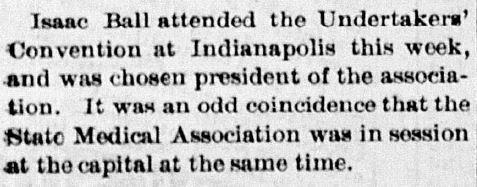
Years later, in 1894, Eugene V. Debs and the American Railway Union (ARU) led a massive labor strike against the Pullman Palace Car Company in the outskirts of Chicago. Approximately 2,000 employees walked off the job in May, demanding an end to the 33 1/3% pay cut they took the year prior. When the strikes escalated into violence, largely due to the aggressive tactics of the Chicago police, the United States Court in Chicago filed an injunction against Debs and the ARU. The injunction claimed that Debs, as head of the ARU, violated federal law by “block[ing] the progress of the United States mails,” the Indianapolis Journal reported. Debs was later arrested for his actions, using legendary civil rights attorney Clarence Darrow for his defense. Some speculated at the time that Robert Ingersoll, himself a lawyer, would defend Debs in court, but that never came to pass. Instead, Ingersoll defended Debs in the court of public opinion, when the press reported his previous treatment for alcoholism in an effort to discredit his cause.

Workers leaving the Pullman Palace Car Works, 1893. Wikimedia Commons.

An article in the July 9, 1894 issue of the Jersey City News reported that Dr. Thomas S. Robertson treated Debs in 1892 for “neurasthenia” and “dipsomania,” terms used in the era to describe anxiety due to spinal cord injury and alcoholism, respectively. To help his friend, Ingersoll had written a letter of introduction for Debs to Dr. Robertson, as he had used the physician’s services before. The article quotes Dr. Robertson at length, who claimed that Debs suffered from exhaustion, which had been exacerbated by drinking, but he had improved in the two years since. When asked if Debs was of sound mind, Dr. Robertson said, “in ordinary times, yes, but he is likely to be carried away by excitement and enthusiasm.” In essence, Debs suffered from what today we might call stress-induced anxiety, which became more pronounced by substance abuse. However, it is important to note that charges of alcoholism were common in this era, and Debs might have exhibited symptoms of it without ever being intoxicated.
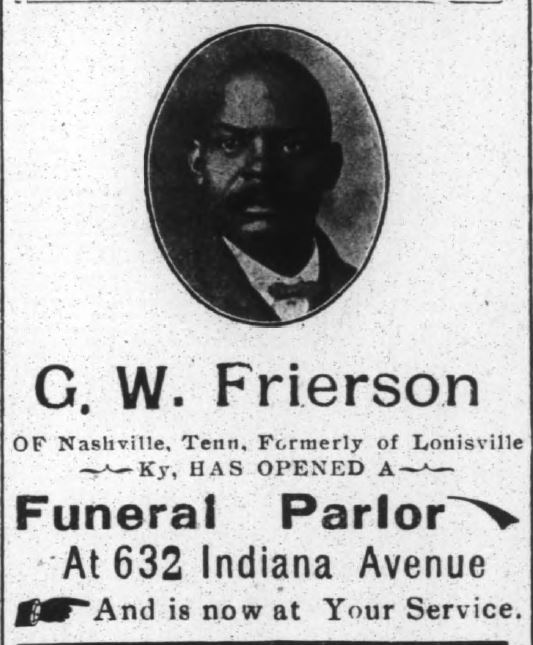
Sensing the intention of the press with this story, Ingersoll released a statement to the Philadelphia Observer, later reprinted in the Unionville, Nevada Silver State on August 27, 1894. In it, he stood up for his friend and the causes he fought for. “I have known Mr. Debs for about twelve years,” Ingersoll said, and “I believe, [he] is a perfectly sincere man—very enthusiastic in the cause of labor—and his sympathies are all with the workingman.” When asked about Debs’s drinking, Ingersoll pushed back on the claims, saying “I never met him when he appeared to be under the influence of stimulants. He was always in good health and in full possession of his faculties.” He also commented on the attempts at scandal in the newspapers, adding that his “testimony is important in view of gossip and denunciation that everywhere attend the public mention of the strike leader.” In one of Debs’ darkest hours, when his character and cause came under fire, Ingersoll publicly defended his friend and challenged the claims made against him. Such was the nature of their bond.

Harper’s Weekly, July 14, 1894. Library of Congress.

While Robert Ingersoll certainly influenced Debs on the importance of oratory and the cause of labor, he also left a profound intellectual influence on the future socialist. Early in his life, Debs developed an iconoclastic view of religion, which primed him for a rewarding relationship with Ingersoll. In conversations with Larry Karsner, published in book form in 1922, Debs reflected on the event that made him weary of organized religion. At the age of 15, Debs attended a sermon at St. Joseph’s Catholic Church in Terre Haute. The priest’s vivid descriptions of hell, with a “thousand demons and devils with horns and bristling tails, clutching pitchforks, steeped in brimstone,” completely soured him on institutionalized Christianity. “I left that church with rich and royal hatred of the priest as a person, and a loathing for the church as an institution,” Debs said, “and I vowed that I would never go inside a church again.” Furthermore, when asked by Karsner if he was a disbeliever at that time, Debs replied, “Oh yes, a strong one.”

He furthered his views on hell in a February 19, 1880 article in the Terre Haute Weekly Gazette. “I do not believe in hell as a place of torment or punishment after death,” he wrote, “. . . the hell of popular conception exists solely in the imagination.” He further argues that while the idea of hell may have served a beneficial function in the past, “as soon, however, as people become good enough to be just and honorable for the simple satisfaction it affords them, and avoid evil for the same reason, then there is no further necessity of hell.” With these words, Debs actually echoed much of what Ingersoll said on the subject in an 1878 lecture. “The idea of a hell,” Ingersoll noted, “was born of revenge and brutality on the one side, and cowardice on the other. In my judgment the American people are too brave, too charitable, too generous, too magnanimous, to believe in the infamous dogma of an eternal hell.”

Robert Ingersoll pamphlet on Hell, 1882. Google Books.

While the doctrine of hell and the strictures of the church left Debs cold, he nevertheless adopted a liberal, nondenominational form of Christianity later in his life, one molded by his exposure to Ingersoll and freethought. In a 1917 article entitled “Jesus the Supreme Leader,” published in the Call Magazine and later reprinted in pamphlet form, Debs shared his thoughts on the prophet from Nazareth. Debs saw Christ not as a distant, ethereal presence, but rather as a revolutionary figure whose own humanity made him divine. “Jesus was not divine because he was less human than his fellow-men,” he wrote, “but for the opposite reason, that he was supremely human, and it is this of which his divinity consists, the fullness and perfection of him as an intellectual, moral and spiritual human being.” He placed Jesus in the same pantheon of transformative figures as abolitionist John Brown, President Abraham Lincoln, and philosopher Karl Marx.

For Debs, Christ’s appeal to “love one another; as I have loved you, that ye also love one another” was the same in spirit as Marx’s famous dictum in the Communist Manifesto: “Workers of all countries unite! You have nothing to lose but your chains. You have a world to win.” Both statements are about solidarity—of people coming together, helping one another, and fighting for a better world. In this sense, Debs interpreted Christ like many humanists and non-sectarian Christians do today—as a deeply human figure that preached love, peace, and harmony with others.

Eugene V. Debs and Jesus of Nazareth pamphlet. Internet Archive.

While Debs and Ingersoll did not share the exact same views on Christianity, they did share a commitment to secularism, tolerance, freethought, and social justice. Debs would parlay his knowledge from Ingersoll and others into a successful political career, running five times on the socialist party ticket and earning nearly a million votes in 1920 while imprisoned for speaking out against America’s involvement in WWI. As Ingersoll was the leader of the “Golden Age of Freethought,” Debs was the leader of the “Golden Age of American Socialism,” with thousands attending his speeches and joining socialist organizations. Despite their friendship being tragically cut short by Robert Ingersoll’s death in 1899, Debs honored the legacy of the Great Agnostic for the rest of his life. Writing in his “Recollections of Ingersoll” in 1917, Debs said:

He was absolutely true to the highest principles of his exalted character and to the loftiest aspirations of his own unfettered soul. He bore the crudest misrepresentation, the foulest abuse, the vilest calumny, and the most heartless persecution without resentment or complaint. He measured up to his true stature in every hour of trial, he served with fidelity and without compromise to the last hour of his noble life, he paid in full the price of his unswerving integrity to his own soul, and each passing century to come will add fresh luster to his immortal fame.

In studying their lives and their friendship, one might say these words for Robert Green Ingersoll could equally apply to Eugene Victor Debs.

Eugene V. Debs standing by pillar. Indiana Memory.