For many years, Sunday made Winona Lake, Indiana his home with his wife and family. It gave him more opportunities to hold revivals in Indiana, especially ones lasting for weeks at a time. One such revival came to Richmond in the spring of 1922. For six weeks, Sunday preached to scores of people in Richmond, “saving souls” and collecting donations from audiences. The Palladium, the city’s premiere newspaper, provided a supplement section in its daily paper for Sunday to share his sermons, stories, and testimonials with the public. It is unclear as to why the Palladium decided to provide such expansive coverage; perhaps a publishing agreement between Sunday’s ministry and the newspaper facilitated the section. An insight into this arrangement might be gleamed from Sunday biographer Theodore Thomas Frankenberg:
Newspapers in any community, whether large or small, must necessarily pay attention to an enterprise which the business men of the town or city are backing to the extent of thousands and thousands of dollars. The element of publicity continues with increasing vigor to the very end of all campaigns, and one of the remarkable features in connection with it is the fact that this publicity is never sought by any direct or overt act — it comes naturally, almost spontaneously, and is easily the fourth factor toward preparing the field for the advent of the evangelist.
In any event, a half-page ad in the Palladium advertised Sunday’s revival and the paper’s forthcoming coverage. “The Palladium will publish a daily supplement giving two full pages of news and pictures regarding the meetings and the sermons in Richmond,” the ad stated. The paper also boasted of its team of reporters who would cover the revivals with a “direct telephone line . . . run from the Tabernacle to the Palladium office in order that there be no delay.” While Sunday’s preaching may have been “old time religion,” the Palladium’s supplement was a modern affair that anticipated the rise of twentieth century American protestant evangelicalism.
The Palladium published its first supplement on April 17, 1922, right after Easter Sunday. Throughout its six-week run, the Billy Sunday supplement followed a predictable pattern. The first page would run a photo of Sunday, often with a quote. The first one, called “I’ve Got a Combative Nature,” quotes the preacher talking about his background in sports and its influence on his preaching. “I was graduated from five gymnasiums. I can go so fast for five rounds you can’t see me in the dust,” declared the Reverend Sunday. The right hand side carried his main sermon, which often focused on a specific topic. For the first issue, Sunday ruminated on what he believed was the “real essence of Christianity,” love:
I will admit that Christianity has fallen away beneath love as the original standard. Love is the dominant principle of the world; love can never be defeated. Love may be checked; love may be prevented for the time being, in accomplishing its aim, but love will drill a tunnel through all the mountains of opposition and reach the goal of a touchdown. Love—it’s the mightiest thing in the world! And the world is starving today for the manifestation of the love of God in the hearts of men and women.
However, Christianity was more than just love to Billy Sunday. It also manifested itself in good works, particularly donations to the church, or in his case, to his revivals. In every supplement, an article or informational table would display the amount of money, in cash and pledges, Sunday’s ministry received for his sermons. The first day, the total collections were $859.71. This wasn’t good enough for the fiery evangelist. “I turned down 25 cities to come here, and it is not fair to me or to the other cities if you do not support me,” Sunday chided. As subsequent issues were published, the money totals and people “saved” became more explicit.
The Palladium’s Billy Sunday supplement also shared with readers some of his best one liners or bits from his sermons. This was a smart move; Sunday was extremely quotable and articulate and would often do more with a sentence than other speakers could do in a paragraph. For example, in the April 18 issue, the Palladium published some of “Today’s Hot Epigrams from Billy Sunday’s Lips.” Here’s some of his best quotes from that issue:
*
I think that God is too busy to pay any attention to the fellow who is trying to lift himself by his own bootstraps.
*
This is not a world of chance. God don’t wind it up and then throw away the key and let her rip till she runs down. Nothing comes by chance.
*
Christianity is not a simply a creed. Christianity is a creed plus Jesus Christ.
*
Like with the first issue, a picture of Sunday, often in an animated preaching pose, accompanied the quotes. This gave readers a choice; either read the long-form sermons or check out their best bits and quotable lines. This provided Sunday with a wider readership than if he had just provided the sermons as a whole.
One of Sunday’s indispensable lieutenants in his crusades for Christ was Robert Matthews, described by the Palladium as the “custodian of the tabernacle.” However, this was not his only job. Matthews served as Sunday’s secretary, a “buffer between the world and his boss,” as well as his “pianist for the chorus, understudy for Rody [Homer Rodeheaver] as the leader of the choir, and finally a good talker when he has to be.” A native of Kentucky, Matthews graduated from Lake Forest College, received musical education in “New York, Paris, Milan, and Melbourne,” and spent time in the newspaper business before joining Sunday’s staff. The Palladium described Matthews as “faithful to Billy,” further noting that “he is sure that Billy is the greatest man on the face of the earth.” Matthews, along with other staff, made sure that the Sunday revivals went perfectly.
Homer Rodeheaver, known as “Rody,” was Sunday’s musical director. Richmond Palladium, April 20, 1922. Hoosier State Chronicles.
The revivals benefited additionally from a well-organized schedule of prayer meetings, led by Florence Kinney, a graduate of Dr. Wilbert W. White’s Bible Training School in New York City and dedicated lieutenant to Sunday. Kinney believed that, “Souls can be saved and individuals converted in those neighborhoods, just as well as at the big tabernacle meetings.” Kinney and Reverend Alfred H. Backus organized Richmond into 10 sections, each with their own superintendent responsible for prayer meetings. Kinney herself taught Bible study classes during the week, scheduled “immediately after the afternoon sermon.” These individualized, personal meetings reinforced Sunday’s sermons, gained new converts, and emboldened the already converted. In this regard, Sunday’s bureaucratic approach echoed the modern evangelical enterprises of Billy Graham and Jerry Falwell decades later.
“Come Up to Help the Lord,” hand-written proclamation from Reverend Sunday. Richmond Palladium, April 21, 1922. Hoosier State Chronicles.
In the supplement for April 21, the Palladiumpublished a hand-written proclamation from Sunday, calling for evangelism in Richmond. “The history of the church is the history of revivals—the Church was born in the revival at Pentecost,” Sunday declared in his letter. He also summoned all of Richmond to join his revival. “I issue a proclamation,” Sunday wrote, “to the forces of truth, morality, righteousness in and out of the churches of Richmond ‘come up to the help of the Lord, against the and devil and all his hosts.” He signed it with his name and “Psalm 34,” which, among other verses, stated that “The Lord redeemeth the soul of his servants: and none of them that trust in him shall be desolate.” Sunday fervently believed that the message of Christianity would fail unless the people actively worked for the propagation of its message.
Billy Sunday’s tabernacle in Richmond, Indiana. Richmond Palladium, April 18, 1922. Hoosier State Chronicles.
To hit home this message, the Palladium ran a small chart, starting in the April 19 supplement, chronicling the money raised and those “saved” at the daily services. Between the afternoon and evening services on April 21, the ministry collected $344 and preached to 4,900 attendees. However, by the weekend’s end, the collection ballooned to $3,183.36 and attendance expanded by 19,700 people. As an aside, the paper also noted that the “foregoing does not include pledges, which will swell the total.” The chart began including converts with the April 26 issue, where 119 “’hit the sawdust trail,’ the first converts of the Richmond campaign.” Within days, the paper named the converted as “trail hitters,” a term used throughout the rest of Sunday’s revival in Richmond. By the time Billy Sunday’s six weeks in Richmond came to a close, his ministry claimed 5,876 “tail hitters” and $34,658 in collections. Not too bad for an old baseball slugger turned champion for the Lord.
Yet, despite his calls for moral behavior and rejection of modern life, there was one group with which he was incautiously naive: the Ku Klux Klan. On May 14, 1922, 12 Klansmen in white robes approached the pulpit during Sunday’s evening service. They stood silent as they handed the reverend an envelope containing a “commendation and $50 in bills.” Sunday took the letter, merely replied “I thank you,” and said to the audience after they left, “I don’t know how you felt, but I commenced to check up on myself.” The Palladium reported that Sunday was “dumbfounded,” even though this was not his first encounter with the Klan. “The klan [sic] has made a present to Mr. Sunday in every city he has been in during the last year. . . . Even the Klan in Sioux City did the same thing,” Sunday confidant Robert Matthews told the press.
The Muncie chapter and the provisional Richmond chapter of the Ku Klux Klan signed the letter commending Sunday for “the wonderful work that you and your associates are doing in [sic] behalf of perpetuating the tenets of the Christian Religion throughout the nation. . . .” The Palladium further noted that this was “the first time in the history of Richmond that the Ku Klux Klan had appeared. . . .” It also would not be their last time. According to historian Leonard Moore, 4,037 men from Wayne County, of which 3,183 were from Richmond, joined the Ku Klux Klan in the 1920s. Of Richmond’s 26,000 residents, over 12% belonged to the Klan during the decade. Sunday’s interaction with the Klan was not an aberration, but rather a sign of things to come.
As for the Reverend, he shrugged off the “dumbfounding” incident, declared that he did not belong to any secret fraternal organizations, and said that “if you behave yourself they won’t bother you.” In an odd turn, Sunday never readdressed the incident, but instead criticized the liberal wing of Baptist Christianity. “It’s the liberal bunch that don’t like me, and I don’t want their backing,” Sunday shared with his audience before he called for attendees to come forward to be saved.” Sunday’s apparent lack of moral clarity on the issue of the Klan does not imply an endorsement of its politics; it only demonstrates that Sunday was not aware of the implications of associating with them. Nevertheless, Sunday’s actions remain problematic.
Billy Sunday’s residence at Winona Lake, Indiana, 1920. Indiana Memory.
About 1,500 saw Mr. Sunday off to his home at 10:20 o’clock Sunday evening. As the train started. Billy Sunday was shaking hands with a member of the crowd and was pulled off the steps to the platform. He managed to catch the steps of the end car as it passed and Richmond’s last sight of the evangelist was as he stood on the platform, waving goodbye.
One of the biggest reasons for that success was the daily newspaper coverage he received in the Richmond Palladium. “The papers in this town have done better in covering this campaign from every angle than any other city have been to,” Sunday told the Palladium on his final day in Richmond. This is no exaggeration. The Palladium gave Sunday six weeks of uninterrupted newspaper coverage in a special supplemental section, a unique experiment in the newspaper’s near-200 year history. They printed his sermons almost verbatim, alongside other stories, quips, and updates on the prayer meetings and the amount of people “saved.” The Palladium‘s wall-to-wall coverage of Sunday’s revivals foreshadowed today’s network of newspapers, magazines, television stations, and internet media devoted to religious programming. Thus, the Palladium’s “Sunday Supplement” underscores the immense influence of Billy Sunday and evangelical Protestantism in the Midwest during the early 20th century.
San Francisco Chronicle, January 14, 1923, p. 10, accessed via Newspapers.com.
The San Francisco Chronicle asked Americans “who have a wide experience and many points of contact with 1922” to predict the trials and triumphs Americans would experience 100 years later.* Probing prominent individuals like a pastor, architect, social reformer, author, film producer, educator, and politician, the paper concluded that there are “plenty of ifs and buts, but in general the prospect for a century hence seems rosy.” As a historian at the dawn of 2022, some of the predictions seem amusingly off-base, like author and critic Henry L. Mencken’s certainty that the U.S. “will be a British colony. . . . The American who will be most agreeably discussed by Anglo-American historians in 2022 will be Woodrow Wilson, the first premier of the United American Colonies.” Notorious moving picture producer D.W. Griffith was equally shortsighted when he stated, “I do not foresee the possibility of instantaneous transmission of living action to the screen within 100 years.” (Inventor-turned reluctant Fort Wayne businessman Philo Farnsworth would transmit the first “electronic television image” just a few years later in California).
Some musings proved surprisingly prescient, like those of architect Thomas Hastings, who wondered, “Will civilization relapse, perhaps through the medium of another world war, into semi-barbarism?” The telephone was only just beginning to be used in households—World Wide What?—when Hastings urged readers to consider “the probability of revolutionizing inventions—even the discovery of forces which we know nothing about now.” Famed birth control activist Margaret Sanger—who reportedly called upon Indianapolis reformer Roberta West Nicholson to help found the city’s first Planned Parenthood clinic—was arguably correct in her belief that access to birth control would result in:
happier homes, greater mutual respect between husband and wife, honeymoons lasting two or three years before children arrive, with husband and wife thoroughly equilibrated to one another, because there has been time for mutual understanding and development before parenthood is entered upon.
The Evening World (New York, New York, February 15, 1922, 3, accessed Newspapers.com.
Among the soothsayers was Mary Garrett Hay, a Charlestown, Indiana native, trailblazing suffragist, and, by 1922, head of New York City’s League of Women Voters. The accuracy of her predictions prompt a look back at her life and career, both of which were far ahead of her time, so to speak. Hay informed the San Francisco Chronicle that in 2022:
The life of even the average woman will be broader and better. Woman’s drudgery in the household will be eliminated, her care of the family will be lessened, as new inventions come in and new methods of work. Women, like men, will do the tasks for which they are best fitted by temperament, gifts and training.
Technological advancements have certainly liberated women from household drudgery. And women have increasingly stepped away from the home and into the public sphere due to a redefinition of the “tasks for which they are best fitted by temperament, gifts and training.” Hay occupied this sphere throughout her life, beginning around 1880, when as a young woman she worked as a drug clerk in Charlestown.[1] Hay later supported herself as a writer, reform speaker, and political consultant in New York City, having eschewed the institution of marriage and accompanying division of labor (Again defying gender norms, she had a long-term relationship with renowned suffragist Carrie Chapman Catt).
Brooklyn Daily Eagle, June 21, 1908, 24, accessed Newspapers.com.
Described as a “born executive,” Hay flexed her entrepreneurial skills when in 1908 she formed the Women’s Travel Bureau. Drawing on twenty years of navigating railroad networks across the U.S. for her suffrage campaign, Hay formed a company that appealed to the unique needs of female travelers, such as featuring safe accommodations and advertising women’s events. Hay told the New-York Tribune that since the 1893 Columbian Exposition, women increasingly used rail travel for a brief reprieve from the demands of family life. This was made possible, she said, because “‘women have for the first time in history begun to earn good salaries.'”[2] The Travel Bureau is one of many examples of Hay carving out opportunities in a male-dominated field by pairing her expertise with public demand.
While Hay’s prediction alluded to shifting gender norms, she made clear in the Buffalo Times that the shift must be more immediate, telling the paper, “‘It is the right of every human to have a career in the home and in the field-and the two are not mutually exclusive.'” She stated bluntly, “‘If men are willing to let their wives go out in quest of careers in the field as well as in the home they are reasonable husbands.'” The paper added that Hay “advocates women taking paid positions even after they are married and employing servants to do the housework far more efficiently than they could ever do it themselves.” In 1926, she argued that not only should women be allowed in the workforce, but that some were better suited for it than the home, noting:
I’ve known many women who were very inefficient mothers but excellent business women. They could manage what we call a man’s job and make a conspicuous success of it, and be absolutely beaten by housework or the rearing of their children.[3]
Of course, in order to work in the professional field, jobs needed to be available. Hay worked to create these as a member of the Committee for Extending Business Opportunities to Women, formed around 1915, because “the entrance of women into various fields of work has been effected with so much difficulty.”[4]
The Evening World (New York, New York), August 25, 1921, 3, accessed Newspapers.com.
In the second half of her prophesy for the San Francisco Chronicle, Hay predicted:
Politically, women will be powerful. They will share with men the real constructive work of government. Many will hold office. If there is not a woman President, the thought of one will shock no one. It will seem natural and proper to elevate women to whatever positions they have the ability to fill. Co-operation will be the magic word in 2022.
Confirming Hay’s point, many Americans in 2016 were shocked not that Hillary Clinton was poised to become the country’s first female president, but that she lost the election in a stunning upset—despite winning the popular vote. The glass ceiling came closer to being shattered when Kamala Harris was elected the first female U.S. Vice President in 2020 and when she briefly became the first woman imbued with presidential power in 2021 when President Joe Biden went under anesthesia for a medical procedure.
In fact, Hay’s own name had been floated as a U.S. presidential candidate in the 1910s. This was, in large part, because of her organizational and political prowess, particularly in recruiting members for the Republican Party.[5] Described as “the big boss of New York,” the G.O.P. appointed Hay to influential positions, soliciting her insight about issues important to women and strategies for mobilizing them to the polls.[6] Friend and fellow Hoosier— and Warren Harding’s presidential campaign manager—Will Hays appointed her chairman of the Republican Women’s National Executive Committee.[7] In this role, she was tasked with organizing “the women in the nation for the Republican Party as she had organized for suffrage. She was sought after at all political gatherings, and was made a delegate to every kind of convention.”[8]
Topeka Daily State Journal, January 29, 1920, 5, accessed Newspapers.com.
From lobbying for Indiana W.C.T.U. branches to heading a West Coast speaking tour organized by Susan B. Anthony to bringing to the Albany legislature “tenement house suffragists to illustrate how much women need the vote on the lower East Side,” Hay evolved from a social reformer to a political organizer.[9] She envisioned women’s influence extending beyond ratification of the 19th Amendment and viewed the political realm as a source of women’s professional fulfilment.
In her “Politics, A Profession for Women” essay for Catherine Filene’s 1920 Careers for Women, Hay wrote that politics “lacks the stultifying effect attaching to most occupations for women. Politics for women means a life of real vitality and worth.” She noted that “women who were trained by suffrage campaigns” were qualified for “good positions” within political parties. Strengths inherent to women, Hay argued, intersected well with those required of the political sector, such as the “ability to judge and handle people . . . sagacity, resourcefulness, power to discern the true from the false, common sense, imperturbability, [and] wide experience with human nature.” Having earned a reputation as an exceptional orator, Hay delivered a speech in 1926 in which she stated governmental work was tantamount to “housekeeping on a large scale.”[10] Because of these convictions, Hay used her sway within the Republican Party to bring more women into politics, although, the Times-Tribune noted, “she frequently found herself a[t] storm center by her insistence that leaders of the party permit women workers to join in the inner councils.”[11]
While she predicted that “Politically, women will be powerful,” Hay wanted not only “political equality between the sexes,” but “equality in every single thing in life.” This sentiment paralleled U.S. Supreme Court Justice Ruth Bader Ginsburg’s belief that “women belong in all places where decisions are being made.”[12] Hay worked for their systemic inclusion, including in higher education, law enforcement, jury duty, and prison reform.[13]
Oakland Tribune (California), November 29, 1927, 28, accessed Newspapers.com.
In this sense, Hay’s approach to equality was unique for the period, as historian William O’Neil argued, “’the postsuffrage feminists failed to see that the woman problem was part of a larger social question involving sex roles in American society and the entire order.’” Furthermore, these reformers “’asked only for legal equality without addressing themselves to the whole range of problems facing women who tried to make a notch for themselves in a man’s world.’”[14] Hay, “one of the best known leaders in the fight for the emancipation of women,” proved the rare exception.[15]
Her 1928 death would exacerbate this void in leadership for women’s equality. But in the nearly 100 years since her passing, her vision has been realized to a meaningful extent, as women increasingly occupy significant roles in the workplace and government. Perhaps she was able to envision the ideals and gender norms that would become fairly commonplace by 2022 because she embodied them herself.
Sources:
This post draws on the research notes for the Mary Garrett Hay historical marker.
* Unless otherwise specified, all material is drawn from the San Francisco Chronicle, January 14, 1923, p. 10, accessed via Newspapers.com.
[1] “Mary G. Hay,” Clark County, Indiana, Census, 1880, accessed Ancestry Library Edition.
[2] Departure of Trains Schedule, National American Woman’s Suffrage Association, New Orleans, March 19th to 25th, 1903, Miller NAWSA Suffrage Scrapbooks, 1897-1911, Scrapbook 3 (1897-1904), Rare Book and Special Collections Division.; “Women Conduct Tourist Bureau,” Brooklyn Daily Eagle, June 21, 1908, 24, accessed Newspapers.com.; “Women Who Travel,” New-York Tribune, August 4, 1908, 5, accessed Newspapers.com.
[3] Cynthia Grey, “Cynthia Says Home and Country Should Be Managed Jointly,” Courier-Post (Camden, NJ), April 19, 1926, 9, accessed Newspapers.com.
[4] “Mary G. Hay,” Clark County, Indiana, Census, 1880, accessed AncestryLibrary.; “Mary G. Hay,” 1910 United States Federal Census, New York, accessed AncestryLibrary.; “Women Form to Open New Fields,” Woman’s Journal and Suffrage News, January 2, 1915, accessed HeinOnline.
[5] Joan Moody, “What Will They Do With It?,” Everybody’s Magazine (November 1919): 113, accessed GoogleBooks.
[6] “Cheers Greet Women as They Enter Politics,” Indianapolis Star, April 3, 1919, 1, 8, accessed Newspapers.com.
[7] “Mary Garrett Hay’s Watchword to Women in Politics Was: ‘Be Nice to the Men’; Fought for Suffrage from Girlhood,” Brooklyn Eagle, September 2, 1928.
[8]Indianapolis Star, April 3, 1919, 1, 8.; Brooklyn Eagle, September 2, 1928.
[9] “Suffrage Leaders Get Together Now,” Star-Gazette
(Almira, NY), March 5, 1910, 2, accessed Newspapers.com.
[10] Cynthia Grey, “Cynthia Says Home and Country Should be Managed Jointly,” Courier-Post (Camden, NJ), April 19, 1926, 9, accessed Newspapers.com.
[11] “Mary Garrett Hay,” The Times Tribune (Scranton, PA), September 1, 1928, accessed Newspaper.com.
[12] “They Will Stand on Their Rights,” Boston Globe, February 27, 1908, 10, accessed Newspapers.com.
[13] “Mainly About People,” Daily News (New York), January 6, 1922, 41, accessed Newspapers.com.; “Women and the Jury System,” The Scranton Republican, February 28, 1922, accessed Newspapers.com.; “Leagued Together for Law Enforcement,” Oakland Tribune, November 29, 1927, 28, accessed Newspapers.com.
[14] Quoted in Winifred D. Wandersee, Women’s Work and Family Values, 1920-1940 (Cambridge: Harvard University Press, 1981), 119-120.
[15]Buffalo Times, July 9, 1922, 52, accessed Newspapers.com.
The life of Hoosier industrialist Henry Ulen seems like a movie—a person of little education and resources who uses his raw talents and savvy to build a massive business empire, who then comes back to his hometown to share the fruits of his success. Perhaps it was his years drifting from town to town on the railroads as a young man that inspired a sense of community, of needing a place to call one’s own. As such, his business ventures were all about providing places with the tools they needed to build communities and wealth of their own. And today, over 120 people still call the town of Ulen home, with the golf course still serving as a hub that brings the community together. The life, work, and charity of Henry C. Ulen exemplified the true meaning of “Hoosier Hospitality.”
Music: “Forest” by Vlad Gluschenko, “Wanderlust” by Scott Buckley, “Chess Pieces” by Silent Partner, “Saturday Groove” by John Deley, “Lake Eerie” by Silent Partner, and “Purpose” by Jonny Easton
George Ade, courtesy of Indiana State Library Rare Books and Manuscripts Collection.
Kentland, Indiana native George Ade is best known as an author who came to prominence during the Indiana Golden Age of Literature. He was a columnist for the Chicago Tribune, authored over twenty books, and even penned several successful Broadway productions. But in Newton County, he was known as “just plain George Ade, everybody’s friend.” In the early 20th century, Ade returned to Newton County and built what would become a cultural mecca – a source of support in hard times and a place of celebration in the good.
Even in an age of notable Hoosier authors, humorist George Ade stood out. Compared to contemporaries like Lew Wallace, Meredith Nicholson, and Booth Tarkington, he employed more of an “every man’s” style, peppering his work with vernacular and popular references. This made his work relatable to the masses in the early 20th century, but a bit difficult to decipher today, as seen in the excerpt below.
Excerpt from Fables in Slang, “The Fable of the Slim Girl who Tried to Keep a Date That Was Never Made,” courtesy of HathiTrust.com.
Ade began writing his “Stories from the Streets and Town” column for the Chicago Record in 1893, inspired by the daily goings-on he witnessed as a reporter on the streets of Chicago. By 1896, the column became popular enough to warrant a selection to be published as the book Artie. Subsequent collections Pink Marks (1897) and Doc’ Horne (1899) soon followed and further boosted the column’s popularity. It was Ade’s “Fables in Slang” that rocketed him to national fame, though.
1900 Satirical ‘More Fables’ by George Ade – (1899 Fables in Slang sequel), is courtesy of etsy.com.
Ade’s first fable, “The Fable of Sister Mae, Who Did As Well As Could Be Expected,” was published in the Record on September 17, 1897. “A Fable in Slang” came a year later and was the true beginning of the column, rocketing him to national fame. These humorous stories, each of which concluded with a satirical moral, such as “in uplifting, get underneath,” earned him the moniker the “Aesop of Indiana.” When the collected Fables in Slang was published in 1899, it became his most successful work up to that point.
With the dawn of the new century, Ade made a career move from columnist to playwright with the opening of The Sultan of Sulu. This first Broadway success was followed by others in quick succession. The County Chairman (1903), The Sho-Gun (1904), and The College Widow (1904) all garnered critical acclaim and helped to establish the musical comedy genre.
Not yet 40 years old, Ade had earned a fortune and retired from the hustle and bustle of life in Chicago to a sprawling fourteen room Tudor-style mansion near Brook, which he dubbed “Hazelden.” Here, he continued to write while he hosted political rallies, such as the 1908 Taft Rally, entertained local and national celebrities, and treated the residents of Newton and surrounding counties to lavish parties. The Muncie Star Press noted that Ade “wasn’t a swimmer and he didn’t dance, but on his farm place . . . he built a dance pavilion and a swimming pool.” Along with the dance pavilion and swimming pool, Hazelden featured a pool house, greenhouses, barns, and, by 1910, a golf course and country club.
This slideshow requires JavaScript.
Just two months after the U.S. entry into World War I, Ade wrote a plea to his community:
It seems that every part of the country, including Newton County, will have to take an important part in the great war now raging. . . Some can give more than others, but every man that can give something and fails to do so, will have to carry in his soul a reasonable doubt as to his good citizenship. Give to the Red Cross this week.
And what George Ade had to give, other than money, was Hazelden. The estate assisted the war effort in small ways, serving as the meeting place for the Newton County Red Cross Executive Committee, and hosting knitting bees, which made socks for soldiers. But in July 1918, Ade pulled out all the stops for Red Cross Day. A dozen airships, carrying military personnel from the Chanute Air Force Base near Rantoul Illinois, were early on the scene for the festivities. Thousands came from as far away as Indianapolis, South Bend, and Chicago to enjoy the grounds on a day with what newspapers of the day called “George Ade Weather.” Fundraisers included a golf tournament, where fans could bid for the chance to caddy for their favorite player and golf balls were auctioned off afterwards. Proceeds from the day totaled over $5,000 (nearly $100,000 today).
George Ade, courtesy of Alchetron.com.
Described in the Chicago Tribune as a “two fisted drinker,” and “one of the most gregarious men who ever lived,” Ade wasn’t afraid of a good time, and after the war years, he turned his attention to just that. On July 4, 1919, an estimated 15,000 revelers flocked to Brook, effectively doubling the population of Newton County for a day. Attendees brought picnic lunches, were treated to music by Bensons Orchestra, brought in from Chicago, and played a few games of “Cage Ball,” a mix of American football and soccer that became popular during the war. The evening was topped off with a fireworks display.
Perhaps the most beloved event on the Hazelden calendar was the annual Children’s Picnic, which featured activities such as baseball games, tug-of-war, dancing, and daylight fireworks. For one day each summer, all children under twelve years old from Newton and surrounding Counties were invited to take in the sprawling grounds. If a child’s family could not afford clothes and transportation to the event, Ade would furnish a new outfit and send a car to get them. The Lafayette Journal and Courier described the 1926 event:
There were clowns, imported for the occasion, magicians, organ grinders and monkeys, fancy divers and swimmers, vaudeville artists and Punch and Judy shows. Each of the 600 children present received a fancy paper cap to wear, and all feasted on ice cream and lemonade.
Annual Children’s Picnic, 1928, Indianapolis Star, September 28, 1930, 10.
For forty years, from when the home was finished in 1904 until Ade’s death in 1944, the humorist presided over scenes such as that described above time and time again. Local obituaries nearly without exception included reminiscences about the community gatherings hosted amongst the lavish gardens on the manicured grounds of Hazelden. But after Ade died following a heart attack, the estate sat empty for nearly two decades until it was acquired by the George Ade Memorial Association. It was subsequently renovated and added to the National Register of Historic Places in 1976.
Inside Hazelden, courtesy of Indiana Landmarks.
Today, Hazelden continues to serve as a gathering place for Newton County residents. The George Ade Historic Preservation Commission oversees operations of the estate, which is available to be rented out and often hosts graduation parties, birthday celebrations, and even weddings. The Commission is in the planning stages of a renovation of the mansion, carriage house, and grounds so it can better meet the needs of the community. If you are interested in learning more about this project or would like to rent out the home, contact Commission Chairperson Krissy Wright.
Note: This post was written using the marker notes for the Indiana state historical marker for George Ade, which can be found here.
Today, we drive over rivers and creeks in a few seconds and barely know their names. But before modern transportation severed so much of our connection to waterways, human contact with rivers practically defined life in water-rich Indiana.
One lost industry that had a brief “boom and bust” over most of the eastern U.S. a century ago was closely tied to the life of the rivers. If you’re keeping a list of industries (like steel and auto manufacturing) that have declined and even vanished from the Midwest, add one more: pearl button making.
Consumers today rarely give a thought to where buttons come from. How synthetic goods are made (i.e., the zippers, plastic buttons, and Velcro that partly replaced shell around 1950) may seem less “romantic” than the work of pearl fishermen hauling shiny treasures out of Midwestern streams in johnboats. Yet in spite of its nostalgic appeal, the pearl button industry also wreaked havoc on the environment and on workers in factories.
(This photo taken on the Wabash River at Vincennes, Indiana, around 1905 shows a pearl fisherman in his boathouse. He kept a “cooker” on hand to steam the mussel shells open. “The meat was fed to hogs or used as bait.” Shells were sent off to button factories.)(Man on a johnboat on the Rock River outside Beloit, Wisconsin, circa 1911. Mussels would clamp down on hooks and not let go until they were cooked off. The rods were often made out of cast-off gas pipes. Photo by Lloyd Ballard. Beloit College Archives.)
At the time of European settlement, midwestern rivers abounded in mussels. As many as 400 species probably lived in the Ohio Valley in 1800. The Mound Builder cultures that once occupied the American heartland found many ways to use mussels and left behind enormous refuse piles — what archaeologists call “middens” — in their towns, which almost always sat beside creeks and rivers. They were large towns, too. In the year 1200, Cahokia, across the Mississippi River from the future site of St. Louis, was bigger than medieval London.
Among Indiana’s early settlers, “diving” for pearls hidden in freshwater mussels dates back to at least 1846, when farmers at Winamac founded a small stockholders association to try to market shells taken from the Tippecanoe River. They sent a man to St. Louis and Cincinnati to ask about the value of freshwater pearls. Prices were low at the time and the “Pulaski County Pearl Diver Association” went bust.
Though a few button factories existed in Indiana before the Civil War — relying on shell, horn, and bone — the American freshwater pearl boom didn’t really gain momentum until 1900. In that year, a pearl frenzy erupted along the Black and White Rivers near Newport, Arkansas. Arkansas’ pearl boom had all the hallmarks of an old-time gold rush. A writer for the Indianapolis Journal reported in 1903:
Within the past three years more than $3,000,000 worth of pearls have been taken from the Mississippi Valley. . . The excitement spread from the land to the river steamboats. Their crews deserted them, and sometimes their captains, and the Black River was the scene of the wildest excitement. New towns were built and old ones were increased to the size of cities. Streets were laid out, banks and mercantile establishments were started, mortgages were lifted, money was plenty and times were prosperous. . . New York pearl dealers flocked there in great numbers.
The writer tells a story, perhaps exaggerated like much of his account, that an African American family who had lived in poverty made enough money pearling to build a large house and hire white servants. He also mentions that New York dealers were often ripped off by sellers masquerading Arkansas pearls as Asian.
Arkansas’ rivers were quickly “pearled out,” but the pearl boom spread and reached its peak around 1905-1910. Southwestern Indiana is almost as close to Arkansas as it is to Cincinnati. When the Southern boom died down, the hunt for pearls came north. The Jasper Weekly Courier reported in October 1903 that pearls had been found in the Wabash River at Maunie, Illinois, just south of New Harmony. “The river is a veritable bee hive and scores are at work securing mussel shells. The price of shells has risen from $4 to $15 a ton and an experienced man can secure a ton in a day. Farmers find it difficult to get farm hands.”
“Musselers” found an estimated $7000 worth of pearls in the Wabash in the first week of June 1909. Charles Williams, a “poor musseler,” found a “perfect specimen of the lustrous black pearl and has sold it for $1250. Black pearls are seldom found in freshwater shells.”
(The steamboat City of Idaho docked at Vincennes, Indiana, around 1907. For a few years, a small button factory on Willow Street produced as many as 3,000 buttons a week from mussel shells harvested along the Wabash. When the factory closed, mussel fishermen sent shells by steamboat and train to the large button manufacturers in Muscatine, Iowa.)
Vincennes experienced an explosion of musseling in 1905, as pearl hunters converged on the Wabash River’s shell banks. Eastern buyers came out to Indiana and frequently offered $500-$1000 for a pearl, which they polished into jewelry in cities like New York. A thousand dollars was a lot amount of money at a time when factory workers typically made about $8.00 a week. But with several hundred people eagerly scouring the riverbanks, the best pearls were quickly snatched up. For about a decade afterwards, “mussel men” and their families focused on providing shells for button manufacturers.
Interestingly, the shell craze caused a squatters’ village to spring up in Vincennes. A shanty town called Pearl City, made up of shacks and houseboats, sat along the river from 1907 to 1936, when as part of a WPA deal, its residents were resettled in Sunset Court, Vincennes’ first public housing.
At Logansport on the Wabash, patients from the Northern Indiana Insane Hospital spent part of the summer of 1908 hunting for pearl-bearing mussels. “One old man has been lucky, finding several pearls valued at $200 each. Local jewelers have tried to buy them but the old man hoards them like a miser does his gold. He keeps them in a bottle, and his chief delight is to hold the bottle so that he can see his prizes as the sun strikes the gems.” In and around Indianapolis, hunters discovered pearls in Fall Creek and the White River, especially around Waverly, southwest of the city.
Though every fisherman sought to find a high-value pearl and make a tiny fortune, the boom’s more prosaic side — button-making — eventually won out. From the 1890s to the 1940s, hundreds of small factories across the Midwest turned out glossy “mother-of-pearl” buttons. The industry especially flourished along a stretch of the Mississippi near Muscatine, Iowa, called the “button capital of the world.” Muscatine’s button industry was founded by John Boepple, a master craftsman from Hamburg, Germany, who immigrated to Iowa around 1887. Muscatine’s factories turned out a staggering 1.5 billion buttons in 1905 alone. About 10,000 workers were employed by button factories in the Midwestern states.
John Boepple lived to see the industry’s impact on rivers like the Mississippi. In 1910, the industrialist turned conservationist began work at a biological station established by Congress at Fairport, Iowa, to help repopulate mussels by reseeding riverbeds. Congress’ role was simply to preserve the industry, not to save decimated species. In 1912, the embattled mussels had their revenge: Boepple cut his foot on a shell and died of a resulting infection.
Although Iowa dominated the American button industry, numerous tiny factories popped up in small Indiana towns, including Mishawaka, Lawrenceburg, Leavenworth, Madison, and Shoals. (Shoals was named for its founder, Frederick Shulz, not for the mussel shoals on the White River.) Taylor Z. Richey, writing from Cannelton, Indiana, described how the work was done along the Ohio River in 1904. Many factories did not create the actual buttons, merely the “blanks” that were shipped out to Iowa.
Created by Robert Ervin Coker, 1921, courtesy of University of Washington, accessed Wikipedia.(In 1910, three buttonworks in Leavenworth, Indiana, employed twenty-four families — most of the population of the town. This two-story Greek Revival building had once been City Hall. Long chutes connected upper windows to wheelbarrows below. Discarded shells were burned to produce lime. “Old” Leavenworth was permanently wiped out by the 1937 Ohio River Flood. Image courtesy of Crawford County Historical & Genealogical Society.)(Workers at a button factory along the Ohio River at St. Mary’s, West Virginia, circa 1910. The man on the far left, second row, in the black apron is Andrew Jackson Wigner, the great-grandfather of Trisha Johns who submitted the photo, accessed https://www.wvgenweb.org/pleasants/workmen.htm)
Working in the button industry was far from quaint and actually proved a hazardous job. Exposure to hydrochloric acid and poor ventilation took a big toll on workers. Author Jeffrey Copeland notes that. there were more cases of pneumonia, typhus and gangrene among button factory laborers than in any other industry. Children as young as eight worked sixty-hour weeks carrying buckets of shells and acid to soften the material up. Eye injuries and loss of fingers often occurred as workers “stamped” the buttons out of shells or operated lathes. Even before the industry reached its turn-of-the-century heyday, gory accidents (such as this one, reported in the Jasper Weekly Courier in 1874) made it into the newspapers:
A French girl, sixteen years old, was caught by her long hair in a revolving shaft at a button factory in Kankakee, Ill., the other day, and the left side of her head was completely scalped. A severe concussion of the brain was also sustained. Her condition was considered critical.
Partly under the leadership of a young activist named Pearl McGill, labor unions in Iowa battled it out with factory owners, culminating in Muscatine’s “Button War” of 1911, a fight that involved arson and the killing of police. In Vincennes in 1903, however, the usual pattern of Progressive-era labor politics seemed to go the other way around. The Indianapolis Journal reported that Eugene Aubrey, owner of a pearl-button factory at Vincennes and allegedly a member of the Socialist Party, fired worker Charles Higginbottom for serving in the militia during Evansville’s bloody July 1903 race riot, when many African Americans were gunned down. The Journal went on to accuse Aubrey of being a secret anarchist.
In his semi-fictional Tales of Leavenworth, Rush Warren Carter described a small-town Indiana button factory in those years. A boy named Palmer Dotson quits school at 16 and gets a job working under superintendent “Badeye” Williams. (Factory workers often lost eyes.) “Cutting buttons was not a business that developed one’s mind or elevated his thoughts,” Carter wrote. “The cutting process was a dull routine to a background of everything but enlightened conversation. Talk about your ladies’ sewing circles. When it came to gossip, [women] were not in the same league with the men in the button factory, who chewed and rechewed every real or imagined bit of gossip until it had been ground to a fine pulp.” Dotson died of tuberculosis at 21. A co-worker decided that opening a saloon would be preferable to stamping buttons.
In 1917, a silent movie based on Virginia Brooks‘ popular novel “Little Lost Sister” was playing at The Auditorium in South Bend. The plot begins in a sordid rural button factory in “Millville” (probably in Iowa), where the heroine, Elsie Welcome, has big dreams about getting out and going to Chicago. A classic stand-off with the foreman ensues:
Although Iowa’s factories were still running in 1946 (the year actor Ronald Reagan chose Muscatine’s Pearl Queen), exhaustion of shell banks all over the Midwest was killing the industry fast. Japanese innovations increased competition after World War II. Synthetic plastics — which were cheap and could withstand washing machines better than shell — were pioneered in the 1920s and eventually took over the industry in the mid-1950s. Instead of smelly buckets of shells, workers handled tubs of polyester syrup. Then, two snazzy new inventions, zippers and Velcro, even cut into the demand for buttons outright.
Indiana’s factories, which had been shipping blanks to Iowa for years, had all gone out of business by the end of World War II. The last independent buttonworks in the U.S., the Wilbur E. Boyd Factory at Meredosia on the Illinois River, closed in 1948. Iowa’s button industry hung on until the mid-1990s, when Chinese innovations in pearl cultivation finally caused it to collapse.
Handpainted sign in for Santa Claus, Spencer County, Indiana, circa 1945, courtesy of the Tara L. Uebelhor Bayse Collection of the Indiana Album.
“Nestled in the wooded hills of southern Indiana, lies a land of fantasy. . . where it’s Christmas every day.”
Indiana has its fair share of uniquely named towns – Gnaw Bone, Popcorn, Pinhook, Needmore, and Pumpkin Center to name a few. But perhaps the most well-known idiosyncratic place name is Santa Claus in Spencer County, Indiana.
So, how did we get this intriguing sobriquet? Before we get there, we should cover some of the history of the area. The Shawnee, Miami, and Delaware tribes first stewarded the land that later became Spencer County. At the turn of the 19th century, many of these tribes joined Tecumseh’s confederation to oppose white encroachment. However, both U.S. policy and the Treaty of Fort Wayne in 1803 and the Treaty of Vincennes in 1804 opened the land to white settlement. Crossing over from Kentucky, white settlers established permanent homes by 1810 in the Indiana territory near Rockport on the Ohio River, 17 miles southwest of modern-day Santa Claus. But by the mid-nineteenth century when settlers decided to incorporate their new town, they did not originally pay such homage to the Christmas holiday.
As with many place names, the origin of the name Santa Claus is mostly the stuff of legend. The Indiana State University Folklore Archive has preserved three versions of the story behind the name Santa Claus. Below is one example:
Several families settled in the area and decided that they should have a name for their community. They decided on Santa Fe. They applied for a post office to make it official. On Christmas of 1855, everyone was greatly excited at the thought of going to their own brand new post office for their Christmas cards and gifts instead of having to ride to Dale. Unfortunately, a large white envelope with important seals arrived the day before Christmas to reveal that a town in Indiana already was named Santa Fe. Determined to get their post office just as quickly as possible, the citizens of Santa Fe decided to discuss the matter that very night, Christmas Eve. While they were signing, the whole world outdoors became filled with an intense, blinding light, and a little boy came rushing in. ‘The Star, the Christmas star is falling! Everyone rushed out just in time to see a flaming mass shooting down from the heavens and crash into a low distant hill. They considered it an omen of good fortune. Returning to the meeting, it seemed to most natural thing for all the folk to agree that the name Santa Fe should be changed to Santa Claus.
This account is certainly embellished to some extent, seeing as the “Christmas Star” (which appears in the sky every twenty years when Jupiter and Saturn align in the winter sky) made its last appearance in 2020 and did not, in fact, fall from the sky in 1855. However, it gives us an idea of why Santa Claus citizens themselves believe to be their origin story.
However it happened, the townsfolk eventually decided on Santa Claus as a replacement name, and the Santa Claus post office was officially established on May 21, 1856.
James Martin, courtesy of the International Santa Claus Hall of Fame.
For years, however, the strangely named town was just that – a town with a strange name. It wasn’t until Santa Claus Postmaster James Martin began answering letters written to Saint Nick in the early 20th century that the town began truly embracing its merry moniker. It’s unclear when or why letters to the man at the North Pole began arriving at the Santa Claus, Indiana post office, but in 1914 Martin began writing back, and the tradition only grew from there.
Mail clerks around the country began rerouting letters simply addressed “Santa Claus” to the Indiana town for Martin to handle. Parents began writing notes with enclosed letters or packages to be stamped with the Santa Claus postmark and sent back, making the letters and gifts under the tree on Christmas morning that much more authentic.
Santa Claus, Indiana post office, courtesy of the Walter P. Reuther Library, Archives of Labor and Urban Affairs, Wayne State University.
By 1928, Martin and his clerks were, not unlike Santa and his elves, handling thousands of letters every holiday season and were garnering enough attention to catch the eye of Robert Ripley of Ripley’s Believe It or Not. Before Ripley’s was an after school tv show and before it was a coffee table book you bought at your school’s annual Scholastic Book Fair, it was a syndicated newspaper panel that shared interesting tidbits and oddities from around the world. And on January 7, 1930, the oddity in question was none other than Santa Claus, Indiana.
Ripley’s Believe it or Not Newspaper Panel, (Spokane) Spokesman-Review, January 7, 1930, 15.
It was a brief mention, but it was enough. The next Christmas, Martin reported that the number of parcels and letters coming through his post office had grown exponentially, adding:
I guess my name ought to be Santa Claus, because I have to pay out of my own pocket for handling all this mail. I’ve hired six clerks to help out and I recon it’s going to cost $200. But it advertises the town and besides lots of folks from all around come out to the store to see us sending out the mail.
With great fame comes great scrutiny, or at least it did in this case. By 1931, the Associated Press reported that officials in Washington were considering changing the name of the town as the stress put on the postal system during the holiday season was becoming too much to handle. Christmas lovers across the country bemoaned the potential loss, but none so loudly as the citizens of Santa Claus, who contacted their U.S. Senator James Watson and U.S. Representative John Boehne, of Indiana.
Watson and Boehne got to work for their constituents. Representative Boehne notified the USPS that the entire Indiana delegation would oppose the name change if it were to go forward. Senator Watson took a more direct route and went straight to Postmaster General Walter Brown to assure him that, “The people won’t want it changed. “ “The name must not be changed nor the office abolished.”
In the end, of course, the citizens were able to preserve their beloved town’s name, and the tradition continued to grow.
Entrepreneurs, hoping to cash in on the Christmas spirit, began to take notice of the small town. In 1935, Vincennes speculator Milt Harris founded the business called Santa Claus of Santa Claus, Incorporated. Harris erected Santa’s Candy Castle, the first tourist attraction in town. Built to look like a fairy castle and filled with candy from project sponsor Curtiss Candy Company, the Candy Castle was the centerpiece of what Harris dubbed Santa Claus Town, a little holiday village of sorts made up of his business ventures. The castle would eventually be joined by Santa’s Workshop and a toy village.
Candy Castle postcard, 1937, courtesy of the Evan Finch Collection of the Indiana Album.
Across town, a different, similarly named business, Santa Claus, Incorporated, brainchild of Chicago businessman Carl Barrett, built another Yuletide monument, a 22-foot tall statue of Santa Claus purportedly made of solid granite. This colossal Kris Kringle was the start of a second Christmas themed landmark, this one called Santa Claus Park. All of this in a town of fewer than 100 people.
Both attractions were dedicated during the Christmas season of 1935, but all the holiday spirit in the world wasn’t enough to keep the peace between Harris and Barrett.
By 1935, the town of Santa Claus, Indiana was home to two organizations – Santa Claus, Incorporated, owned by Carl Barrett, and Santa Claus of Santa Claus, Incorporated, owned by Milt Harris. Barrett and Santa Claus, Incorporated were developing Santa Claus Park, which featured the 22-foot Santa Claus statue. Harris and his company were developing Santa Claus Town, featuring Santa’s Candy Castle. Barrett filed suit against Harris, alleging that the latter had no right to use a name so similar to its own. Meanwhile, Harris filed suit against Barrett because Barrett had bought and was building Santa Claus Park on land that had been leased to Harris by the previous owner.
A judge put an injunction on Santa Claus Park, meaning Barrett could not move forward with development. Eventually, this tongue twister of a case went all the way to the Indiana Supreme Court, which ruled in 1940 that both companies could keep using their names and overturned the injunction, meaning that the plans for Santa Claus Park could move forward, regardless of Harris’s lease.
However, the protracted legal battle, combined with wartime rationing, which impacted tourism due to gasoline and tire shortages, took a toll on both attractions. By 1943, cracks ran through the base of the giant Santa Statue and the Candy Castle had closed its doors.
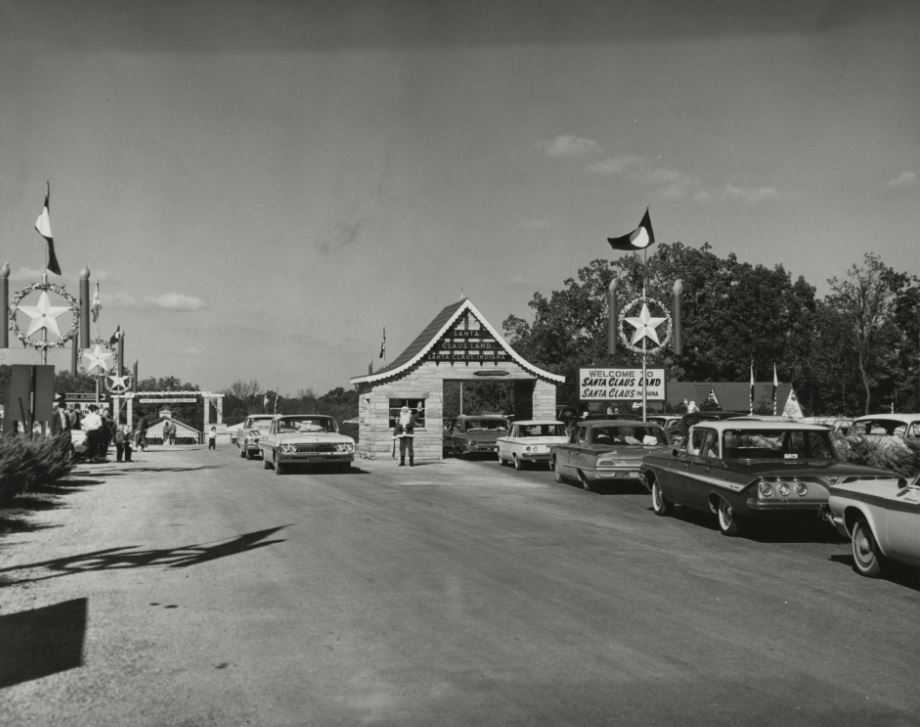
Entrance to Santa Claus Land, 1951, courtesy of J. Willard Marriott Digital Library at the University of Utah.
With the end of the war came new opportunities. In 1946, retired Evansville industrialist and father of nine, Louis Koch, opened Santa Claus Land after being disappointed that the town had little to offer visiting children hoping to catch a glimpse of the jolly man in the red suit. This theme park, reportedly the first amusement park in the world with a specific theme, included a toy shop, toy displays, a restaurant, themed rides and, of course, Saint Nicholas.
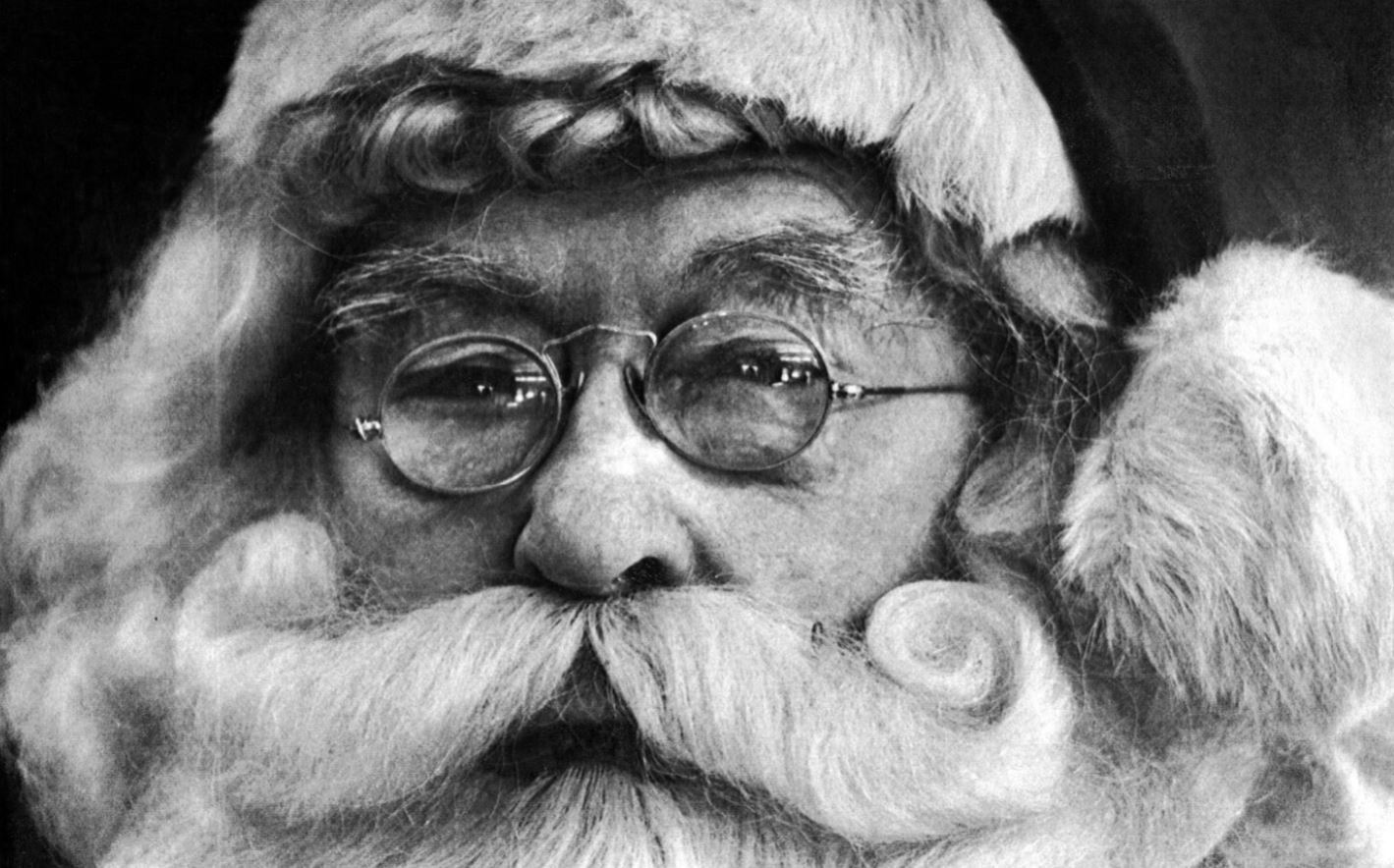
This was no run of the mill Santa Claus, though. Jim Yellig would become, according to the International Santa Claus Hall of Fame, “one of the most beloved and legendary Santas of all time.” Yellig had donned the red and white suit at the Candy Castle and volunteered to answer letters to Santa for years before becoming the resident Santa at the new park, a position which he held for 38 years. During his tenure as Saint Nick, Yellig heard the Christmas wishes of over one million children.
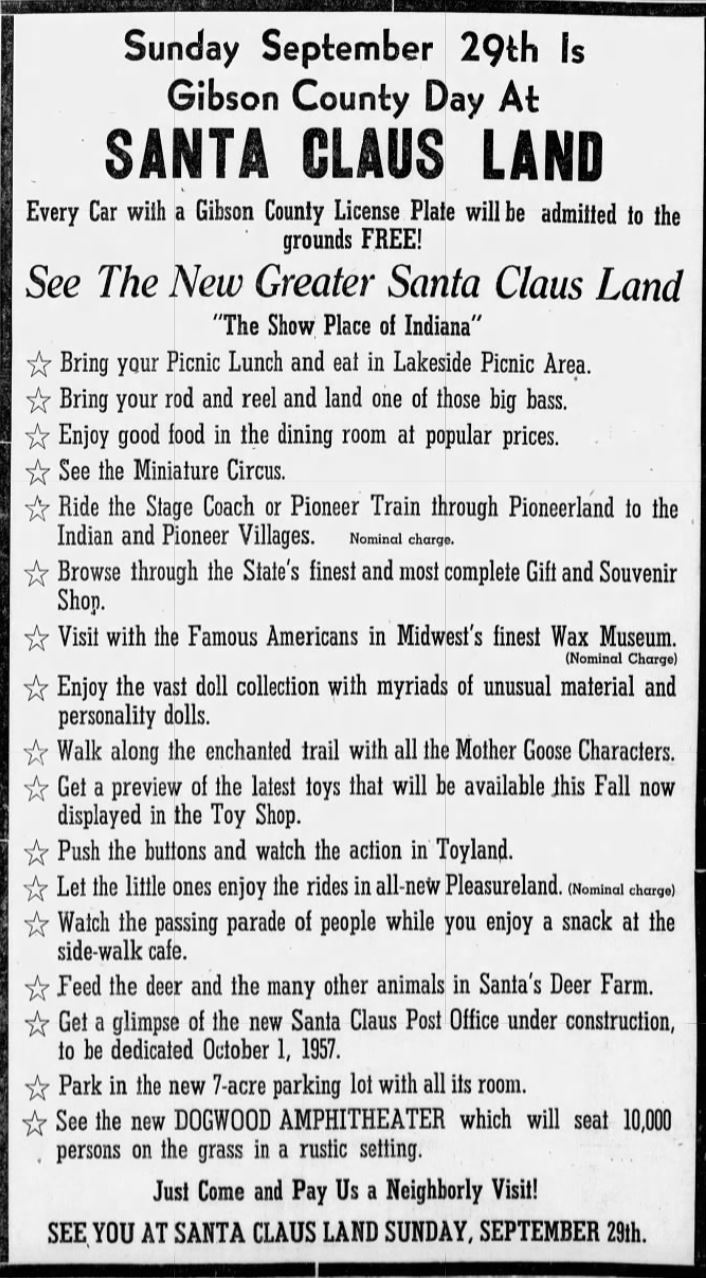
Jim Yellig, Santa Claus at Santa Claus Land, courtesy of the Allen County Public Library Digital Collections.Santa Claus Land advertisement, Princeton Daily Clarion, September 25, 1957, 8, accessed Newspapers.com.
Throughout “Santa Jim’s” tenure, Santa Claus Land continued to grow, thanks in large part to Louis Koch’s son, Bill Koch, who took over operation of the park soon after its founding. By 1957, the park offered a “miniature circus,” a wax museum, Santa’s Deer Farm, and an outdoor amphitheater. Live entertainment shows, such as a water ski show, started and in the early 1970s rides such as Dasher’s Seahorses, Comet’s Rockets, Blitzen’s Airplanes, and Prancer’s Merry-Go-Round were added. And in 1984, the Koch family expanded from a strictly Christmas-themed park to include Halloween and Fourth of July sections and changed its name to Holiday World. Still in operation today as Holiday World & Splashin’ Safari, the theme park, which features what are considered some of the best wooden roller coasters in the world, welcomes over 1 million people per year.
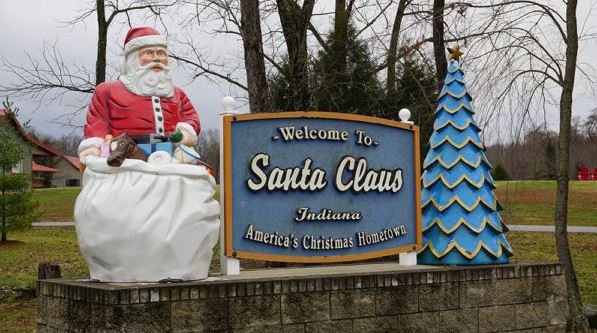
Current Santa Claus, Indiana welcome sign, courtesy of Santa Claus, Indiana.
Today, the town of Santa Claus is more “Christmas-y” than ever. Many of its 2,400 residents live in Christmas Lake Village or Holiday Village on streets with names like Poinsettia Drive, Candy Cane Lane, or Evergreen Plaza. The Candy Castle was renovated and reopened in 2006 and is known for its wide selection of cocoas and its Frozen Hot Chocolate. Carl Barrett’s 22-foot Santa Statue was restored by Holiday World in 2011 and now welcomes tourists from all over the world. Visitors to Holiday World can stay at Lake Rudolph Campground and RV Park or Santa’s Lodge. Every Christmas season, the small town comes alive with festivals, parades, and even Christmas fireworks. And, of course, dedicated volunteers still answer children’s letters to Santa, even if they sound a little different than they used to.
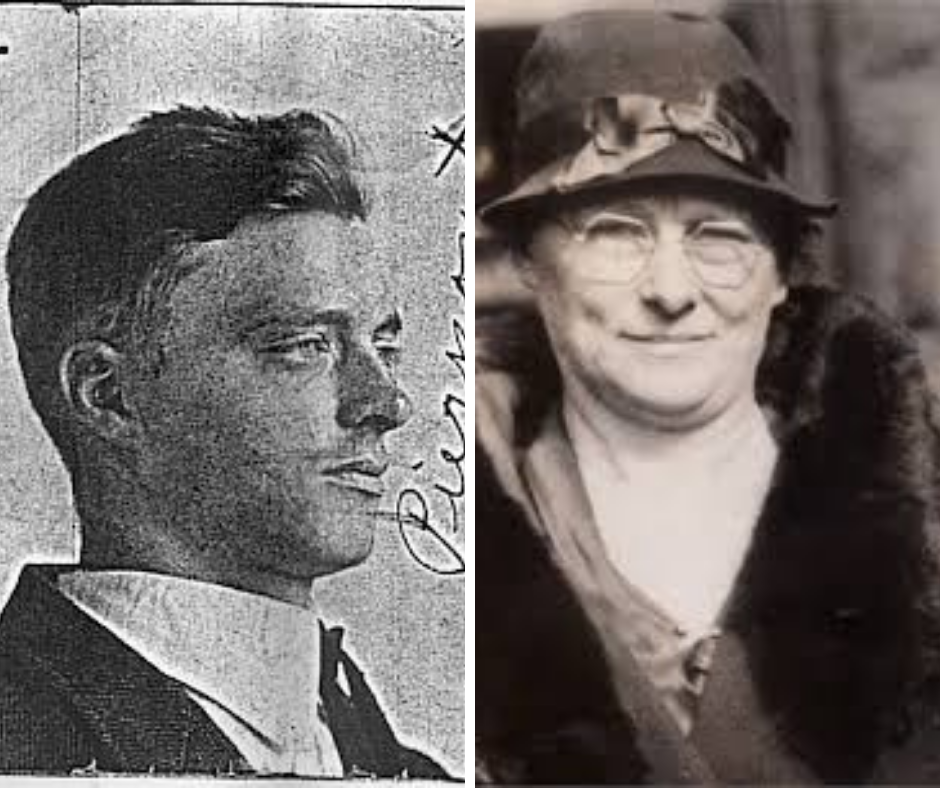
“Harry is a fine boy, he never told me a lie in his life,” Lena Pierpont proclaimed about her son, “Handsome Harry” Pierpont, who was considered the brains of the John Dillinger gang.[1] Like many families, the Pierponts rallied around their son in times of trouble. The extent to which they defended Harry demonstrated both the depths of parental love and the pitfalls of willful ignorance. Harry’s troubles centered on the frenzied period between September 1933 and July 1934, when the Dillinger gang became America’s most wanted criminals for a crime spree that impacted Indiana communities big and small.
While Dillinger became the FBI’s very first “Public Enemy Number 1,”[2] 32-year-old Harry Pierpont was often credited with being the architect of the Dillinger gang’s crimes, and the mentor who helped make Dillinger a skilled criminal.[3] Born in Muncie in 1902, Pierpont had amassed a lengthy criminal history long before meeting up with Dillinger. Pierpont was linked to a series of 1920s bank and store robberies across the state, including in Greencastle, Marion, Lebanon, Noblesville, Upland, New Harmony, and Kokomo, prior to landing in the Indiana State Prison at Michigan City – where he befriended and mentored Dillinger.
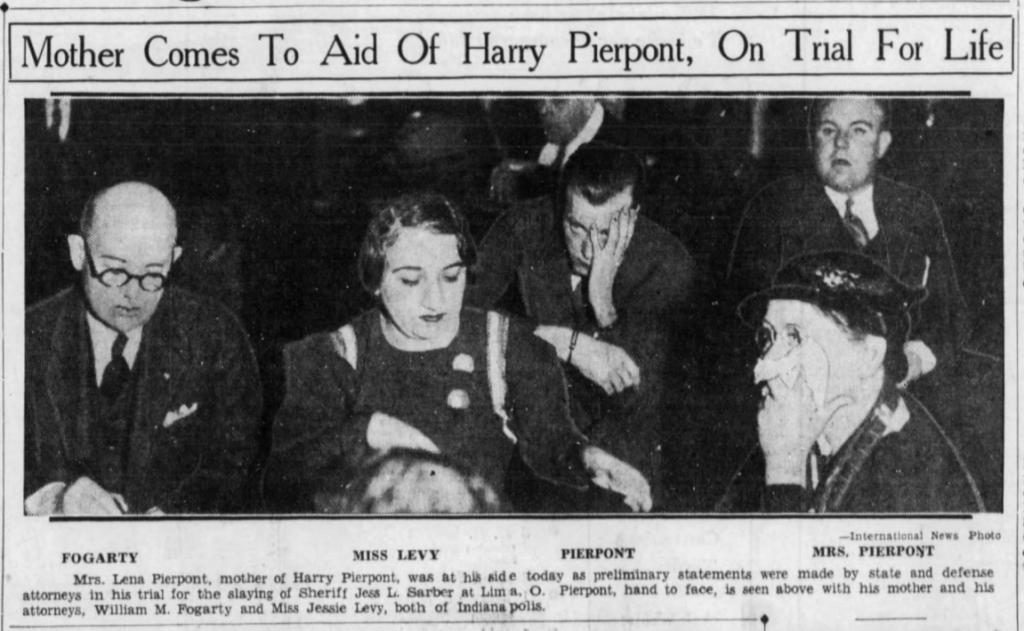
Pierpont’s criminal sophistication, however, had not spared him from arrest. By July 1934, he was arrested and awaited execution in Ohio for the murder of Lima County Sheriff Jesse Sarber. The sheriff had been killed in October 1933 as gangsters broke Dillinger out of the county jail. Pierpont’s mother, Lena, and father, J. Gilbert, instinctively believed in their son’s innocence and grew resentful over the “persecution” they said they endured from authorities after they had relocated from Ohio to Goshen, Indiana in April 1934. Pierpont’s beleaguered parents had come to the Hoosier city to try and “make an honest living in a respectable business.”[4]
By mid-July, with Dillinger still at large (although only days away from being slain by federal officers in Chicago), the Pierponts were under constant surveillance in an all-out effort to locate Dillinger. They had rented a “barbeque and beer parlor” on what was then called State Road 2 (now U.S. 33 West). Known as the “Cozy Corner Lunch” spot, the roadhouse was a half mile northwest of the famous A.E. Kunderd gladiola farm just outside the Goshen city limits.[5] Conducting what she called her first “free will interview” given to a journalist, Lena told the The Goshen News Times & Democrat, “I am going to try and open this place and run a legitimate business as soon as these men stop trailing us. Mr. Pierpont (her husband) is ill and unable to work, so all we want is to earn an honest living.”[6]
The Goshen News Times & Democrat reported that the Pierponts had rented the barbeque stand on an one-year lease offered by a couple identified as Mr. and Mrs. Rodney Hill. Although summer was nearly half over, the Pierponts had not opened for the year because a requisite beer license was still pending. The Pierponts believed this was held up by local officials facing pressure from federal authorities. Lena bitterly explained that the couple had sold all of their farm goods in Ohio in order to open the Goshen business.
“We should not be persecuted,” Lena explained. “We’re simply unfortunate. The government should call off its detectives and allow us to live as other good American citizens.” She pointed at a car parked about a quarter mile away and said, “See that car down the road? They’re always watching us.” She alleged that “Every minute for 24 hours a day we’re shadowed. They think we know (John) Dillinger and that he may come here. We don’t know him and we don’t want to.”[7] She insisted that her son was hiding in the attic of her home on the night the Ohio sheriff was killed, and while he was a fugitive escapee from the Indiana State Prison at the time, he was no murderer.[8]
Lena suggested that if she and Gilbert did know Dillinger maybe “we could get a deposition from him to the effect that our son, Harry, did not kill Sheriff Jess Sarber at Lima, Ohio.” Harry had assured her that Dillinger would clear him of the murder “and name the real slayer,” thus saving her son from the electric chair in Ohio.[9] The Indianapolis Times reported in September, Lena successfully arranged to meet with him in Chicago. According to her account, when asked who freed him from the Lima jail, Dillinger said “‘I’ll tell you who turned me out. Homer Van Meter is the man who fired the shot that killed Sarber and Tommy Carroll and George McGinnis are the men who were in the Lima jail and turned me out.'”[10]
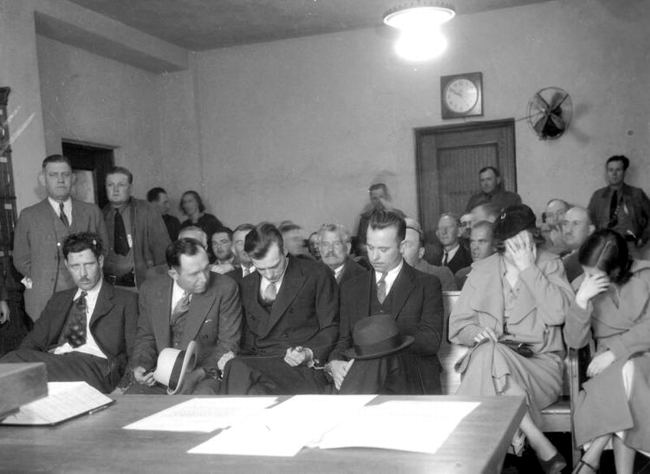
Members of the Dillinger outlaw gang, Russel Clark, Charles Makley, Harry Pierpont, John Dillinger, Ann Martin and Mary Kinder, are arraigned in Tucson, Arizona on January 25, 1934, courtesy of the Associated Press.
Although used to letting his wife serve as family spokesperson, Gilbert Pierpont told an enterprising reporter from The Goshen News-Times & Democrat, “Harry (Pierpont) will not die for the murder of Sheriff Sarber. We are looking for a reversal of the Lima verdict by the Ohio Supreme Court. If not, the case will go to the United States Supreme Court.”[11] Harry’s angry and reportedly ill father said he didn’t like talking to reporters “because of so many false statements they have made about my son.” Contrasting her ailing husband, Lena “was jovial during the interview” and “jokingly remarked that the press would have it all wrong” when writing about her son.[12]
State and federal law enforcement officials were quick to impeach the Pierponts. Captain Matt Leach, who headed the effort of the Indiana State Police to bring the marauding gang to justice, actually identified Pierpont as “the brains” of the Dillinger gang. It was Pierpont, Leach said, who came up with the idea of springing Dillinger from the county jail in Lima by posing as Indiana police officers. When Sheriff Sarber demanded to see their credentials, Pierpont reportedly said, “Here’s our credentials,” and fired multiple shots into the lawman, killing him instantly.[13]
It was a short-lived, but “productive” period of freedom for thirty-one-year-old Dillinger after being sprung from the Lima jail. During this stint, he led his gang in a bold April 12, 1934 raid on the Warsaw Police Department, where they seized a cache of guns. The gang also conducted a deadly robbery of the Merchants National Bank in downtown South Bend on June 30, killing a police officer and injuring four others in a brazen sidewalk shootout. Federal agents put a stop to the spree when they gunned down Dillinger on the streets of Chicago on July 22, just nine months after the Pierpont-led escape from the Ohio jail.
The Akron Beacon Journal, March 8, 1934, 1, accessed Newspapers.com.
While Dillinger met his “death sentence” on a Chicago street, Pierpont remained on Ohio’s death row for the murder of Sheriff Sarber. Lena said she and her husband would continue to make the journey of more than 200 miles from Goshen, Indiana to Columbus, Ohio, “every weekend” to see their son. “We will continue to do this as long as we have any money,” she said.[14] Lena also declared she would continue to challenge state and federal authorities for their alleged harassment of her family. She had reportedly talked to an Elkhart attorney about bringing suit against state and federal authorities.
“We are unfortunate that our son is in prison under sentence of death,” Lena said, adding “No other members of our family have a criminal record. We should not be persecuted. They tell us that these men, who are constantly nearby in parked automobiles ready to follow us at any time we may leave, are federal government men.”[15] Lena’s claim that her son Harry was the only member of her family who had run afoul of the law was not accurate. The Pierponts’ younger son, Fred, 27, and Lena herself, were both arrested and held on illegal possession of weapons charges and vagrancy in Terre Haute in December 1933. A car driven by Lena on the day she was arrested contained almost $500 in cash and a sawed-off shotgun.
To publicize her claims of harassment, a day after granting an exclusive interview to The Goshen News Times & Democrat (picked up by the Associated Press and reported by newspapers across the nation), Lena marched into the Elkhart County Courthouse at Goshen, demanding that she be granted her long-delayed beer license and that an “order of restraint” be placed against detectives following them.[16] Despite his family’s attempts to win over “the court of public opinion,” as summer gave way to fall in 1934, Harry’s appeals to the Ohio Supreme Court were coming to no end other than delaying his execution. Surprisingly, in late September, Pierpont and fellow Dillinger gang member, Charles Makley, staged a spectacular, yet unsuccessful escape attempt from the Ohio Penitentiary. Fashioning realistic-looking handguns made of soap (and blackened with shoe polish), Pierpont and Makley were immediately “outgunned” by prison guards, who killed Makley and critically wounded Pierpont in a shootout.[17]
By October, Pierpont could no longer escape his fate. As one reporter noted, Pierpont “whose trigger finger started the John Dillinger gang on its short but violent career of crime that blighted everything it touched, must die in the electric chair at the Ohio Penitentiary.” Prison officials reported “the doomed man has reconciled himself to death and embraced his former faith, the Roman Catholic religion.”[18]
Sullen and weakened by the gunshot wounds sustained during his failed prison escape, Pierpont strongly contrasted with “the braggart who once boasted he would kill every cop on sight.” Now, jailers said, Pierpont wished out loud that he too had been fatally wounded in the prison shootout.[19] “Pierpont’s mother, Lena, by this time living near Goshen, Indiana, and his sweetheart, Mrs. Mary Kinder, an Indianapolis gang ‘moll,’ are remaining true to the fallen gangster to the last,” one newspaper account told. Kinder, whom reporters were quick to point out was previously married, “even went to Columbus recently[,] determined to marry Harry in prison before he dies.”[20]
South Bend Tribune, October 19, 1934, 1, accessed Newspapers.com.
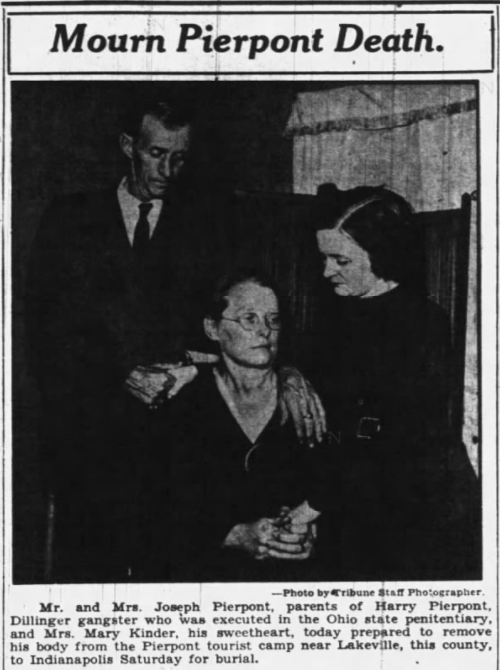
On October 17, 1934, the “fair-haired brains of the dissolved Dillinger mob” was executed. The Associated Press noted, “Quietly, unaided and with the ghost of a smile on his lips, the 32-year-old killer sat down to death in the gaunt wooden chair within the high stockade of the prison guarded in unprecedented fashion.”[21] Reporters who witnessed the execution said Pierpont “was not asked for any ‘last word,’ and he volunteered none. He just sat down with a rueful smile, closed his eyes, strained the muscles of his lanky, six-foot-two frame, as the current struck, clenched one fist – and that was all.”[22] A national wire photo showed Kinder comforting Lena and Gilbert at their new home along U.S. 31 in Lakeville in St. Joseph County, where they had moved after their failed attempt to start a roadhouse near Goshen.
A funeral was conducted for Harry inside the Pierponts’ home, led by a priest from the Sacred Heart Catholic Church of Lakeville. The services were held an hour earlier than was announced to keep reporters away. Harry Pierpont had told Ohio prison officials that he desired a “simple, but lavish funeral” and wanted his remains be released to his parents in Indiana.[23] The South Bend Tribune reported, “His casket was adorned only by a small wreath of artificial flowers, and lay grotesquely surrounded by canned goods and automobile accessories in his parent’s home store.”[24] Harry was eventually buried at the Holy Cross and St. Joseph Cemetery in Indianapolis.
Lena Pierpont would appear in the news one more time for her resilience. In the summer of 1937, Lakeville town authorities took court action to rid the village of “a band of roving coppersmiths” who had settled at Lena’s White City Inn. Surely she refused to oust them because she needed the income in the lean Depression years, but perhaps she also related to those on the fringes of society, trying their best to survive.[25]
The Pierponts suffered another tragedy when Harry’s younger brother, Fred, died in March 1940 at the age of 33 from injuries suffered in a car crash near South Bend. Perhaps being forced to hone the art of resilience due to the upheaval wrought by Harry helped them survive this second blow. Lena died in her Lakeville home on October 21, 1958 at the age of 78. Her long-suffering husband Gilbert, died three years later also at Lakeville at the age of 80. They were buried alongside their infamous son in Indianapolis.[26]
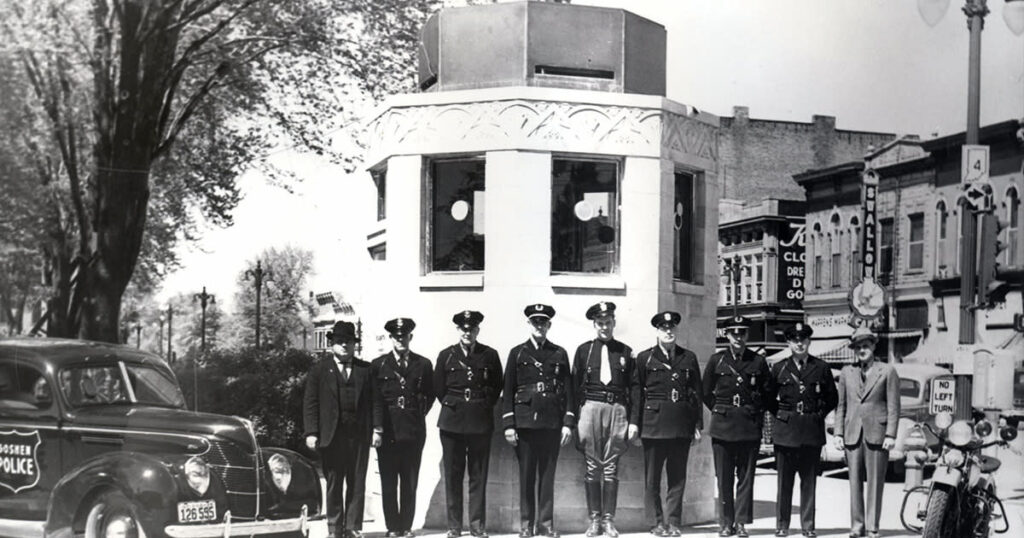
* Interestingly, the Goshen connection to the Dillinger gang, beyond the Pierponts’ battles there, is forever enshrined in the city’s limestone police booth opened in 1939. The impressive octagon structure sits on the corner of the Elkhart County Courthouse square, opposite Goshen’s two largest banks. Complete with bulletproof glass (donated by two of the city’s banks), the booth (partially funded by Works Progress Administration dollars) was never called into duty as Goshen’s banks escaped being robbed.
Sources:
*Primary documents were accessed via Newspapers.com, the Goshen Public Library, and the Goshen Historical Society.
[2] Andrew E. Stoner “John H. Dillinger, Jr.” in Linda C. Gugin and James E. St. Clair, eds., Indiana’s 200: The People Who Shaped the Hoosier State (Indianapolis: Indiana Historical Society Press, 2015), 96.
[3] Patrick Sauer, “Harry Pierpont: John Dillinger’s Mentor” in Julia Rothman and Matt Lamothe, eds., The Who, the What, the When: Sixty-Five Artists Illustrate the Secret Sidekicks of History, (San Francisco: Chronicle Books, LLC., 2014), 42.
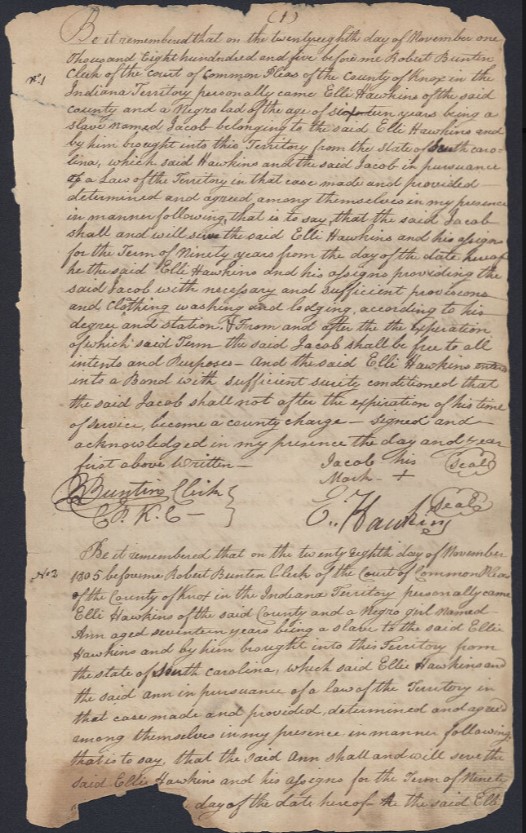
Slave Registry, Indiana Territory, Knox County, 1805-1807, Early Vincennes Collection, Knox County Public Library, accessed Indiana Memory.
Black Hoosiers helped shape Indiana by establishing early farming communities, preserving the Union through service in the Civil War, gaining suffrage for women in the 1920s, defending democracy in WWI and WWII, and expanding equality and political power throughout the Civil Rights Era and beyond. But Black Hoosiers also suffered enslavement in Indiana, violent persecution, discrimination in jobs and housing, Jim Crow laws, and lynching.
Many Black Hoosiers and Black Americans continue to feel the stress imposed both by the continued disproportionate violence against people of color as well as the inherited traumas of the past. Already facing entrenched and systemic racism in American culture, people of color have additional burden of social media and news outlets filled with images of violence, sometimes fatal, against Black people. These images only reinforce the brutal American legacy of slavery, lynching, and Jim Crow.[1]
This racial trauma impacts mental health, sleep patterns, appetite, fertility, and susceptibility to disease, among other detriments. According to Safe Black Space, a community organization promoting healing, people of color “are experiencing trauma related to systemic racism and are feeling the impact of our humanity not being valued.” Their statement continues:
Some of us avoid our feelings or numb out. Some of us experience fear that something bad is going to happen to us or to our loved ones. Some of us are struggling with rage and frustration. It can be overwhelming.[2]
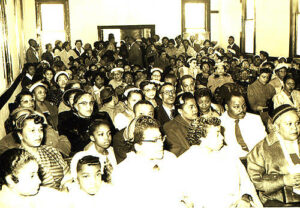
“Trinity United Methodist Church (Muncie),” photograph, 1948, Other Side of Middletown Photographs, Ball State University Digital Media Repository, accessed Indiana Memory.
But sacred Black spaces have been and continue to be essential to healing from this trauma, feeling safe, breathing deeply, and reclaiming health. The history of overt racism and violence inflicted on Black Hoosiers by their white neighbors makes clear just how important Indiana’s African American churches were to Black Hoosiers in centuries past. Since at least the early 19th century, Black Hoosiers gathered in small churches across the state to worship, celebrate, and socialize – but also to organize opposition to voter suppression and the Klan, to form local NAACP and Urban League branches, and organize protests and rallies that furthered civil rights.
Local history can show us the extraordinary in the ordinary, the bravery of average folks, and the work of a community to make the world just a little better. Allen Temple in Marion, Indiana was not unlike other Black churches in the Midwest or even others in Grant County. And yet, Allen Temple pastors and members pushed their community to desegregate, to increase rights of African Americans, and to stop violence against Black Marion residents. And those feats are no less remarkable for being reflected by other churches. The Civil Rights Movement and the gains it brought Black Americans was not an inevitable wave of progress. This wave was made up of individual droplets of hard work and bravery by small groups of people like those who found a home at Allen Temple African Methodist Episcopal Church.
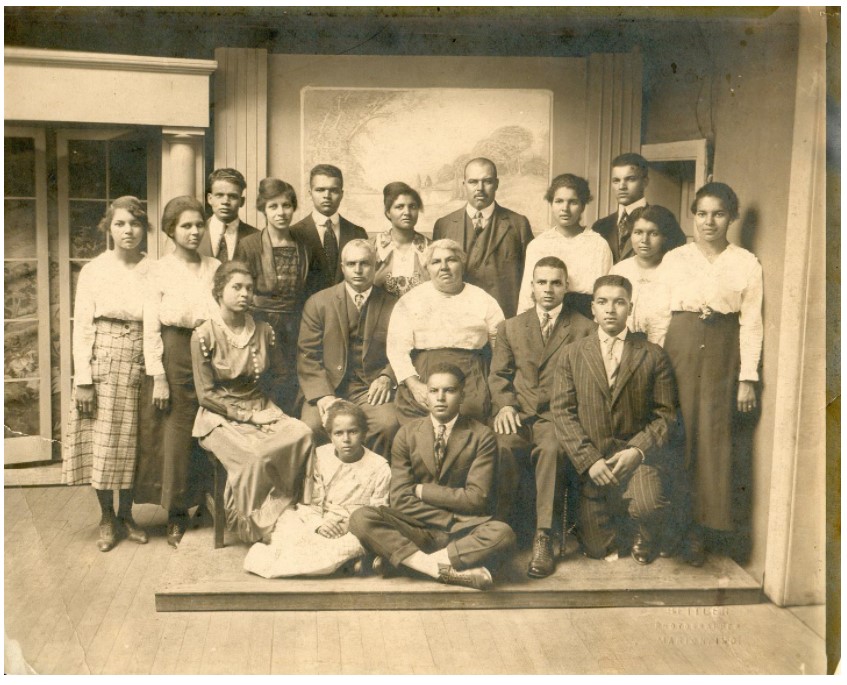
Family of Joseph and Martha Pettiford at Weaver Settlement, n.d., accessed Free African Americans.
Allen Temple’s history is rooted in Weaver Settlement. Black pioneers fleeing threats to their freedom in southern slave states founded this nearby Grant County community by the 1840s. Weaver grew over the decades as the pioneers were joined by other free and formerly enslaved families. These hardworking Black settlers established productive farms and the settlement grew to over 3000 acres by 1860. As the self-sustaining community thrived, residents built schools, churches, and stores, and male residents participated in the political process. But farmers could only divide their land between so many children before the plot would no longer be able to sustain a family. One or two children would inherit the farm, while others would have to find work elsewhere. By the 1880s, the descendants of the settler-farmers were looking to Marion for employment opportunities.[3]
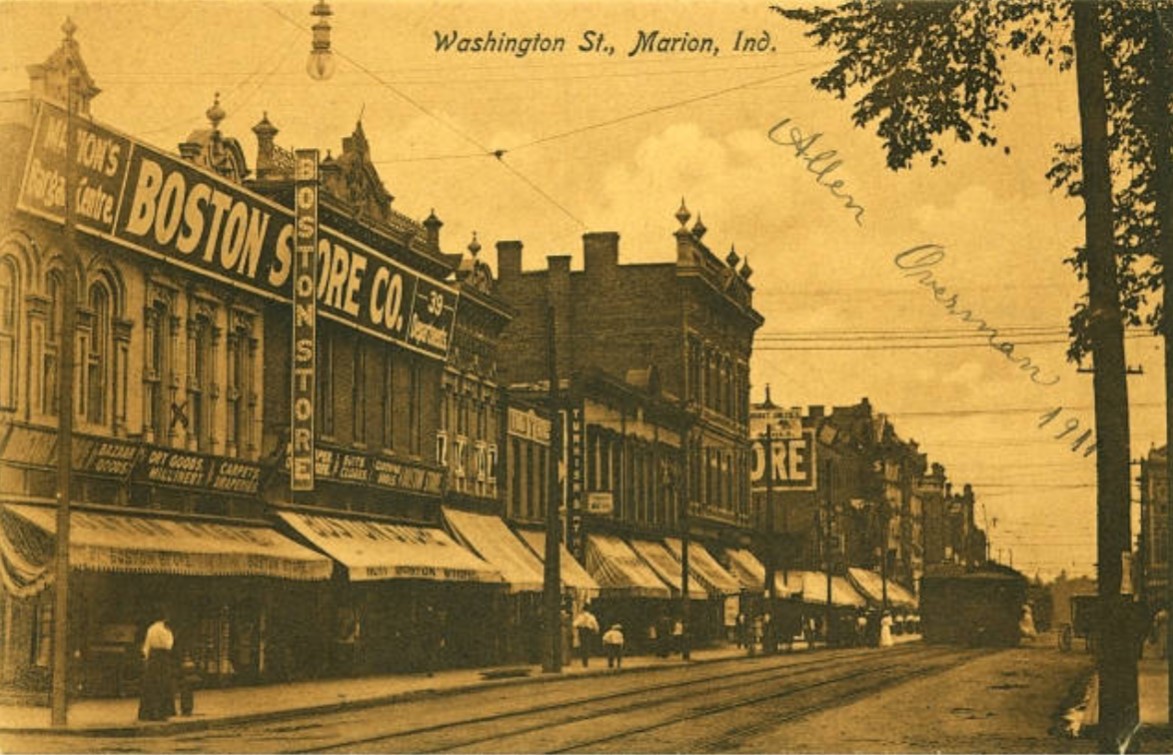
As more African Americans moved to Marion, the Rev. G. W. Shelton, who served as pastor of Hill’s Chapel at Weaver Settlement, began organizing a new A.M.E. church in South Marion. Marion residents had already established an A.M.E church on 5th Street in the city’s downtown, but Weaver residents settling on the southside needed both a religious and civic center in that area. Rev. Shelton completed the organization of the as-yet-unnamed church in September 1900. Church and county histories report that the congregation first gathered in a private home. By November 1901, the congregation purchased the church building at Washington and Thirty-Fifth Streets from a Protestant congregation.[4]
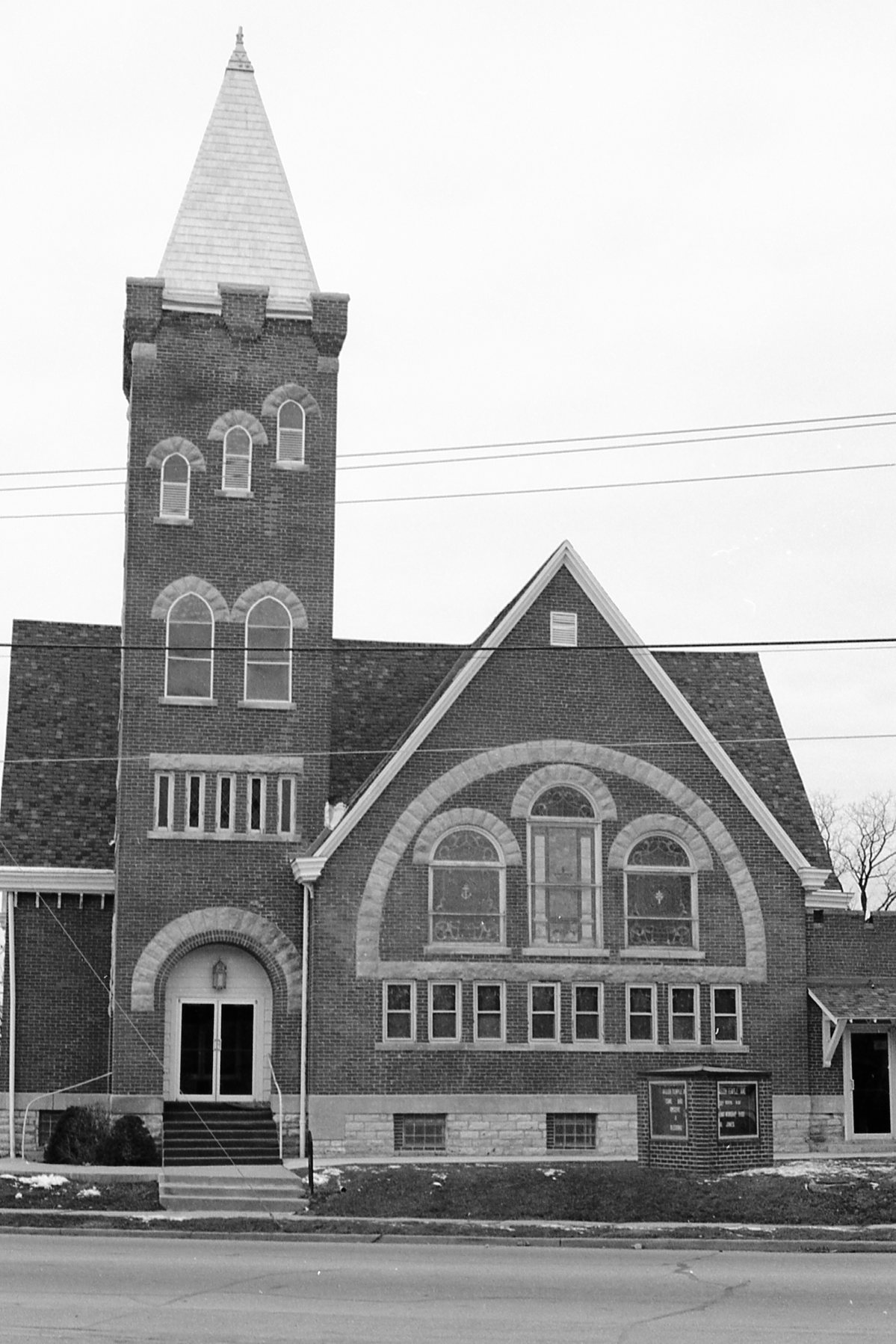
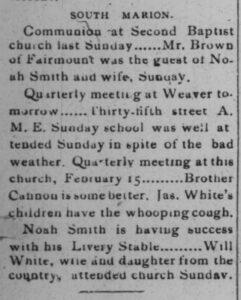
Indiana Department of Natural Resources, “Allen Temple African Methodist Episcopal,” IHSSI County Survey, SHAARD Database, Indiana Historic Buildings, Bridges and Cemeteries Map, accessed arcgis.com.“South Marion,” Indianapolis Recorder, February 7, 1903, 3, Hoosier State Chronicles.
Most of the information about Allen Temple’s early history comes from columns in the Indianapolis Recorder reporting on the Black communities of Weaver and Marion. For several years of the church’s early history, the newspaper referred to the church as “the South Marion Mission” or “the 35th Street A. M. E. Church.” From 1901 to 1904, church leadership organized a choir, raised funds for improvements, and established a Sabbath School. Congregants hosted social dinners, Thanksgiving suppers, and lectures by prominent religious leaders.[5]
“Pastor of the 35th Street Church,” Marion News-Tribune, July 23, 1905, 7, microfilm, Marion Public Library.
In 1905, the congregation finished remodeling the building and the church joined the Indiana A.M.E. Conference, officially making it a part of the larger A.M.E. hierarchy and organization. Finally, on July 23, 1905, the church received the name Allen Temple during a “grand rally.” More than 600 African American residents of Marion and surrounding communities attended a corner stone laying celebration. Allen Temple Rev. J. J. Evans, leading regional A.M.E. clergy, the prestigious “colored Masons,” and the Marion mayor were among those who led the ceremonies. Church leaders chose the name Allen Temple to honor Bishop Richard Allen, the founder of the African Methodist Episcopal denomination.[6]
Over the following decades, Allen Temple hosted fundraisers and revivals, often sharing members and pastors with Hill’s Chapel, and worked to pay off its mortgage.[7] Meanwhile, Marion prospered from the gas boom and industrial workers organized and became more political. By the end of WWI, the city boomed. According to historian James Madison, “Lining the Courthouse Square in the 1920s were banks, clothing stores, drug stores, ice cream parlors, cigar stores, and theaters, some spreading a block or so off the square.” Black Marion residents were among the city’s business owners, professionals and civic employees. But they were not welcome everywhere in their own hometown.[8]
“Washington Street, Marion, Ind.,” postcard, c. 1911, Postcards of the Jay Small Collection, Indiana Historical Society Digital Collections, accessed Indiana Memory.
Black residents did not have access to a number of Marion businesses and recreational attractions. Segregation was the rule, despite the 1885 Indiana Civil Rights Act that legally gave African Americans the right to patronize these establishments. In addition, bootleggers and gamblers brought increased crime as they flouted Prohibition. The police were reportedly apathetic at best. Most alarmingly, the Ku Klux Klan rose in power as many white Protestant Hoosiers turned their fears of crime, immigration, and increased diversity into an organized force for hate and discrimination.[9] But these forces did not go unchallenged.
When NAACP state president Katherine “Flossie” Bailey organized a Marion branch in 1918, Allen Temple Rev. W. C. Irvin signed on as a founding member.[10] Allen Temple clergy would continue to serve the NAACP at the state and local level throughout the church’s history. In September 1929, Bailey brought African American U.S. Representative Oscar DePriest to Allen Temple. Speaking to a large crowd of Black congregants and residents, DePriest called on the audience to vote and “to stand together.”[11] Again, Allen Temple was not unique as a civil rights organizational center. Black churches across the country served this role. Allen Temple was not even unique in Marion, as several other churches hosted civil rights rallies and speakers as well. But that does not make it less heroic.
“Oscar DePriest,” glass negative, 1929, National Photo Company Collection, Library of Congress.
In September 1930, a white mob tore three Black teenagers, accused but not convicted of crimes against two white Marion residents, from the Marion jail. The mob then beat, mutilated, and lynched Tom Shipp and Abe Smith. The perpetrators left the young men’s bodies hanging as a message to Black residents that “they were at the mercy of white residents,” according to historian Nicole Poletika. The story of the 1930 Marion lynchings has been thoroughly and sensitively told elsewhere by other scholars, notably by James H. Madison in his 2001 monograph Lynching in the Heartland.[12] But understanding that Marion’s Black community was deeply wounded, shaken, and afraid for their lives is important to understanding the significance of the work that Marion’s Black churches accomplished in the shadow of the lynchings.
“Grant Sherriff’s Ousting Is Asked,” Indianapolis Star, August 21, 1930, 9, Newspapers.com.
In the face of this horror and fear, some local Black leaders still found the courage to speak out and call for action. Rev. Hillard D. Saunders, who had only recently been appointed pastor of Allen Temple, joined Bailey and others in demanding legal justice in the wake of the lynchings. They presented the Indiana governor with a petition calling for the removal of the sheriff who failed to protect Smith and Shipp. [13] While Bailey deserves the credit for ultimately leveraging the heinous crimes into anti-lynching legislation, the united support of the local NAACP leaders, Marion clergy, and the courage of every day Black residents demanded the attention of the Indiana General Assembly and governor. [14]
“John Campbell Dancy,” photograph, n.d., accessed Victoria W. Wolcott, “John Campbell Dancy Jr.,” January 19, 2007, BlackPast.org.
Allen Temple members and clergy continued to humbly push Marion towards greater inclusion and equality. In 1945, the church hosted John C. Dancy, executive secretary of Detroit Urban league.[15] Dancy had helped desegregate industrial businesses in Michigan, opening skilled positions to African Americans. He likely spoke to Marion residents on peaceful desegregation tactics.[16] By 1947, Allen Temple hosted regular meetings of the Marion Urban League, which was incorporated in 1942 with a much-needed mission of working “to secure equal Opportunities in all sectors of our society for Black and other minorities.”[17] In May 1949, Allen Temple pastor C. T. H. Watkins joined speakers from Marion College and the Indiana Jewish Community Relations Council at an “interracial fellowship dinner.”[18] By November 1949, the Marion Urban League boasted a membership of 350 African Americans, almost 15% of the city’s Black population.[19]
Yet Marion remained segregated. In 1954, the Marion Urban League and the local NAACP successfully worked to desegregate the public pool, a highly visible symbol of inequality in the city. White and Black Marion residents pushed for increased hiring of Black teachers and police officers throughout the 1950s and 60s, making small but regular gains.[20]
In 1961, A.M.E. leadership appointed the “dynamic” Rev. Dr. Ford Gibson to serve as pastor of Allen Temple. An Indianapolis native and former school teacher with a Ph.D. in sociology, Rev. Gibson had recently served as the president of the Indianapolis NAACP. In 1957 and 1958, Rev. Gibson led “the epic struggle for fair employment” at local supermarkets.[21] Unsurprisingly, when he arrived at Allen Temple, Rev. Gibson invested himself in the fight for greater equality in Marion.
In the summer of 1962, Rev. Gibson and Rev. B. A. Foley of Bethel AME led a campaign demanding an “immediate investigation and the removal” of Marion Postmaster Charles R. Kilgour.[22] The pastors charged that Kilgour, as president of the Francis Marion Hotel, which “allegedly refused to accommodate Negroes,” should be removed from his position as postmaster.[23] Foley and Gibson publicly called on U.S. Attorney General Robert Kennedy to act. Rev. Gibson, who had also served as president of the Indiana chapter of the NAACP, addressed a crowd of 300 people at a mass meeting. According to the Indianapolis Recorder, the pastor stated that the Black residents of Marion “will not stop until segregation is dead and buried and never to rise again.”[24]
“Rev. Ford Gibson Re-Elected NAACP President for Year,” Indianapolis Recorder, December 27, 1958, 1, Hoosier State Chronicles.
While Kilgour kept his job, Rev. Gibson continued his calling. Rev. Gibson went on to serve the NAACP as the president of the Indiana Conference of Branches and president of Region 11, which included eight state organizations. He also joined the 1964 March on Washington and worked for the passage of the Civil Rights Act.[25] While Black Americans continued to make progress toward equality, Marion still had a long way to go.
By July 1969, the city was on edge. The Marion NAACP reported “continued police brutality, abuse, harassment and refusal to protect young black people in that city.”[26] White residents blamed local Black youth for a series of firebombings that destroyed a lumber company and country club.[27] The Marion NAACP reported “arrests of black victims of unprovoked assaults by white hoodlums and the holding of young black people in custody and refusal of bonds on illegal grounds.”[28] At the same time, the Marion city council approved the purchase of police dogs, threatening to further escalate violence.[29]
Charles Moore, “Civil Rights Demonstrations, Birmingham Protests,” photograph,1963, Collection of the Smithsonian National Museum of African American History and Culture, accessed Smithsonian.
On July 19, the Indianapolis Recorder reported on the national NAACP convention where the organization addressed the escalating violence in Marion. Marion representatives reported that in only one week, seventy-five Black residents had been arrested by Marion police “in a fashion of harassment and intimidation.” Once jailed, authorities were demanding excessive bail bonds of up to $10,000. Most alarmingly, the Marion NAACP leadership, including local branch president Carlyle Gulliford, received death threats.[30]
“Marion NAACP Elects,” Indianapolis Recorder, February 25, 1956, 9, Hoosier State Chronicles. [Carlyle Gulliford pictured far right.]In response, NAACP president Roy Wilkins called on the state NAACP organizations of Indiana, Illinois, Ohio, Michigan, Wisconsin, Kentucky, and West Virginia to descend on Marion for “a seven-state mass protest rally” on July 20.[31] The NAACP published a list of demands for Marion officials, mainly attacking segregation and job discrimination. They demanded the city hire Black firemen, policemen, and officials and called out specific companies who would not hire African Americans, including the municipal phone and light companies. The NAACP also called for fair housing and mortgage practices and for an end to segregation in recreational facilities.[32]
An estimated 3,000 people marched in the name of these demands, including the congregants of Allen Temple. Long time member Pearl Bassett, who was also active in the Urban League and a leader within the state NAACP, remembered the march. She recalled, “We first had the walk from 26th Street to the courthouse for discrimination and equal opportunities for people and jobs. And it was a wonderful thing.”[33] Bassett told the Indianapolis Recorder, “It was so well organized and we accomplished what we set out to do.”[34] Black activists did change Marion, but it took a long time. The city’s civil rights progress trailed the nation and the state. In his book Lynching in the Heartland, Dr. James Madison presents convincing evidence that this stunting of equality was in large part a result of the lingering fear and trauma imposed on the community by the 1930 lynchings.[35]
But for centuries sacred Black spaces have served to heal some of this trauma. In these spaces, people of color can feel heard and process anxiety, engage in prayer and meditation, and become empowered through activism. Thus, these spaces are essential to creating positive change in all communities. By marking and preserving these spaces, we honor those people of color who sought refuge here throughout history- a moment to regain their strength in the face of oppression in order to continue fighting for civil rights. Each small, historically Black church across our state has a story to tell. The Indiana Historical Bureau and the friends and family of Weaver Settlement look forward to dedicating a new state historical marker in 2022 to tell the story of Allen Temple.
Notes:
[1] “Coping with Racial Trauma,” Department of Psychology, University of Georgia, psychology.uga.edu.
[2] Akilah Cadet, “Black Health Matters: Safe Spaces to Exist and Thrive,” January 29, 2021, Healthline, healthline.com; Safe Black Space, “Historical Perspective,” www.safeblackspace.org.
[3]Indiana Historical Bureau, Weaver Settlement State Historical Marker, in.gov/history.
[4] “Weaver,” Indianapolis Recorder, February 25, 1899, 1, Hoosier State Chronicles; “Marion Flashes,” Indianapolis Recorder, September 15, 1900, 5, Hoosier State Chronicles; “Marion Flashes,” Indianapolis Recorder, July 6, 1901, 5, Hoosier State Chronicles; “Marion Flashes,” Indianapolis Recorder, November 16, 1901, 5, Hoosier State Chronicles; Asenath Peters Artis, “The Negro in Grant County,” 1909, in Centennial History of Grant County, 1812-1912, edited by Ronald L. Whitson (Chicago: Lewis Publishing Co., 1914), 348-57, accessed Archive.org. Church histories produced by Allen Temple report that the congregation first met in the home of local resident Turner Wallace. IHB was unable to confirm the claim with census or newspaper research. Noted local historian Aseneth Peters Artis reported in 1909 that the congregation then purchased the building at Washington and Thirty-Fifth Streets from a Protestant congregation in 1901. This would have to have occurred in the second half of the year as the Indianapolis Recorder reported in July 1901 that the congregation was looking to build a church. By November 1901, the Indianapolis Recorder reported that “the South Marion Mission held services in the Methodist Protestant Church on 35 street.” It still took the congregation some years to pay off the mortgage.
[6]“Marion Flashes,” Indianapolis Recorder, July 8, 1905, 3, Hoosier State Chronicles; “Conference Meets,” Indianapolis Recorder, July 22, 1905, 1, Hoosier State Chronicles; “Pastor of the 35th Street Church,” Marion News-Tribune, July 23, 1905, 7, microfilm, Marion Public Library; “Great Event,” Marion News-Tribune, July 24, 1905, 2, Marion and Grant County File, Marion Public Library.
[8] James H. Madison, A Lynching in the Heartland: Race and Memory in America (New York: Palgrave, 2001), 32.
[9] Madison, 30-42.
[10] Marion Indiana Branch National Association for the Advancement of Colored People, Application for Charter, Date of Organization Meeting: November 28, 1918, NAACP Founding Documents, Library of Congress, copy available in IHB’s Allen Temple marker file.
[11] “Marion Group to Escort DePriest,” Kokomo Tribune, September 7, 1929, 11, Newspapers.com; Madison, 60.
[12] Madison, passim.
[13] “A. M. E. Church Appointments Made Public,” Indianapolis Times, October 1, 1929, 16, Hoosier State Chronicles; “Grant Sherriff’s Ousting Is Asked,” Indianapolis Star, August 21, 1930, 9, Newspapers.com.
[14]Nicole Poletika, “Strange Fruit: The 1930 Marion Lynching and the Woman Who Tried to Prevent It,” Untold Indiana, May 15, 2018, blog.history.in.gov.
[15] Merle L. Thruston, “Marion, Ind.,” Indianapolis Recorder, February 24, 1945, 15, Hoosier State Chronicles.
[16] “John Campbell Dancy,” photograph, n.d., accessed Victoria W. Wolcott, “John Campbell Dancy Jr.,” January 19, 2007, BlackPast.org.
[17] “Urban League, Carver Center Hold Annual Meet at Marion,” Indianapolis Recorder, December 13, 1947, 9, Hoosier State Chronicles; “Marion Urban League Stages Campaign; Seeks 600 Members,” Indianapolis Recorder, May 7, 1949, 9, Hoosier State Chronicles.
[18] “Fellowship Meet Addressed by Local Cleric, at Marion,” Indianapolis Recorder, May 14, 1949, 9, Hoosier State Chronicles.
[19] “Marion Urban League Lauded at Meet: Work of Marion Urban League Wins Praise,” Indianapolis Recorder, November 12, 1949, 9, Hoosier State Chronicles.
[20] Madison, 130-138.
[21] “Hoosier Minister Gets Degree in California,” Indianapolis Recorder, August 25, 1951, 6, Hoosier State Chronicles; “Rev. Ford Gibson Re-Elected NAACP President for Year,” Indianapolis Recorder, December 27, 1958, 1, Hoosier State Chronicles; “Ministerial Appointments Are Made at AME 123rd Meet,” Indianapolis Recorder, November 18, 1961, 9, Hoosier State Chronicles.
[22] “Marion Hotel Owner Under ‘Bias Fire:’ Ind. Postmaster Party to Charge of Jimcrowism,” Indianapolis Recorder, June 30, 1962, 1, Hoosier State Chronicles.
[23] Ibid.
[24] “AME Minister Scores Racial Bias at Marion, Ind,” Indianapolis Recorder, July 7, 1962, 1, Hoosier State Chronicles.
[25] “Dr. Ford Gibson Assumes New AME Church Post,” Indianapolis Recorder, July 6, 1968, 13, Hoosier State Chronicles; “Dr. Ford Gibson to Speak Sun. at Allen Chapel AME,” Indianapolis Recorder, January 11, 1969, 7, Hoosier State Chronicles.
[26] “NAACP Protests Racial Atrocities at Marion,” Indianapolis Recorder, July 5, 1969, 1, Hoosier State Chronicles.
[27] “Riots Engulf Three Hoosier Cities,” Indianapolis Recorder, July 5, 1969, 1, Hoosier State Chronicles.
[28]”NAACP Protests Racial Atrocities at Marion,” 1.
[29] Madison, 140.
[30] “Wilkins to Address Marion Rally,” Indianapolis Recorder, July 19, 1969, 1, Hoosier State Chronicles.
[31] Ibid.
[32] “3000 Turnout for Marion Protest,” Indianapolis Recorder, July 26, 1969, 1, Hoosier State Chronicles.
[33] Pearl Bassett, Oral History Interview, 2009, University of Southern Indiana, University Archives and Special Collections, David L. Rice Library, University of Southern Indiana.
[34] Annette L. Anderson, “NAACP Victorious Then and Now,” Indianapolis Recorder, July 10, 1993, 11.
“Valpo” is a thriving university today, with some of the best programs in Indiana — and has no connections whatsoever to the KKK. Yet, a century ago, after its rapid rise to national fame, the highly-respected school experienced hard times that took many alumni and faculty by surprise.
Renowned for its economical tuition and low cost of living — as well as for admitting women and students from overseas — by 1905 “Old Valpo” enjoyed one of the highest enrollments of any private university in the U.S. With over 5,000 students that year, the school ranked just behind Harvard. Its affordability to working-class Americans led many to praise it as the aforementioned “Poor Man’s Harvard.”
Students from all over the U.S. and the world trained to be public school teachers there. Some were later busy teaching English to immigrants employed at Gary’s new steel mills. Valpo’s programs in law, engineering, medicine, and dentistry were well-regarded. Its College of Medicine and Surgery had been brought over from Northwestern University in Chicago. When the college moved back to the Windy City in 1926, it formed the nucleus of Loyola’s medical program.
Harvard and Yale might have been too good to take out ads in Chicago newspapers. But this ad from 1905 appeared next to one for another great school on the rise, the University of Notre Dame.
The Inter Ocean, Chicago, August 1, 1905. Newspapers.com.
Yet, once enrollment peaked in 1907, venerable Valpo plunged into an unexpected, two-decade-long decline. After accreditation of American colleges and universities began at the turn of the century — partly driven by a desire to standardize high-school education and thereby “unify” the country — Valparaiso failed to win accreditation. Suddenly unable to transfer their credits, current and prospective students found the school a harder sell, especially as affordable new state universities, teachers’ colleges, and urban night schools entered the competition. Valpo’s lack of a football team and Greek life were another stumbling block, though it hurriedly scraped together a football program in the early 1920s and even played Harvard. (It lost 22-0 in its first game.)
Postcard from Valparaiso University, 1911. Flickr.com.
World War I issued another blow. The famously affordable university had always attracted international students. (One of the more unusual of them was future Soviet Comintern agent Mikhail Borodin, “Stalin’s Man in China,” who would die in a Siberian gulag in 1951.) But after 1914, many of these students left to fight for their European homelands in WWI. When America entered the war against Germany in 1917, student military enlistment left Valpo’s academic and residence halls almost empty. Also, with plenty of war-related jobs now available to women, female students also tended to skip out on college for the duration of the war.
Journal Gazette, Mattoon, IL, July 17, 1923. Newspapers.com.
In 1919, Indiana passed a new law requiring private colleges to maintain a half-million dollar endowment. Cash-strapped Valparaiso University, burdened with a $350,000 debt (almost $5 million in today’s money) faced the real prospect of bankruptcy. The school’s trustees even tried to sell it to the state that year for use as a public teacher’s college, but the Indiana legislature declined the offer.
Holding on by a thread — and led by controversial president Daniel Russell Hodgdon, who turned out to hold fake medical degrees — desperate trustees and the equally-desperate citizens of Valparaiso sought new owners. That list of potential “saviors” grew to include the Presbyterian Church, the International Order of the Moose, and the owner of Cook Laboratories in Chicago, who wanted to turn the campus into a syringe factory and provide 1,000 jobs to townsfolk.
Daily Republican, Rushville, Indiana, August 16, 1923. Newspapers.com.
Then, in August 1923, a new bidder expressed interest. For some residents of Valparaiso — which hosted a parade of at least 6,000 Klansmen in May 1923 that attracted 50,000 visitors from around the Midwest — the offer from the Ku Klux Klan to take over the struggling school seemed like a God-send. Academics, alumni, and students thought differently, especially Catholics and Jews, and many were ready to pack up and leave. Yet, as far as the trustees were concerned, the question of selling Valparaiso University to the Ku Klux Klan mostly came down to whether that organization itself had the resources to made good on its own offer.
The efforts of the revived Klan proved more durable than that which had died out in the 1870s. Klan rallies and parades occurred all over the North and West, from Chicago and L.A. to Oregon and Maine. KKK membership in those years peaked in Indiana, Illinois, and Ohio, “ground zero” for some of the biggest Klan activity. D.C. Stephenson, the Grand Dragon of the Ku Klux Klan in 23 states, operated mostly out of his headquarters in Indianapolis, a city that was almost taken over by Klansmen and Klanswomen; It was also a city that fought a valiant battle in the press, courts, and churches to discredit the “Invisible Empire.”
The “second wave” of the Klan defined itself as a hyper-patriotic organization of white Protestant Americans and was more mainstream than at any other point in its history. Instead of waving the Confederate flag at rallies and parades as had previous iterations of the Klan, they flew the red, white, and blue. During the 1920s, the Klan was less concerned with suppressing African Americans than with stemming the tide of new immigration coming from Southern and Eastern Europe — including to heavily-industrial towns like Gary, just thirty miles from Valparaiso. The Klan sought to cripple an imaginary conspiracy contending that Catholics wanted to destroy American public schools and hand the U.S. government over to the Pope. It also warned of the activities of “Jewish Communists” and anarchists in the wake of the Russian Revolution and the 1919 Red Scare. Prohibition of alcohol, another cause taken up by the KKK, was a barely concealed way to crack down on immigrant culture.
Ku Klux Klan Rally in Washington, D.C. on September 13, 1926. Library of Congress.
These views were shared by thousands of Americans who didn’t belong to the Klan. The “Invisible Empire” even found strange bedfellows in the Progressive movement, including women’s suffrage advocates, who espoused some of the same “reform” ideals promoted by the Klan, albeit with different objectives. They also got involved in public health. In 1925, the organization helped fund a hospital in Logansport that catered only to Protestants. Alongside these initiatives, acquiring a university would have helped the Klan project a more legitimate image. Since Valparaiso was a teacher’s college, the Klan could also propagandize American children from within schools.
When encountering obvious concern from much of the faculty and student body, Elrod assured the press that a Ku Klux takeover of the school would change nothing except the trustee board, which was to be filled with Klan appointees. The school would remain open to women and would be non-sectarian, Elrod insisted — though Catholic students were already beginning to drop out and enroll elsewhere. Ludicrously, Elrod initially claimed that the Klan would admit any applicant who met the proper educational requirements, including African Americans, though he later admitted that the school would not have adequate facilities for them. (The sad irony is that Valparaiso University did not admit African Americans even before the Klan tried to buy it.)
Fort Wayne Journal-Gazette, August 16, 1923. Newspapers.com.
Few people (trustees excepted, it seems) took Elrod at his word when he said that nothing else would change at the university, except skyrocketing enrollment and the return of its once prestigious reputation. Yet Elrod’s enemies had already come out. In the Fiery Cross on August 24, 1923, he was busy singling out “un-American” and “alien forces” as his opponents. Elrod may have been quick to pick up on campus rumors that Catholic priests from Notre Dame had visited town, spurring the Klan to act soon and not be outbid by the “agents of Rome.”
Heavy opposition came from the press. Even in Indiana, major urban newspapers tended to be anti-Klan, including the Indianapolis Star, Indianapolis News and most famously the Indianapolis Times, which won a Pulitzer for its battle against the group. Some of the sharpest criticism, however, came from George R. Dale, the wildly colorful and energetic editor of the Muncie Post Democrat. Dale, who endured death threats and assaults on his life and that of his family, ran a paper that was virtually one long, rambunctious op-ed piece, employing a folksy humor to give sucker-punches to the powerful “Indiana Realm.” Dale went on to become mayor of Muncie in 1930.
Editors and cartoonists nationwide– including E.H. Pomeroy, an illustrator for the Valparaiso Vidette — tore into Elrod’s proposal once it came out that he might, in fact, get hold of the $350,000 in cash needed to bail the school out of debt. (Elrod also promised that the Klan would set it up on a million-dollar endowment, twice the amount required by Indiana law.) As the story spread across the U.S., an illustrator in the New York Call went straight for the jugular, publishing a parody of Dante’s Inferno — “Abandon All Brains Ye Who Enter Here.” The cartoon depicts book-burning, classes in whipping and tar-and-feathering, a “Klinik” to teach “100% Americanism,” and a commencement day ceremony where students sport an unconventional new style of cap and gown.
Abandon All Brains, Ye Who Enter Here. Republished in Literary Digest, September 15, 1923. UNZ.org.
Another critical broadside came from Helena, Montana. The writer in Helena’s Independent Record thought that a bout of education for those in the Klan might at least have a few “salutary” side-effects.
The Independent Record, Helena, Montana, August 28, 1923. Newspapers.com.
One editorial, “Ku Klux and Kolleges”, appeared in Robert W. Bingham’sLouisville Courier-Journal. It asks if there is no provision in the Indiana school’s original charter to prevent the sale to the Klan. The Courier-Journal also pointed out that many teachers in Kentucky had been trained at Valparaiso in its better days, and that Kentuckians should be concerned about its ultimate fate.
Louisville Courier-Journal, July 27, 1923. Newspapers.com.
Though excitement among some Valparaiso citizens allegedly ran high, Milt Elrod was probably too quick to make blustery promises about the Klan’s own financial strength. His proposal to buy the school wasn’t completely baseless, but Elrod was a notorious booster and propagandist.
Through the sale of thousands of robes, newspaper subscriptions, and membership fees, the leadership of the Klan had amassed huge fortunes for itself. D.C. Stephenson had gone from being a poor coal dealer in Evansville to a wealthy man by age 33, but he squandered Klan money on liquor, women, cars, and a yacht. Even the $350,000 needed to buy the Valparaiso campus — not to mention the $1,000,000 offered as an endowment — was apparently beyond the ability of the Klan to come up with (or hang onto).
The American press and higher education breathed a sigh of relief when, after just a few weeks, Elrod feebly announced that the Klan had changed its mind due to “legal technicalities.” Some papers reported that — true to the Louisville Courier-Journal’s suggestion — a clause in the school’s original charter had been discovered, preventing control by any “fraternal, benevolent or charitable order” (an inaccurate description of the Klan, at any rate).
Fort Wayne Daily News, September 5, 1923. Newspapers.com.
“Legal technicalities” caused by the school’s charter might have been a myth, a clever way for both the university and the Klan to save face after the embarrassing episode. Most newspapers ran with it, but there seems to be little evidence that university trustees would have called off the sale if enough cash had been put down in front of them.
Fort Wayne Journal-Gazette, September 11, 1923. Newspapers.com.
In the summer of 1925, the Lutheran Church-Missouri Synod rescued the run-down, almost abandoned school. Lutherans at that time had several colleges and seminaries around the U.S., but no university. They announced vague plans to use it as a theology school or teachers’ college. Securing the deal was assisted by Reverend John C. Baur, a Lutheran minister and noted opponent of the Ku Klux Klan in Fort Wayne, Indiana.
The Republic, Columbus, Indiana, May 18, 1925. Newspapers.com.
Under Lutheran guidance, Valparaiso University’s fortunes gradually turned around, though it barely survived the Great Depression. By the 1950s, “Old Valpo” once again ranked among Indiana’s and the nation’s best colleges, a reputation it still holds today.
Courtesy of the Indianapolis Star, May 6, 1937. Accessed via ProQuest.
Indiana is a sports state through and through. From our long history with Hoosier Hysteria and March Madness to our deep passion for the football team that arrived in the dead of night to the checkered flags dotting the capital city every May, it’s clear we love our sports. While many Hoosiers are familiar with our love for basketball, football, and racing (among many other popular pastimes), there’s also a long history in the state of Indiana with another much less known and perhaps more controversial sport:
Roller Derby.
Over the long decades of the sport’s existence, Hoosiers had a complicated relationship with Roller Derby. They loved it and found it immensely entertaining, but was it true sport? Was it more of an entertainment spectacle? Could Roller Derby scores grace the sports page of the Indianapolis Star or the Indianapolis Times the same as the box scores for other sports? Not everyone thought it should, yet thousands of Hoosiers still clamored for tickets whenever the Roller Derby wheeled into town.[i] There was just something deeply amusing about the fast-paced skating and amped up action of the mad whirlers as they skated around and around the banked track. The Roller Derby offered fans something that no other full contact team sport did: women competing on par with men, and for that reason, the Roller Derby was both beloved and spurned.
“Two women’s league roller derby skaters leap over two who have fallend,” World-Telegram photo by Al Aumuller, March 10, 1950, Courtesy of Wikimedia Commons.Leo Seltzer, Courtesy of Jerry Seltzer’s blog, rollerderbyjesus.com
Roller Derby, in its modern form, was born out of the struggles of the Great Depression. There is a long history in the United States of various roller-skating races and marathons, and many of them were even called roller derbies. However, in the 1930s, an entertainment promoter named Leo Seltzer decided to try his hand at putting on a roller derby. He had recently become the main leaseholder on the Chicago Coliseum and after hosting a series of walkathons and danceathons was convinced that these attractions couldn’t hold the long-term interest of paying crowds.
Dance Marathon, Courtesy of the New York Public Library Digital Collections.
Yet deep in the throes of the Depression, he knew he needed cheap entertainment that the average American could relate to and spend some of their hard-earned money enjoying. Seltzer claimed to have read an article that stated that well over 90% of Americans roller skated at some point in their lives, but he also drew inspiration from previously held roller marathons, skating races, popular 6-day bicycle races, walkathons, and danceathons to create what he dubbed the Transcontinental Roller Derby (TRD).[ii]
Photo courtesy of Made in Chicago Museum.
The first Transcontinental Roller Derby was held at the air-conditioned Chicago Coliseum on August 14, 1935, in front of 20,000 enthused fans. Here’s how it worked: ten co-ed pairs of skaters were competing against each other to, in essence, skate approximately 3,000 miles across the country (the distance could vary). One of each pair of skaters had to be skating on the track at all times the roller derby was open, which often was 6-12 hours a day. The women generally skated against the women for a particular interval and then men against the men. Their progress was tracked through a giant map of the United States featuring a transcontinental route, for instance, from Indianapolis to Los Angeles: According to Roller Derby: The History of an American Sport, “small lights on the map were lit as skaters advanced along the replicated path, marking their distance and mileage as they progressed city by city.”[iii]
Martin and McKay, Courtesy of the National Roller Skating Museum.
The first skating duo to complete the 3,000 mile journey won the roller derby. Corrisse Martin and Benjamin McKay won the first TRD in Chicago. Roller Derby clearly a success, Seltzer took his spectacle on the road.[iv]
For the next couple of years, the TRD barnstormed the country, hosting Roller Derbies in venues across the nation. However, the business side of the Roller Derby operated out of Seltzer’s offices in Gary, Indiana.[v] Despite the ties to northern Indiana, the TRD did not skate in Indiana until the spring of 1937 when it rolled into Indianapolis. By then, Indy fans were eager to greet the sport and its skaters. According to an Indianapolis Star headline a week before the derby began, “Thrilling ‘jams’ await Roller Derby spectators” at the Coliseum at the state fairgrounds.[vi] Only one local Indianapolis resident participated in the first Hoosier Roller Derby: Tom Whitney. He was a veteran of the sport, however. Jane and Jack Cummings of Lafayette, a husband and wife team, joined the fray, and Gene Vizena, of East Gary, was also among the skating teams in that first competition in Indy.[vii]
Courtesy of the Indianapolis Star, April 13, 1937, Accessed via ProQuest.
The TRD would return to Indianapolis for a second stint in late September to mid-October 1937, again held at the Coliseum.[viii] Five thousand fans showed up to watch the competition on October 6, 1937, where they apparently discovered, “it was possible to yell louder than a combination of sirens and bells.”[ix] The fans loved it, but the newspapers weren’t exactly sure what to make of it. As one Star reporter wrote, “The curtain rolled up on the roller derby last night and if you will bear with the roller derby reporter while he unravels his neck and focuses his eyes he will try to tell you about this dizzy occupation.”[x]
But major changes were a-coming to the Roller Derby late in 1937 that would dramatically alter the competition, propel it into the limelight, and eventually make people question its legitimacy. The rules prior to late December 1937 prevented skaters from any physical contact with each other as they completed the marathon-style endurance race. This had become a frustrating facet of the race for larger skaters who were frequently outmaneuvered by the smaller and quicker skaters that easily lapped them. At a series held in the Miami, Florida area late in the year, a group of skaters let their frustrations out on the track and “began pushing, shoving, and elbowing the speedsters, pinning them in the pack behind them . . . The referees ended the sprinting jams and started penalizing and fining the bigger skaters, eliciting loud boos and hisses from the excited crowd.”[xi] Leo Seltzer always paid close attention to crowd reactions and ordered the refs to allow the skaters to continue with contact, to much fanfare.
“Roller derby at Atlanta Municipal Auditorium,” 1937, Lane Brothers Commerical Photographers, Courtesy of Georgia State University Special Collections, Digital Public Library of America
Later that night, Seltzer and famed essayist and playwright Damon Runyon, who was at the game and witnessed the enthusiastic crowd response, rewrote the rules over dinner to permanently allow contact. From that point forward, the game evolved away from a marathon-style race to a full contact team sport, albeit one with amped up dramatics, lots of hard-hitting, and frequently a fight or two.[xii]
Damon Runyon, 1938. Courtesy of the Irish Times and Getty Images.
Here’s how the new game worked: Five players of the same sex from each team started on the oval track together—two jammers (players that could score points) and three blockers. Once the referee blew his whistle, the ten skaters began skating counterclockwise around the track and then grouped together to form what was dubbed a “pack.” According to Roller Derby, once skaters formed the pack, “the jammers, who began in the back of the pack, attempted to work their way through the pack to break free from the blockers.”[xiii] The blockers had a more complicated job of playing simultaneous offense and defense—their mission was to prevent the opposing team’s jammers from breaking out of the pack while also helping their jammers break through the pack to then score points. Immediately after the first jammer broke free of the pack, a jam clock began: “this meant that the jammers had two minutes to lap the pack and attempt to score as many points as possible before the jam time ran out.”[xiv] Jammers scored points for every opponent they passed after breaking through the pack that first time.
Courtesy of the Logansport Pharos-Tribune (Logansport, Indiana), October 9, 1936, Accessed via Newspapers.comCourtesy of the Indianapolis Star, June 12, 1949. Accessed via ProQuest.
This newer version of Roller Derby really gained national prominence and coverage when it rooted itself in the New York City area with a lucrative ABC television network contract that telecast the event live every week for three years. From 1949-1952, the Roller Derby made its way into homes across the nation and became a staple of primetime TV. Various channels broadcast the sport for Hoosier viewers, ranging from the Indianapolis-based channel WFBM (Channel 6) to WGN out of Chicago (Channel 9) or WCPO Cincinnati (Channel 7).[xv] This provided a huge popularity boost to the sport, and fans loved watching the hard-hitting action of the male and female skaters competing together on a team. Indeed, it had higher viewership and ratings than other sporting events that were broadcast, such as boxing, wrestling, and college football, but there was a downside to this as well. The regular primetime programming without any sort of off-season led viewers, in part, to categorize the sport as entertainment television as opposed to a sporting event. This, along with the female skaters ready to battle it out on skates, endeared the sport to many while causing sports editors to thumb their noses at the Roller Derby.[xvi]
Courtesy of the Indianapolis Star, September 29, 1937. Accessed via ProQuest.
The Indianapolis Star coverage provides a great case study on the love-hate relationship with Roller Derby. Even prior to the TV exposure, the Indianapolis sports editors were leery of covering the Roller Derby as true sport, and often stories on the derby were intermixed among other sections of the paper—not in the “Sports, Financials, and Classifieds” section. As early as 1940, the Star sports editor explained why Roller Derby coverage wouldn’t appear on the sports pages: “When it came to the roller derby here we said, ‘Nay, nay’ for the sports pages—purely amusement. There was a squawk from the promoters, but the ‘front office’ backed us up in our contention.”[xvii]
Courtesy of the Indianapolis Star, October 31, 1954. Accessed via ProQuest.
Yet, Roller Derby was covered occasionally in the sports pages throughout the 1940s, but in 1954, the Star doubled down on their stance, despite continuing to provide coverage on the first Roller Derby in the city for years (on the sports page no less): “A mechanized morality play called the Roller Derby has dusted off an old wrestling script and moved dizzily into the Coliseum.”[xviii] The author allowed that “despite a journey that has no terminus, all on board seem to have fun. The crowd—made up of those who like to comment loudly on the performances of the athletes—exercises its vocal chords as strenuously as the athletes exercise their ideas of coed mayhem.”[xix] Still, he added an extra dig on the female skaters: “Girls skate against girls and boys against boys. But it’s quite difficult to determine when the sex of the competition changes off. If anything, the girls are the more nasty.”[xx]
Courtesy of the Indianapolis Star, May 4, 1941. Accessed via ProQuest.
Regardless, Hoosiers came out in droves to attend the Roller Derby whenever it came to Indiana. Roller Derbies were held at the Coliseum at the State Fairgrounds, at Victory Field, at Butler (now Hinkle) Fieldhouse in Indianapolis, and it even came to Fort Wayne in the spring of 1953.[xxi] According to the Angola Herald, “Fort Wayne [was] one of the smallest cities to ever play host to the Roller Derby teams. Most of the time the skaters are booked into large cities like New York, Philadelphia, Denver, Chicago, Milwaukee, San Francisco, and Los Angeles.”[xxii]
Over the decades, until the Seltzer Roller Derby folded in the mid-1970s, Hoosiers continued to grapple with their enjoyment of the game and their confusion over how to characterize it. Whether it was a “scripted morality play”[xxiii] or a “big league counterpart . . . to baseball, football, basketball and other sports,”[xxiv] Hoosiers loved the hard hits, big spills, and over-the-top action of the female and male skaters.
Stay tuned for another blog post focusing on Hoosiers starring in the Roller Derby, namely the Kemp family (3 Indianapolis siblings who took the sport by storm)!
Sources:
Courtesy of the Indianapolis Star, May 29, 1937. Accessed via ProQuest.
[i] “King and Aronson Lead Derby Field,” Indianapolis Star, May 1, 1937; Crowd of 8,376 At Roller Derby,” Indianapolis Star, May 2, 1937; “They Go ‘Round and ‘Round and Have The Darndest Time—At Roller Derby,” Indianapolis Star, September 29, 1937; “Derby ‘Menaced’ By Black Shirts,” Indianapolis Star, October 6, 1937; “Interest in Roller Derby Reaches New High; Hoosier Team Captain Returns,” Indianapolis Star, April 2, 1939; “Roller Derby Due At Victory Field,” Indianapolis Times, May 30, 1949; “Roller Derby Comes to Fort Wayne, Angola Herald, May 14, April 29, 1953; “Chiefs Beat Westerners, 35-34,” Indianapolis Star, October 29, 1954.
[ii] Michella M. Marino, Roller Derby: The History of An American Sport, (Austin: University of Texas Press, 2021),18-20; Hal Boyle, “Roller Derby Gives Women Something to Yell About,” Spokane Daily Chronicle, June 5, 1950; Leo Seltzer, quoted in Herb Michelson’s A Very Simple Game: The Story of Roller Derby, (Oakland, California: Occasional Publishing, 1971), 7; Jerry Seltzer, interview by author, June 17, 2011, Sonoma, California, digital audio recording, Michella Marino Oral History Collection, W.E.B. DuBois, University of Massachusetts Amherst.
[iii] Marino, 20; Bob Stranahan, “Thrilling ‘Jams’ Await Roller Derby Spectators,” Indianapolis Star, April 11, 1937.
[v] “Incorporations,” Indianapolis Star, September 18, 1935; “Kaplan Says His Arrest was Outrage,” The Times (Hammond, Indiana), November 24, 1937; Marino, 22-23.
[vi] Bob Stranahan, “Thrilling ‘Jams’…”; Bob Stranahan, “Skaters Practice at Coliseum Oval For Start of Roller Derby Tonight,” Indianapolis Star, April 15, 1937.
[vii] “Hoosier Team in Roller Derby,” Indianapolis Star, April 13, 1937; “Ten Roller Derby Teams Announced,” Indianapolis Star, April 14, 1937.
[viii] “Fall Roller Derby To Start Sept. 28,” Indianapolis Star, September 17, 1937; “Thirty in Derby Starting Tuesday,” Indianapolis Star, September 21, 1937; “They Go ‘Round and ‘Round and Have The Darndest Time—At Roller Derby,” Indianapolis Star, September 29, 1937;
[ix] “Derby ‘Menaced’ By Black Shirts,” Indianapolis Star, October 6, 1937.
[x] “They Go ‘Round and ‘Round and Have the Darndest Time—At Roller Derby,” Indianapolis Star, September 29, 1937.
[xv] “WFBM-TV Ch. 6 Programs for Friday,” Indianapolis Star, June 10, 1949; “Thursday TV, April 26, 1951,” Indianapolis Star, April 21, 1951; “WGN-TV Chicago (Channel 9),” Indianapolis Star, November 11, 1951; “Your Radio and Television Programs for Saturday,” Indianapolis Star, February 2, 1952 “Your Radio and Television Programs for Saturday,” Indianapolis Star, March 1, 1952.
[xxi] “Ten Roller Derby Teams Announced,” Indianapolis Star, April 14, 1937; Bob Stranahan, “Skaters Practice at Coliseum Oval For Start of Roller Derby Tonight,” Indianapolis Star, April 15, 1937; “Interest in Roller Derby Reaches New High; Hoosier Team Captain Returns,” Indianapolis Star, April 2, 1939; “Field of 37 Set For Roller Derby,” Indianapolis Star, June 1, 1949; “Indianapolis Cops Lead in Roller Derby,” Indianapolis Star, June 2, 1949; “Roller Derby Comes to Fort Wayne May 14,” Angola Herald, Wed. April 29, 1953.
[xxii] “Roller Derby Comes to Fort Wayne May 14,” Angola Herald, Wed. April 29, 1953.

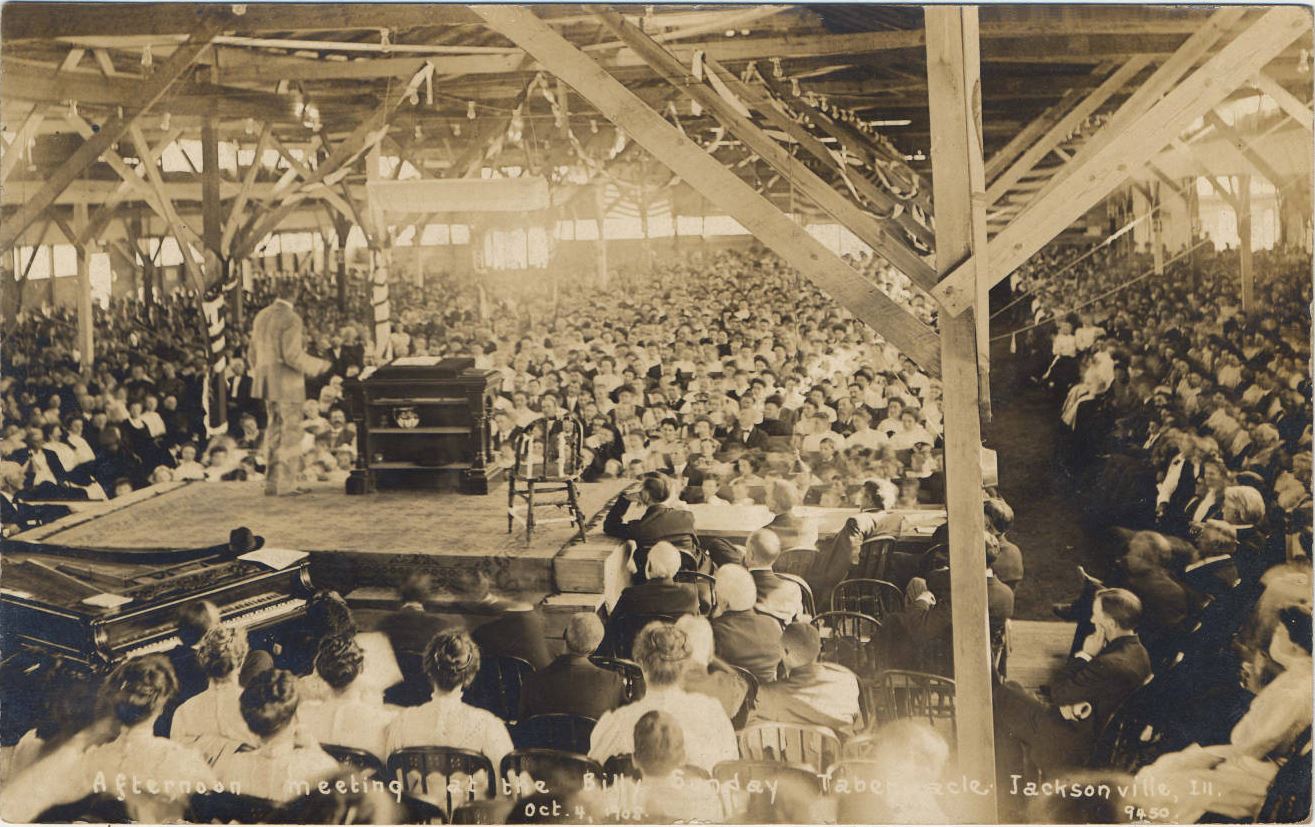
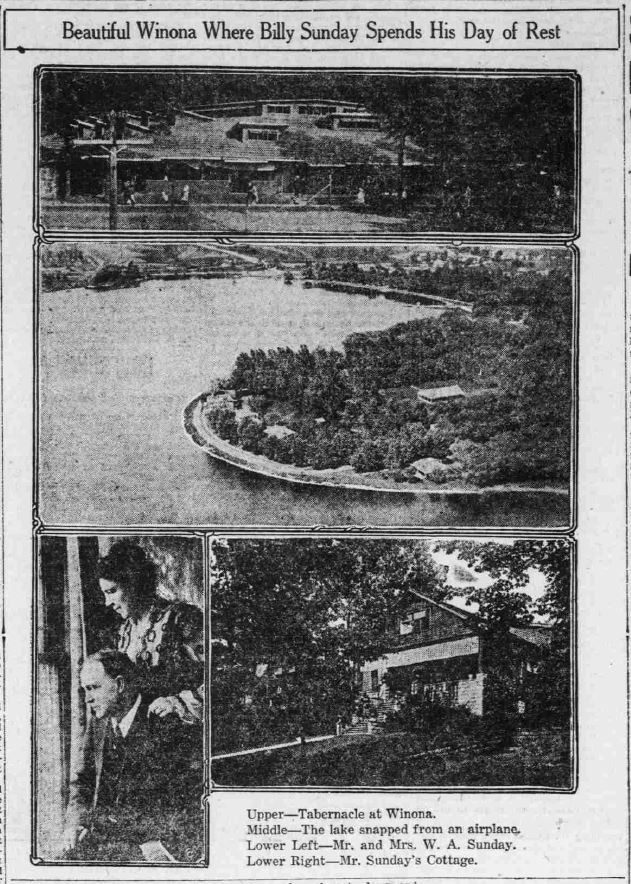
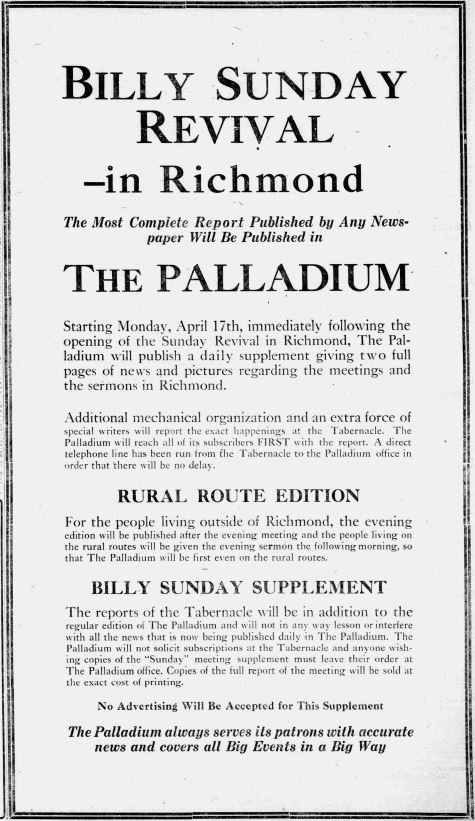
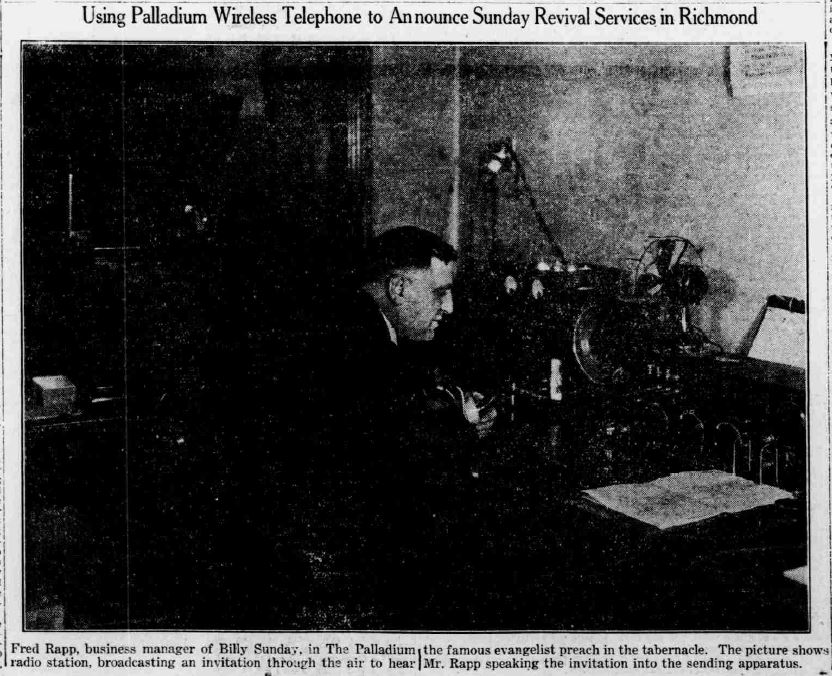
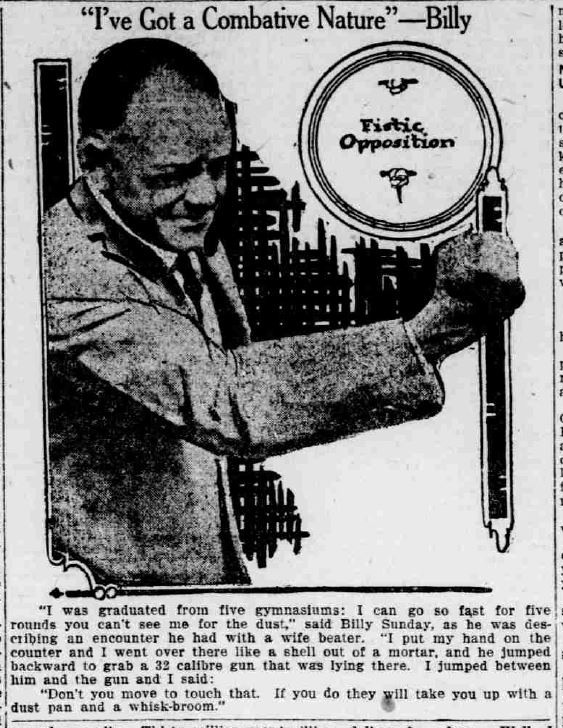
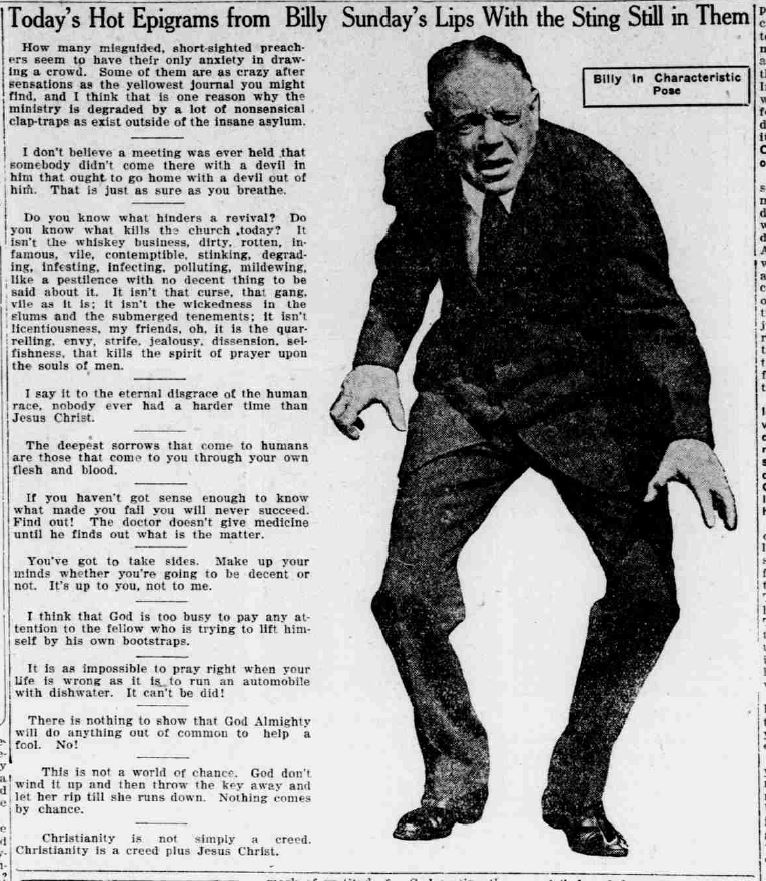
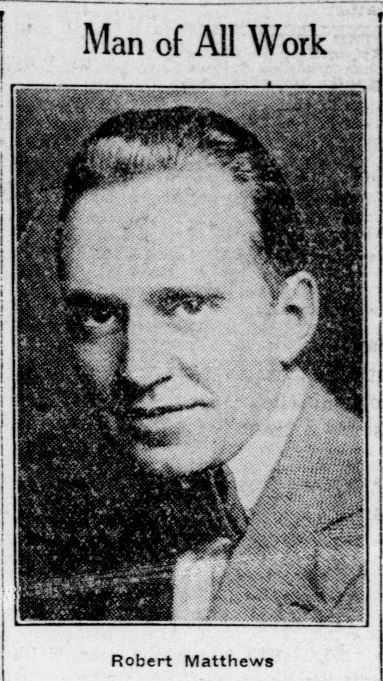
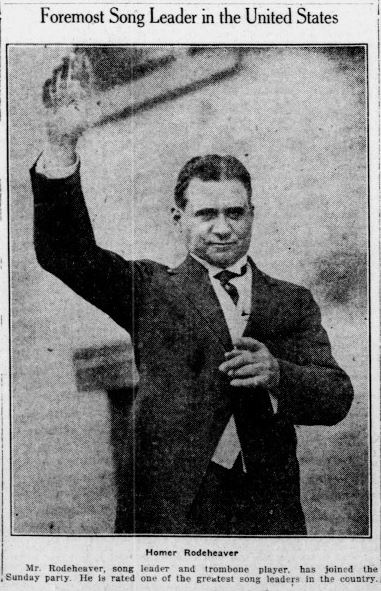
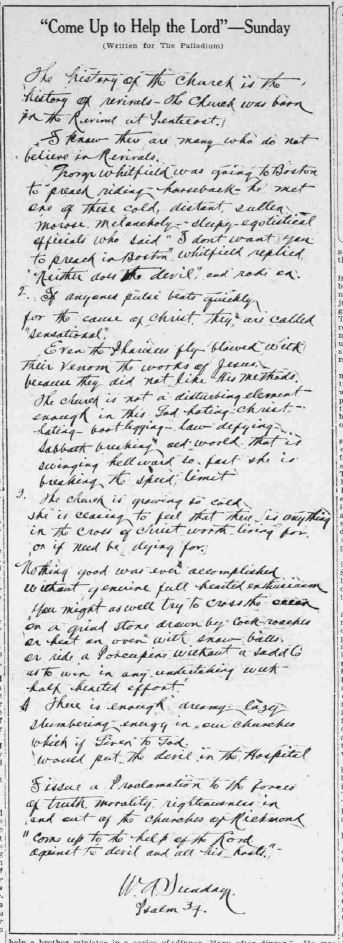
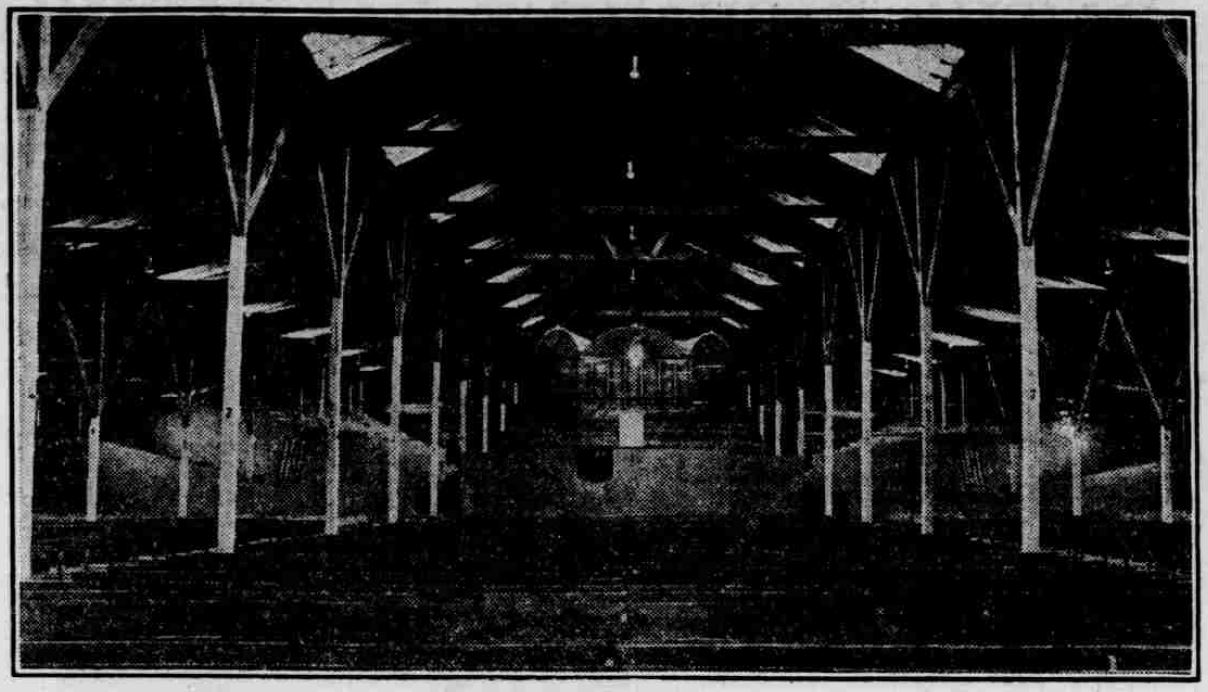
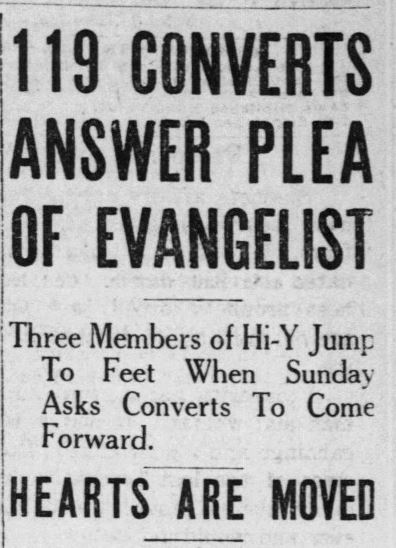
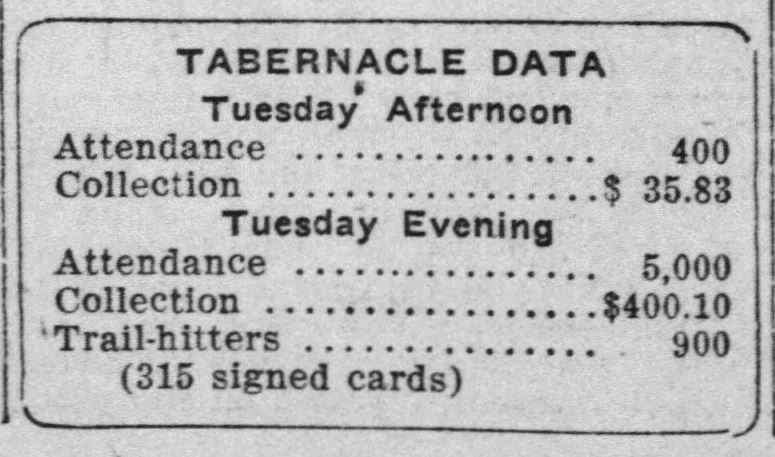
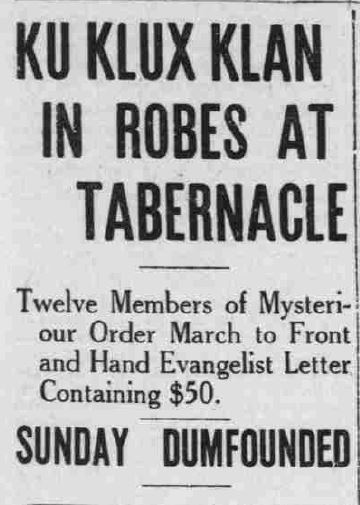
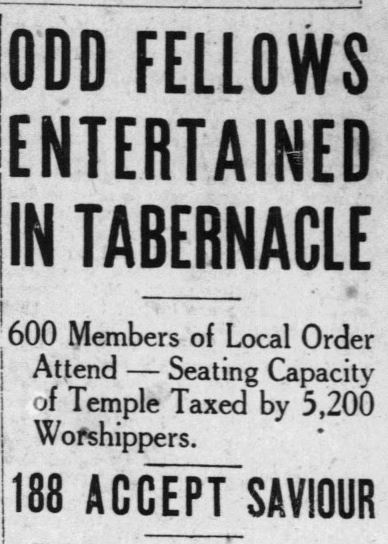

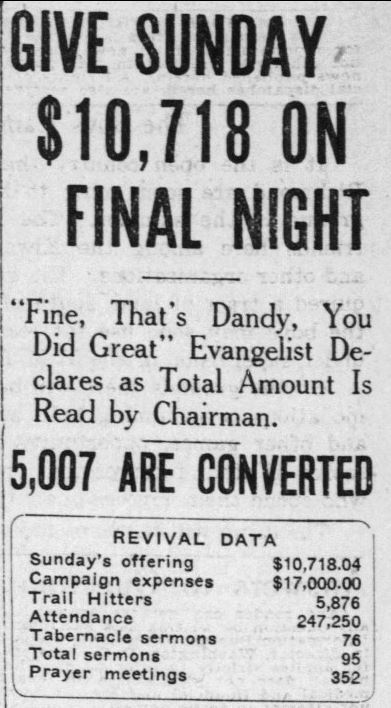
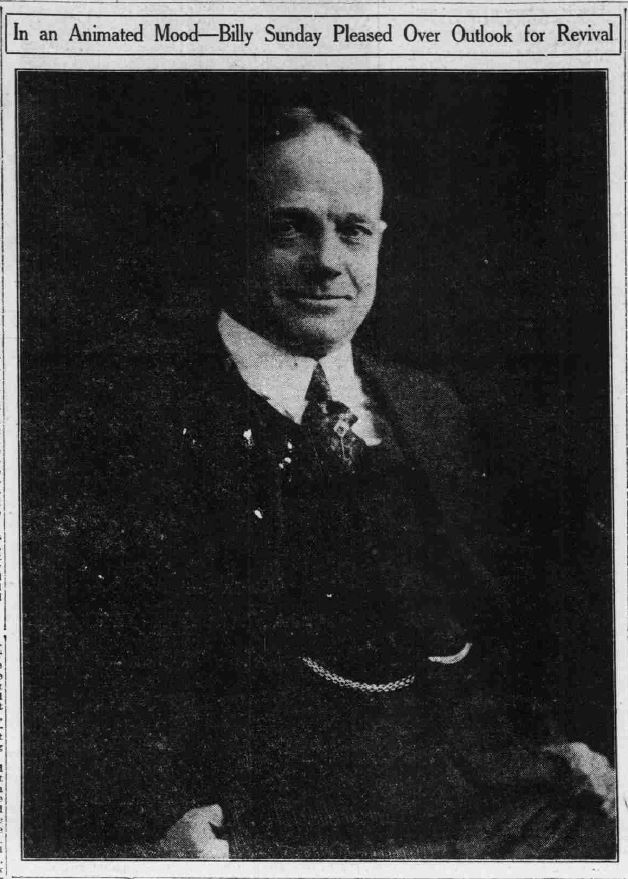
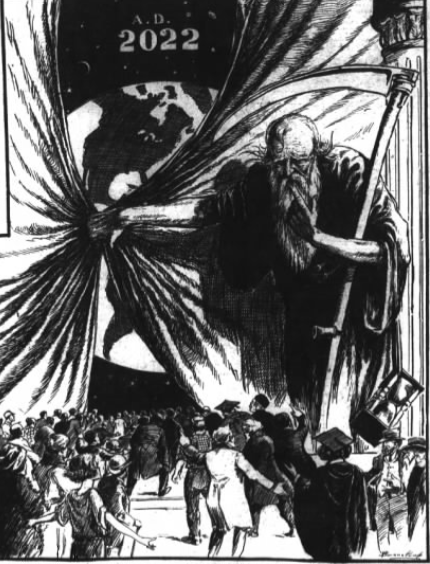
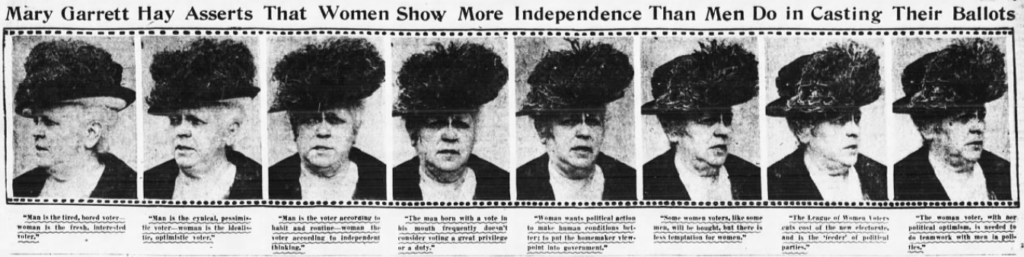
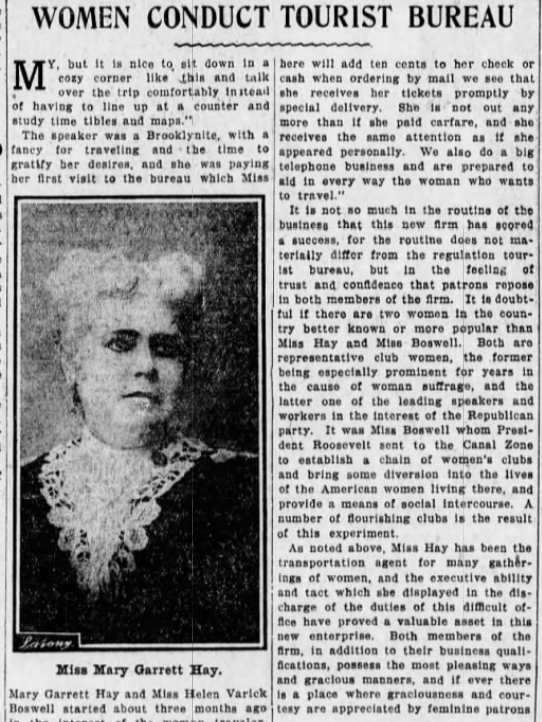
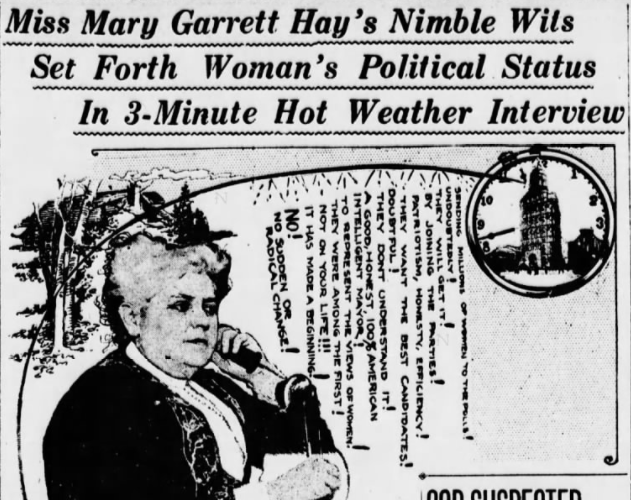
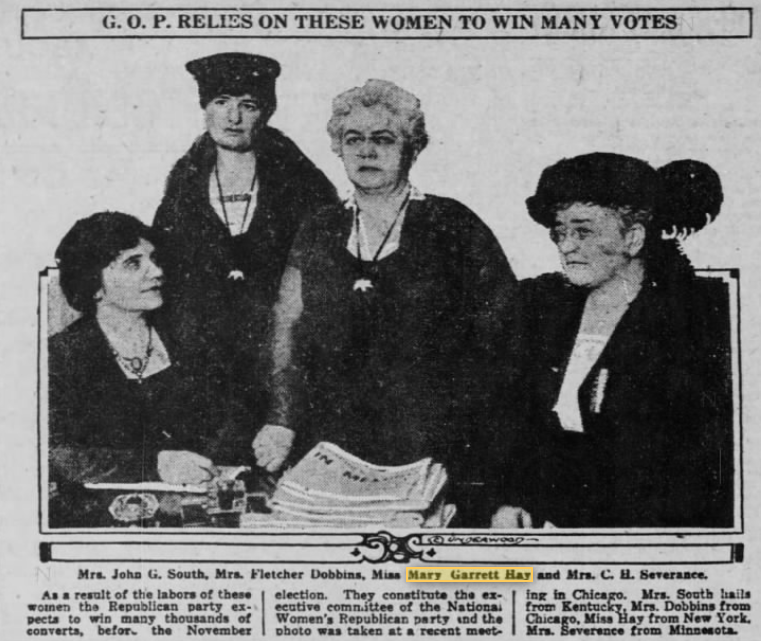
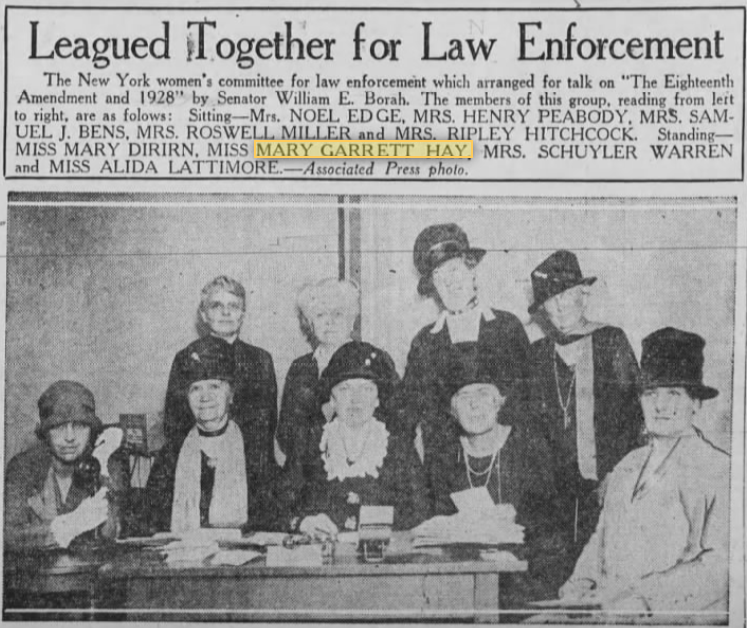
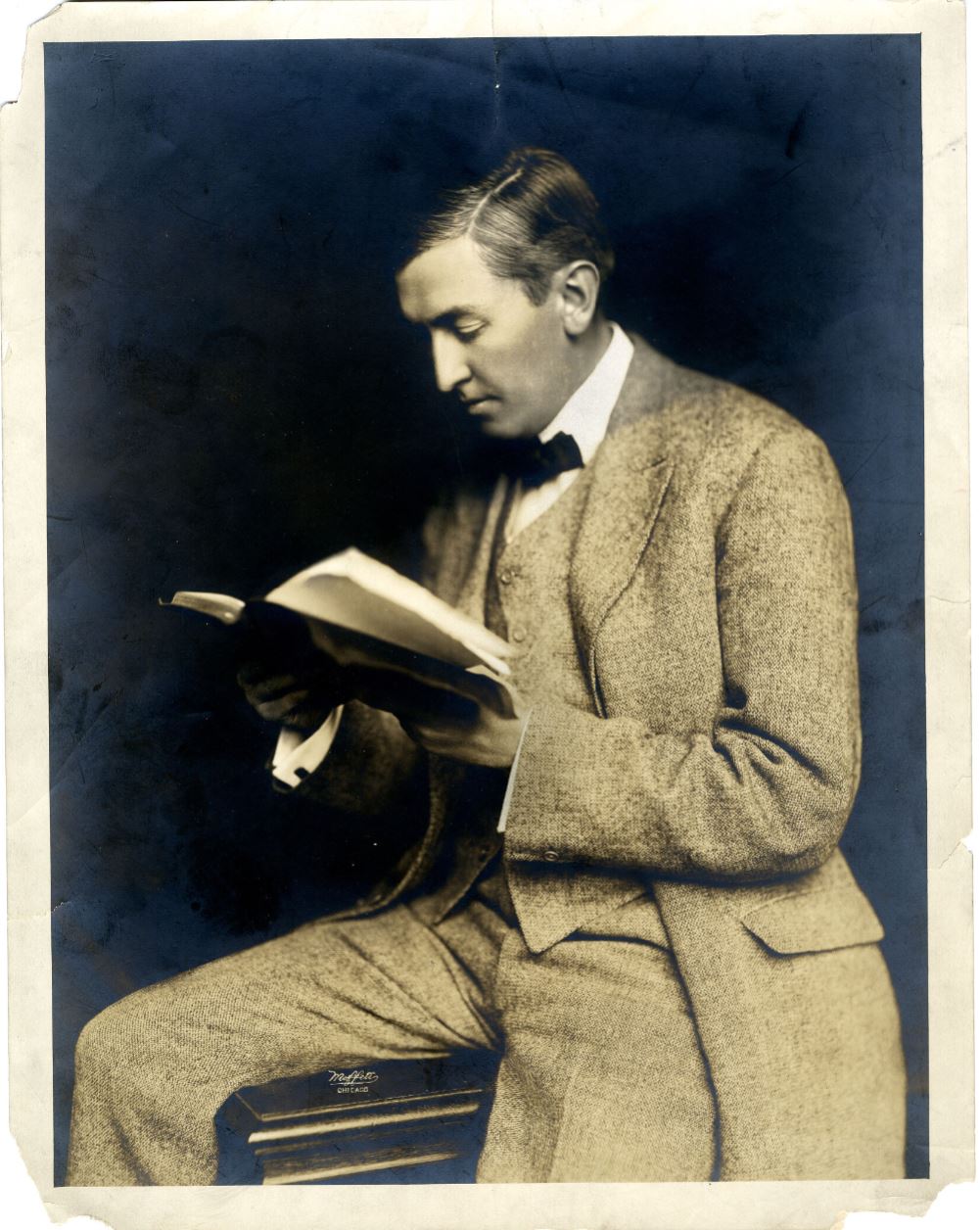
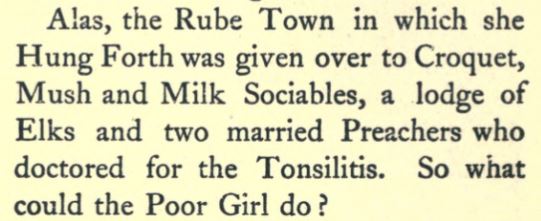
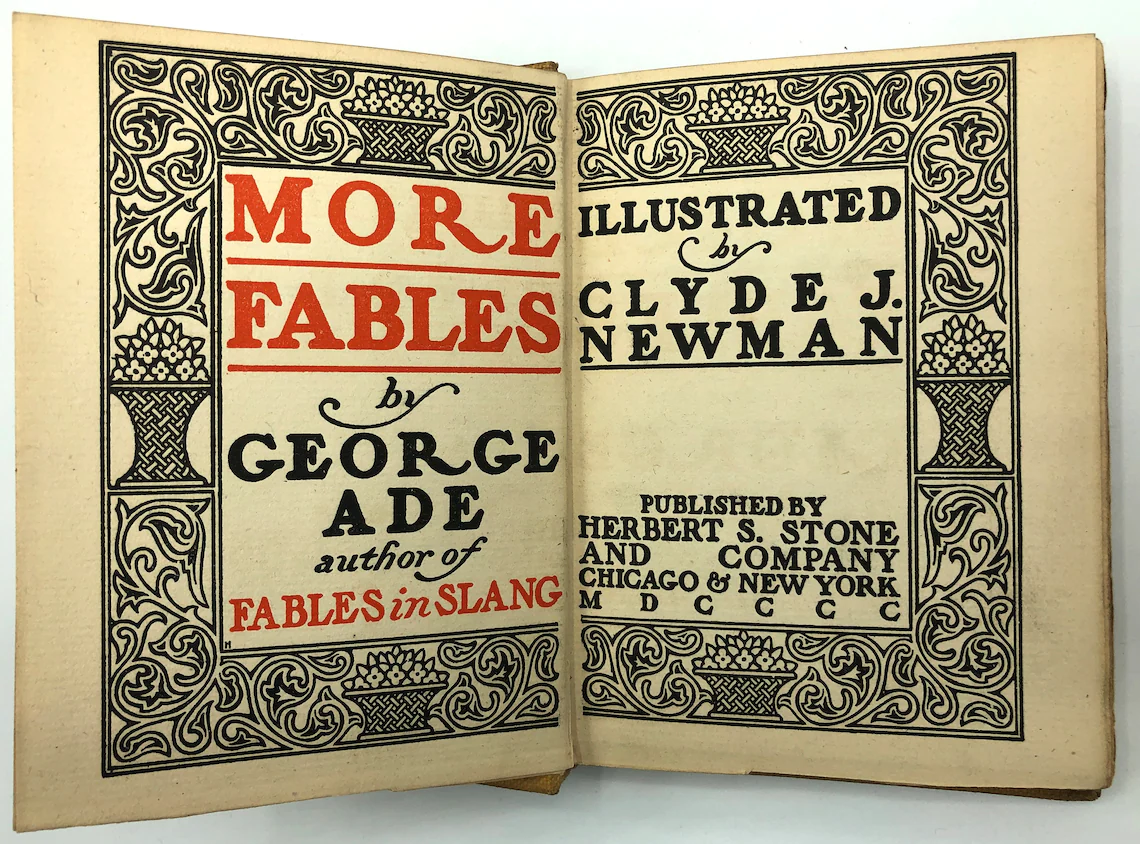
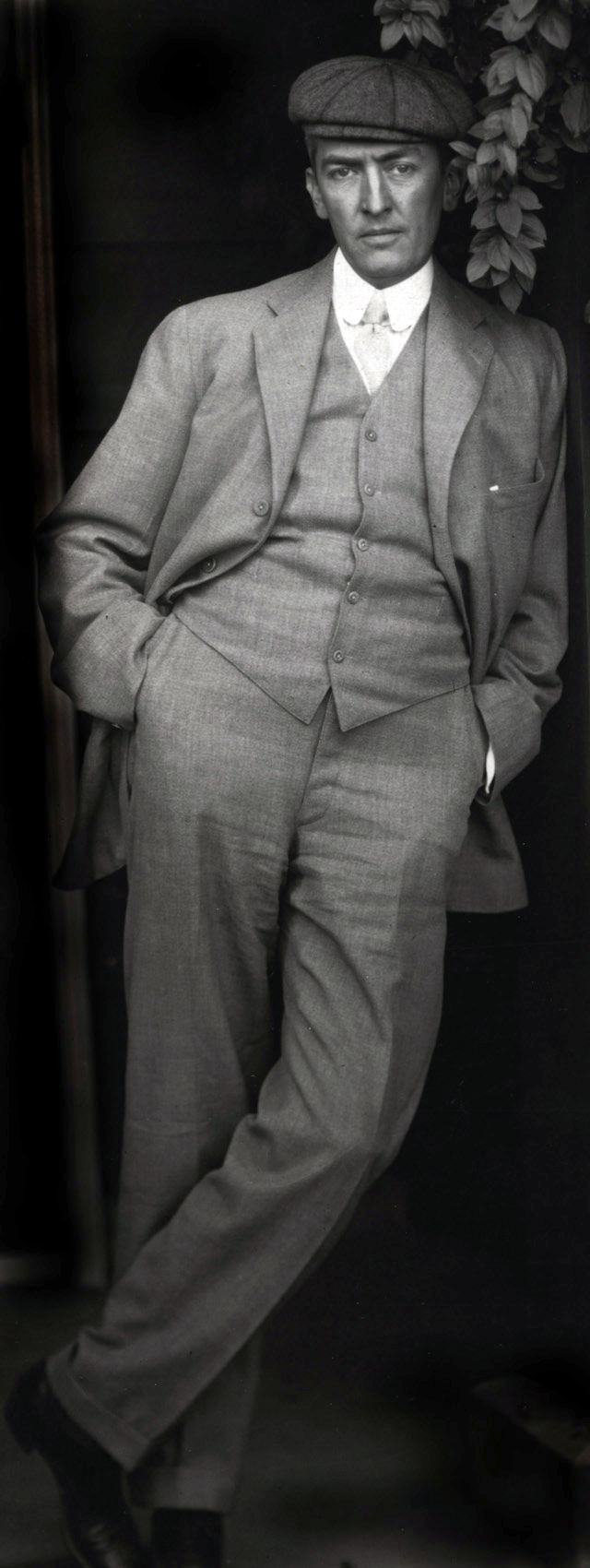
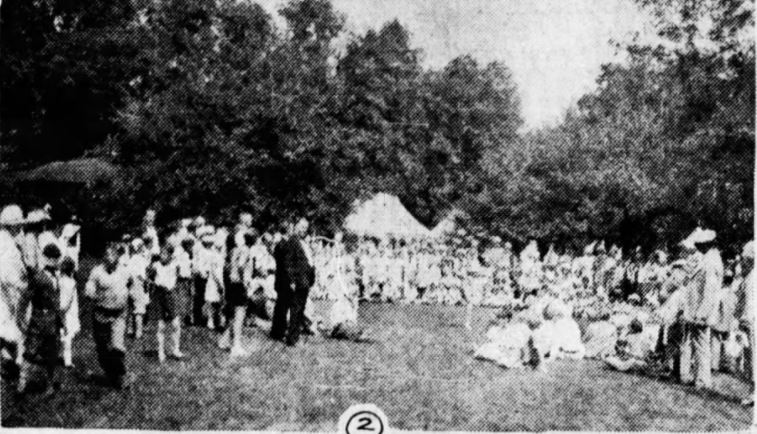
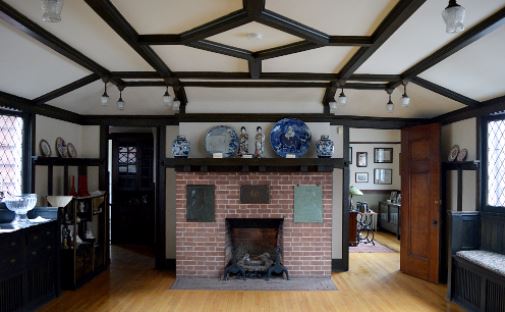

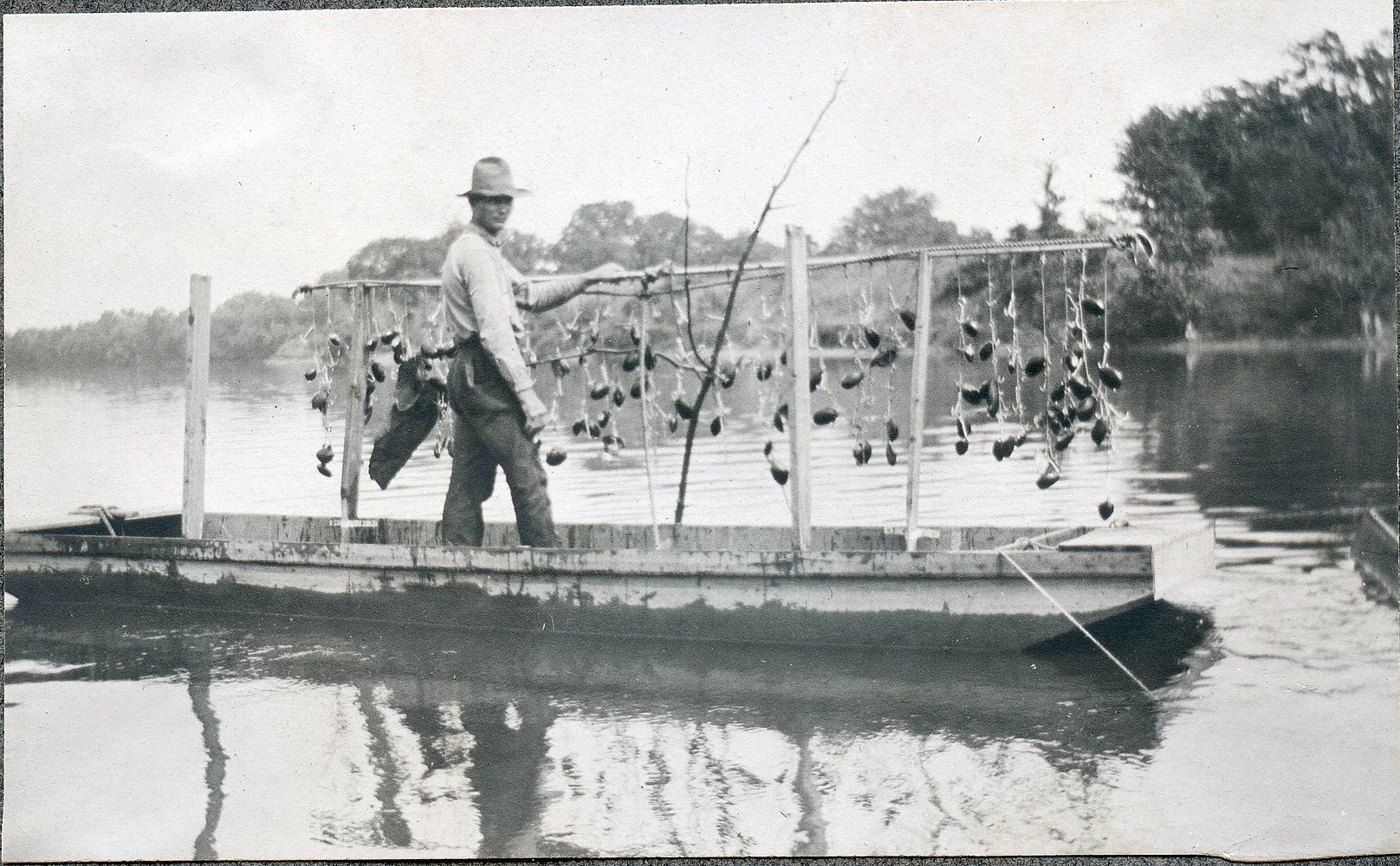


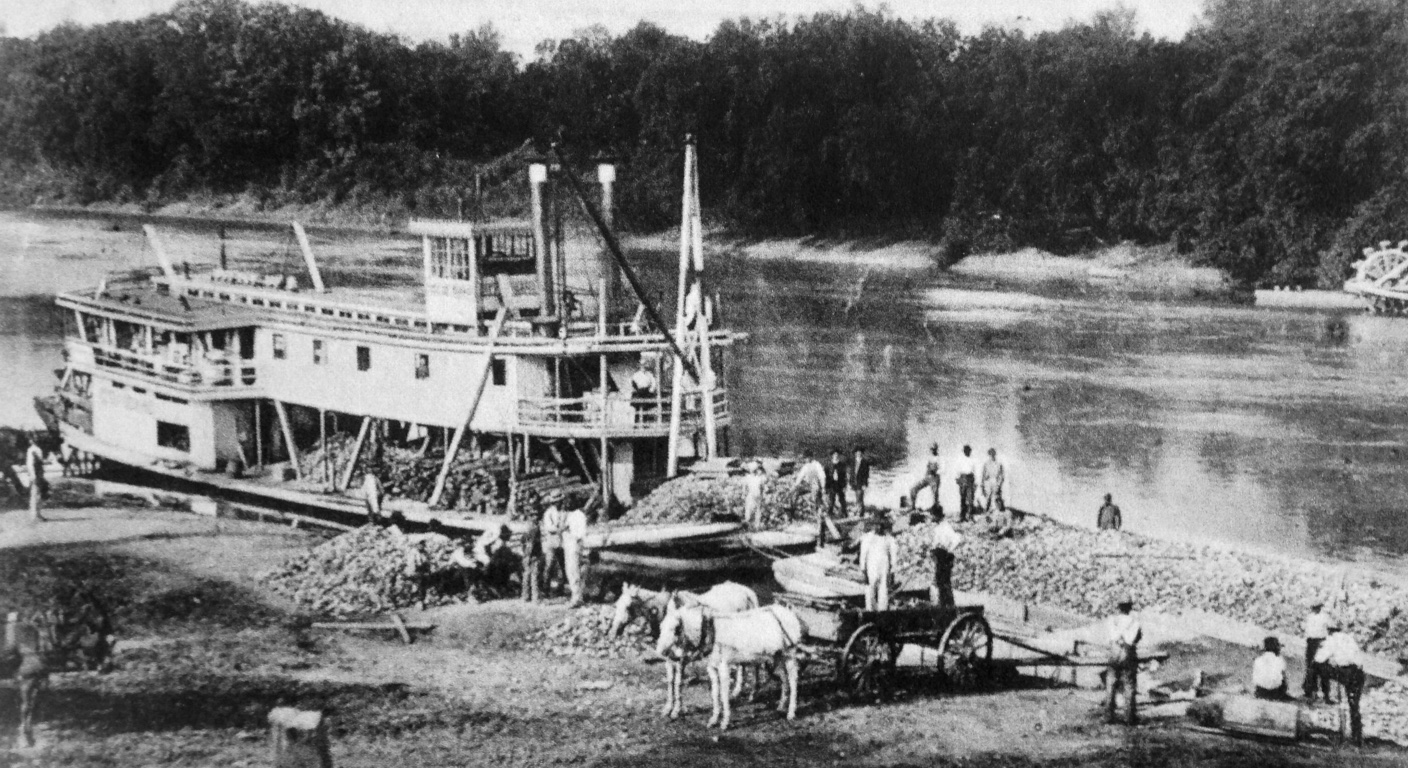
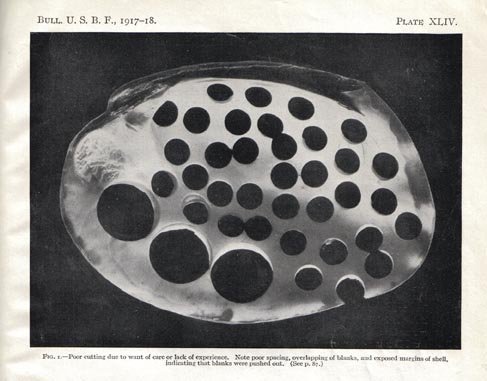


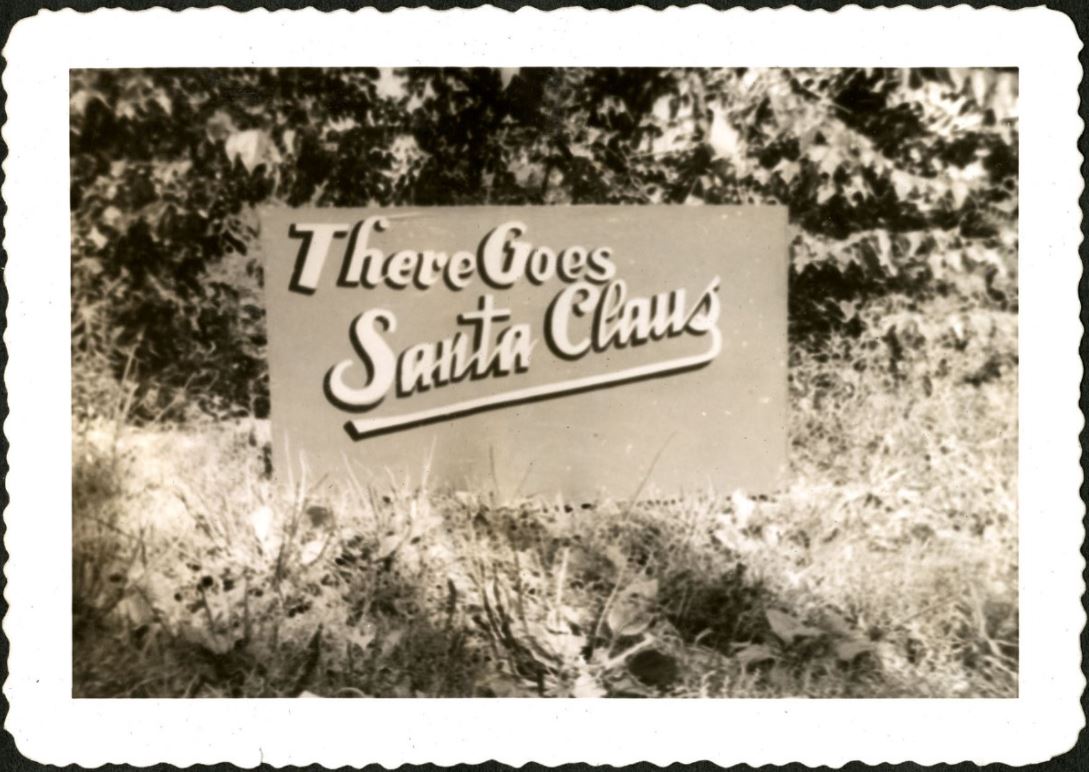
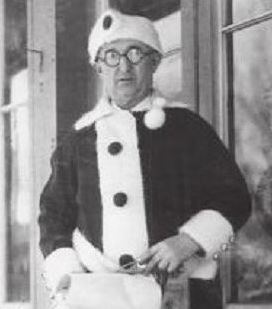
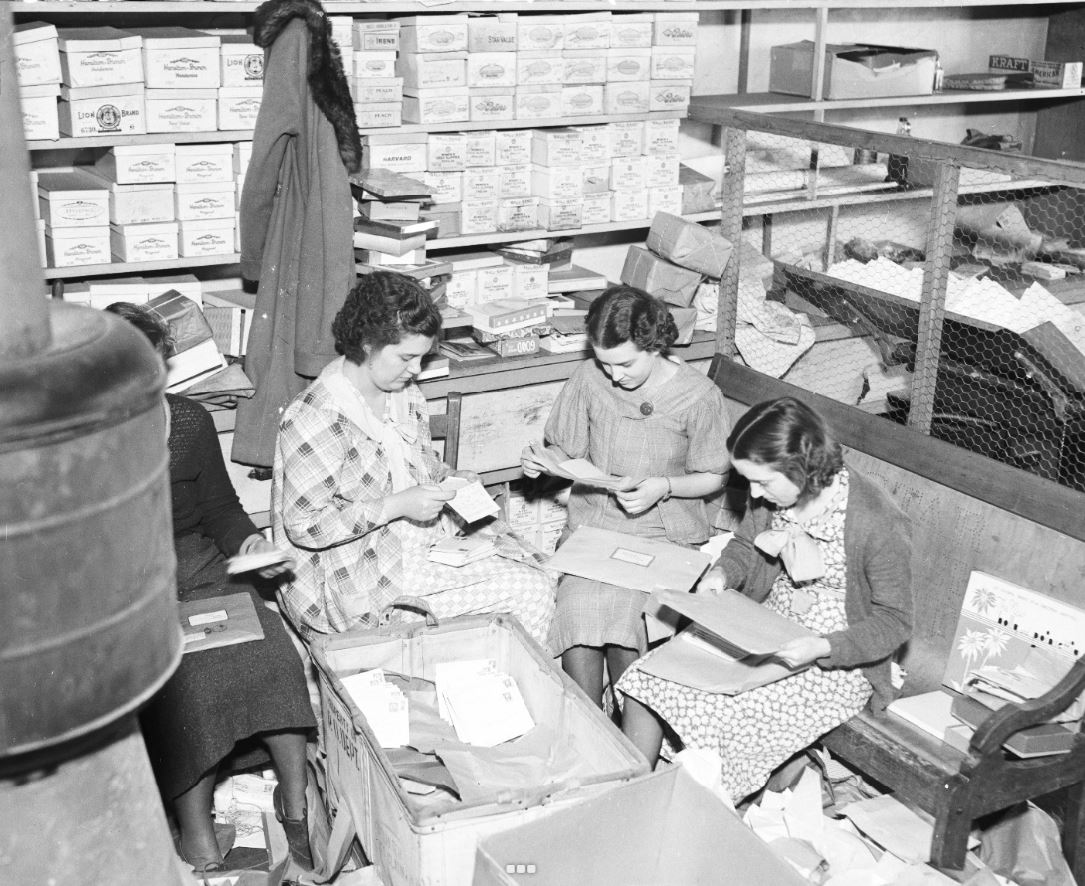
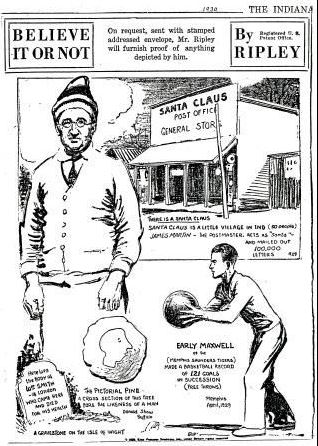
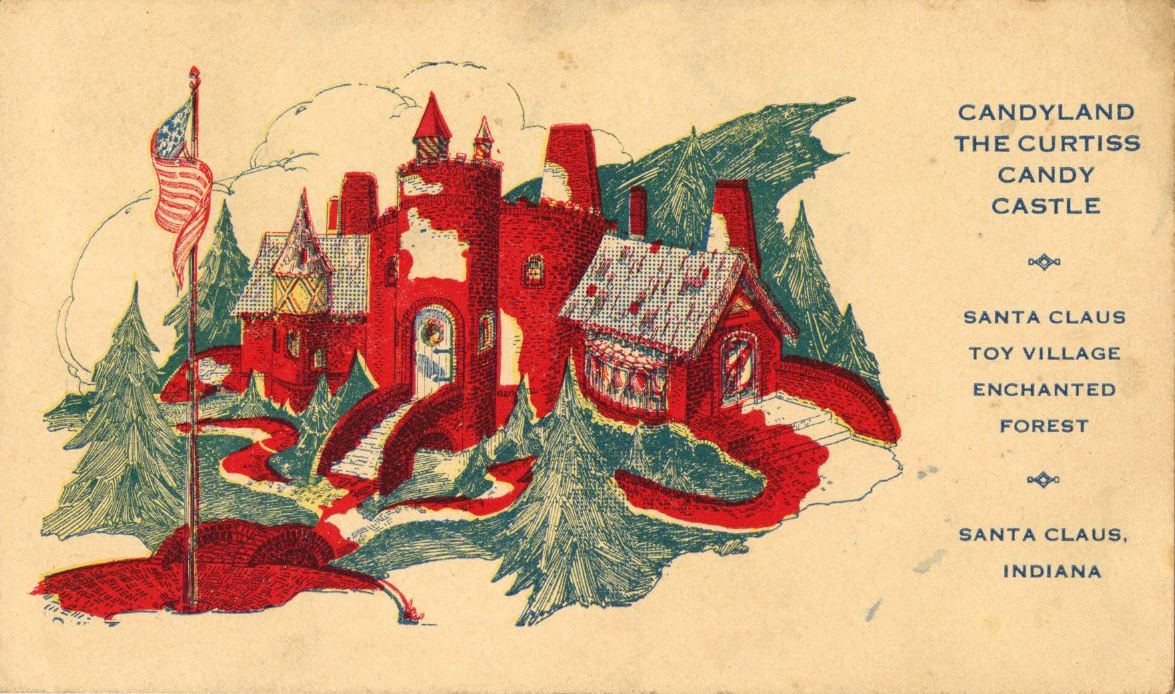
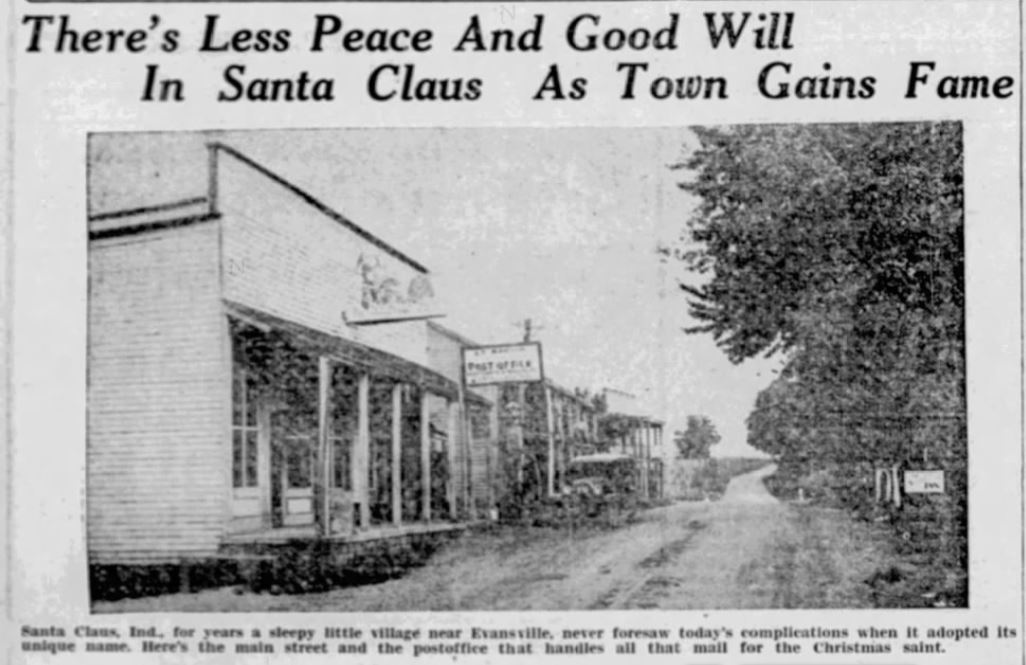 By 1935, the town of Santa Claus, Indiana was home to two organizations – Santa Claus, Incorporated, owned by Carl Barrett, and Santa Claus of Santa Claus, Incorporated, owned by Milt Harris. Barrett and Santa Claus, Incorporated were developing Santa Claus Park, which featured the 22-foot Santa Claus statue. Harris and his company were developing Santa Claus Town, featuring Santa’s Candy Castle. Barrett filed suit against Harris, alleging that the latter had no right to use a name so similar to its own. Meanwhile, Harris filed suit against Barrett because Barrett had bought and was building Santa Claus Park on land that had been leased to Harris by the previous owner.